
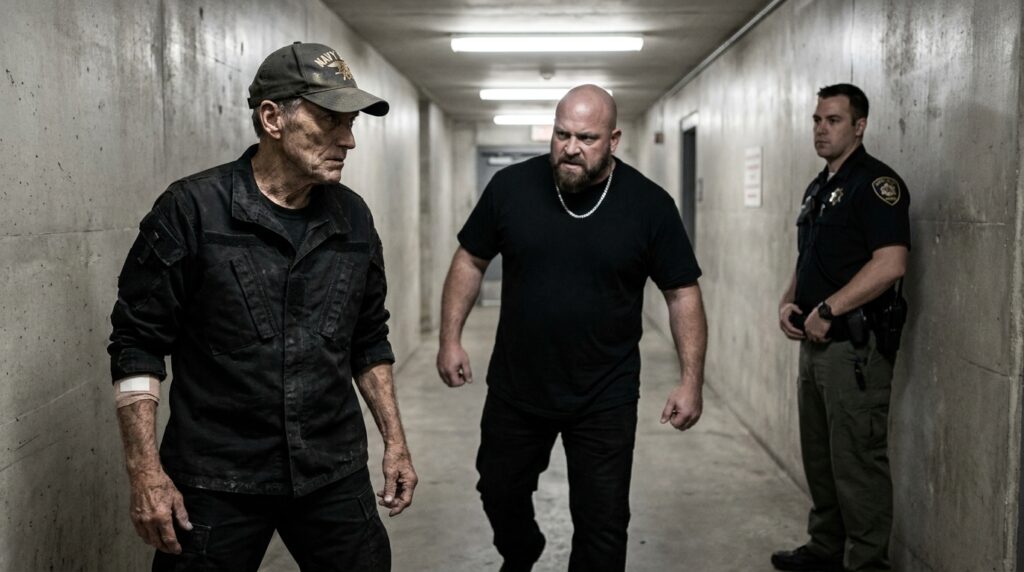
CHAPTER 7: THE REVERSED CORRIDOR
The rhythmic thud of the low-altitude rotors outside grew dense, a heavy, air-compressing throb that forced the plexiglass panels of the intake room to rattle inside their rubber gaskets. The marshal’s finger remained locked against the trigger of his heavy Colt revolver, but his center of gravity shifted. His shoulders tightened beneath the crisp wool of his uniform jacket, his sharp gray eyes darting toward the ceiling where flakes of ancient white plaster were beginning to sift downward like dead skin.
“A validation loop requires an external relay, John,” the marshal said, his voice flat, rejecting the shift in parameters through pure institutional stubbornness. “The trunk lines in this district are entirely dead-copper. Nothing leaves this floor.”
“The transponder didn’t use the district trunk,” John Vance stated. He didn’t rise from his stance, keeping his bad left knee locked out to prevent the joints from buckling under the increasing gravitational pressure of the room. He reached down slowly, his fingers pressing against the edge of the glass partition, tracing a long, jagged crack in the laminate. “It didn’t need to. Your operators brought three encrypted satellite links inside their tactical gear blocks when they breached the processing lane. The moment they turned on their visors, they gave my old unit a direct line-of-sight signal straight down the shaft.”
Behind Vance, the door of the property vault groaned. The first operator staggered out, his nose a crushed purple line behind his cracked visor, his hands blindly tracing the tile wall for support. The second man followed, his short carbine held low, his infrared illuminator casting an erratic blue circle across the ceiling as his internal software tried to recalibrate against the system-wide lockout flashing on the monitor.
“Marshal,” the second operator rasped, his voice vibrating with a sharp edge of panic. “The elevator relays are fried. Someone’s blowing the primary breakers from the substation block.”
The unshielded fluorescent lightbulbs overhead died with a final, metallic pop. For a fraction of a second, the room fell into absolute darkness, save for the blinking red text on the diagnostic screen behind Harris: CRITICAL SECURITY BREAK – EXTERIOR AUTHORIZED ENTRY.
Then, the emergency auxiliary lights kicked in—not the dim amber safety strips of the prison infrastructure, but the stabbing, high-intensity white beams of tactical searchlights cutting straight through the smoke-filled ventilation grates from the roof structure.
The heavy steel door of the primary intake block tore inward with a deafening, hydraulic crack.
A dozen figures flooded the corridor, their movements a seamless extension of the same elite geometry Vance had used to neutralize Miller. They wore the dark, desaturated navy uniforms of the Naval Criminal Investigative Service specialized response unit, their long-barreled rifles held at a flawless high-ready position, their visors clear and transparent under the glaring white beams.
At the center of the formation stood a woman in her late fifties, her dark hair pulled tight into a regulation bun beneath a black ball cap. She wore a tailored wool trench coat over a high-ranking naval intelligence uniform, her shoulder boards gleaming with the gold braid of a rear admiral. She didn’t look at the gray-clad retrieval operators or the dead desk sergeant. Her eyes locked directly on the faded Navy SEAL cap sitting level across Vance’s lined brow.
“Step back, marshal,” Admiral Torres said, her voice cutting through the hum of the auxiliary generators with the sharp, transactional chill of a command deck. “Your detainer has been unsealed by the department. You’re out of your depth.”
The marshal’s hand remained raised for three long beats, the heavy hammer of the Colt still drawn back. He looked at the gold star on his breast-badge, then at the twelve rifle muzzles pinned precisely to the center of his chest plate. Slowly, with the deliberate, heavy friction of a man who knew his name was being systematically erased from the federal ledger, he lowered the weapon and placed it flat on the counter.
“You’re protecting a ghost, Admiral,” the marshal said, his face returning to its expressionless gray baseline as two agents stepped forward to strip his leather belt. “The pipeline was authorized three levels above your desk.”
“The pipeline was an unauthorized hemorrhage,” Torres replied flatly. She didn’t look at him as he was led toward the open administrative elevator shaft. She stepped through the shattered partition, her leather shoes crunching softly on the fragments of glass and wood splinters until she stood exactly two feet from Vance.
Vance let his breath out through his nose, his shoulders relaxing by a fraction of an inch, though his spine remained a straight, rigid line. He reached into his pocket and placed the brass pocket knife and the confiscated key on the counter beside the marshal’s dropped revolver.
“Rourke is on Layer Four,” Vance said, his gravelly voice dropping into its flat, operational register. “They’ve got seven others down there. They were prepping them for non-attributable transit.”
Torres looked at the diagnostic terminal screen, her eyes tracing the hand-scrawled tracking label H. ROURKE – RET-04 before she nodded once to her tactical lead. “We’ve already secured the subterranean elevator block, Master Chief. The medical retrieval teams are moving down now.”
She looked back at Vance, her gaze softening by a minuscule margin as she noticed the deep, rhythmic hitch in his breath from his swollen left knee. She reached into her pocket and pulled out a heavy, steel-banded Rolex Submariner dive watch, its face scarred with a deep scratch across the glass from an old Mediterranean deployment. She placed it in his hand, the metal band still retaining the faint warmth of her uniform pocket.
“The processing overreach ends here, John,” Torres said softly, her voice dropping below the operational din of the room. “The uniform changes, but the training never leaves the bone. Let’s get our people home.”
Vance looked down at the watch, his thumb tracing the pale, unexposed band of skin on his left wrist before he slid the heavy metal housing back over his joint, clicking the safety latch home with a sharp, final snap. He looked back down the long, narrow iron corridor where Miller was sitting up against the wall, holding his broken wrist while a naval corpsman tended to his shoulder. The room was silent now, the unearned arrogance of the facility broken down to its raw concrete foundations.








