
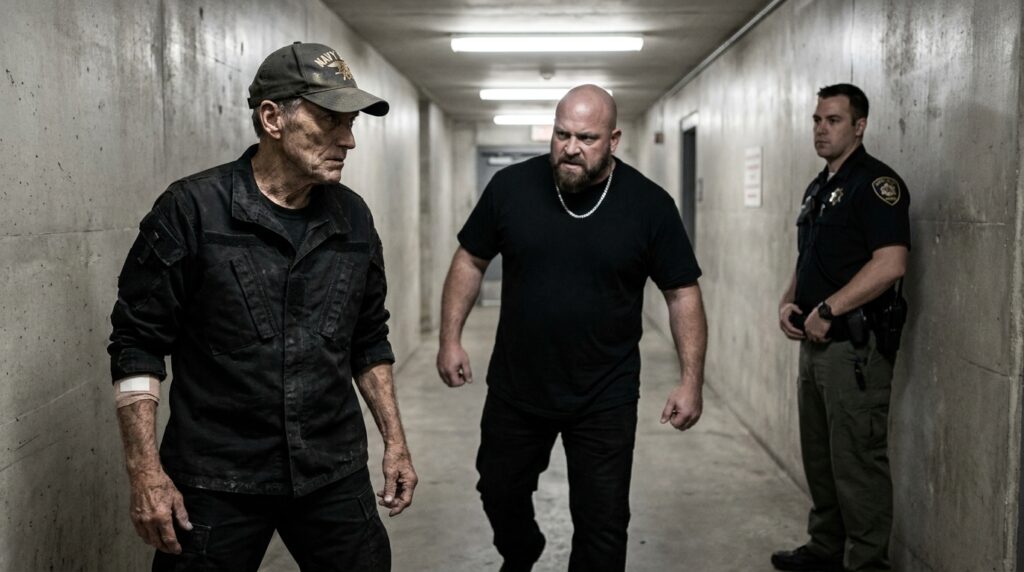
CHAPTER 2: THE COLD GEOMETRY OF THE ROOM
The bypass key was surprisingly heavy, its edges square and unpolished, biting into the meat of John Vance’s palm as he closed his fist. It was cold—colder than the air in the corridor, colder than the concrete floor where Miller’s chest still hitched in ragged, shallow gasps. Vance didn’t slide the metal into his pocket immediately. He let his thumb trace the laser-etched lettering across the face of the brass stub: SEC-SYS-09-ALPHA. That wasn’t bureau nomenclature. The Federal Bureau of Prisons didn’t use Greek designations for its electronic asset lockers; naval intelligence logistics did.
“Get your hands off your belt, son,” Vance said.
He didn’t turn his head to look at Harris. He kept his eyes on the heavy iron hinge of the block gate twelve feet ahead, but his voice cut through the damp air like a wire.
The guard’s boot leather scraped against the floorboards. Harris’s fingers, which had been twitching a fraction of an inch above the plastic grip of his baton, went completely still. The young man’s throat clicked as he swallowed hard, his posture flattening further against the cinderblock wall until the rivets on his utility belt groaned against the masonry.
“He… he lunged at you,” Harris stammered. His voice had lost its institutional weight, thinning out into the reedy cadence of a civilian who had suddenly realized the walls around him weren’t thick enough to keep the world out. “I have to log the use of force. I have to call the shift supervisor.”
“You won’t log anything yet,” Vance muttered. He finally turned his head, the brim of his faded Navy SEAL cap casting a sharp, triangular shadow across his nose. The lines around his mouth were deep, like channels cut into dry river stone by fifty years of high-pressure salt water. “Look at the floor. Does it look like a fight happened here?”
Harris looked down. Miller was rolling onto his side now, his large, bearded face stained purple where it had met the concrete, but there was no blood. No broken teeth. No evidence of a strike. The geometry of the takedown had been too clean, a mechanical redirection of mass that left the skin intact while the inner equilibrium remained shattered. Miller’s heavy chain lay coiled next to his ear like a dead snake.
“He fell,” Harris whispered, the lie tasting like ash but offering a path of least resistance.
“He tripped over his own weight,” Vance corrected flatly. He stepped forward, his left knee giving a distinct, dull pop that radiated a cold spike of white pain up into his hip. He didn’t let his shoulder drop. He carried the limp internally, locking the joints through sheer habit until the movement appeared seamless to the untrained eye. “Open the processing gate.”
“The desk sergeant has your intake file,” Harris said, his hand moving automatically toward the keycard reader beside the iron door, his movements jerky, uncoordinated. “They haven’t verified the detainer from the marshal’s office. You shouldn’t even be in this corridor yet.”
“Then let’s go help him verify it.”
The heavy electromagnetic lock released with a sound like a small pistol shot—a metallic clack that echoed down the narrow spine of the processing lane. Vance walked through before the steel door had even finished swinging home.
The intake room beyond was small, square, and illuminated by a single unshielded bulb that hummed at a frequency that made the back of Vance’s teeth ache. A desk sergeant with a soft belly and graying hair sat behind a three-inch slab of plexiglass, his eyes fixed on a monitor that flickered with green columns of old DOS-based data. On the counter beside him sat Vance’s personal effects: a water-damaged leather wallet, a brass pocket knife with the blade ground down from three decades of sharpening, and a small, empty patch of gray felt where his Submariner dive watch should have been.
Vance focused on the empty felt. The skin on his left wrist felt naked, abnormally light, the pale band of unexposed flesh reminding him with every pulse that his time was no longer his own.
The desk sergeant didn’t look up until Vance’s knuckles tapped against the plexiglass speaker grill.
“Vance, John,” the sergeant read off the screen, his voice nasal, bored. He reached for a plastic bin to slide the effects across the drop tray. “The system’s flagging your origin code. Says the routing manifest came through a non-standard terminal at Norfolk. I can’t assign you a permanent bunk until the logistics cell clears the transfer.”
Vance didn’t look at the sergeant’s face. He looked at the paperwork sticking out from beneath a heavy steel clipboard on the desk. The top sheet bore a circular stamp in purple ink—the same ink used on the security key currently burning a hole in his palm.
“Who signed the manifest?” Vance asked.
“Not your concern, Chief,” the sergeant said, finally looking up, his eyes narrowing as he noticed Harris standing two steps behind Vance, looking pale and holding his baton by the wrong end. “Something wrong out there, Harris?”
“Nothing,” Vance said before the boy could speak. He reached into the drop tray, his fingers wrapping around the brass pocket knife and his wallet, his hand masking the movement as he slipped the brass security key onto the metal counter, sliding it precisely beneath the edge of the purple-stamped intake sheet. “The sergeant was just about to tell me why a maritime transport detainer is being routed through an inland processing block.”
The desk sergeant stared at Vance, his eyes dropping to the sheet, then down to the small piece of brass that had just appeared beneath the paper. His boredom vanished. His jaw went rigid, the soft fat beneath his chin tightening as his fingers moved away from the computer keyboard. He didn’t look at Harris. He didn’t look at Vance. He looked at the key, recognizing the stamped code SEC-SYS-09-ALPHA with the immediate, defensive alertness of a man who had just found a live grenade in his desk drawer.
“Harris,” the sergeant said, his voice dropping an octave, losing its bureaucratic drone. “Take the other detainee back to the holding cells. Now.”
“But Sergeant, Miller’s still on the floor—”
“I said now, officer,” the sergeant snapped, his hand covering the purple-stamped sheet, concealing the key beneath his palm.
The door behind Vance began to click, the internal relays hummed, and the light on the wall shifted from green to a steady, warning amber. Someone else was accessing the floor from the administrative elevator at the far end of the room, and the sound of heavy, vibram-soled tactical boots began to echo through the ventilation shaft.








