
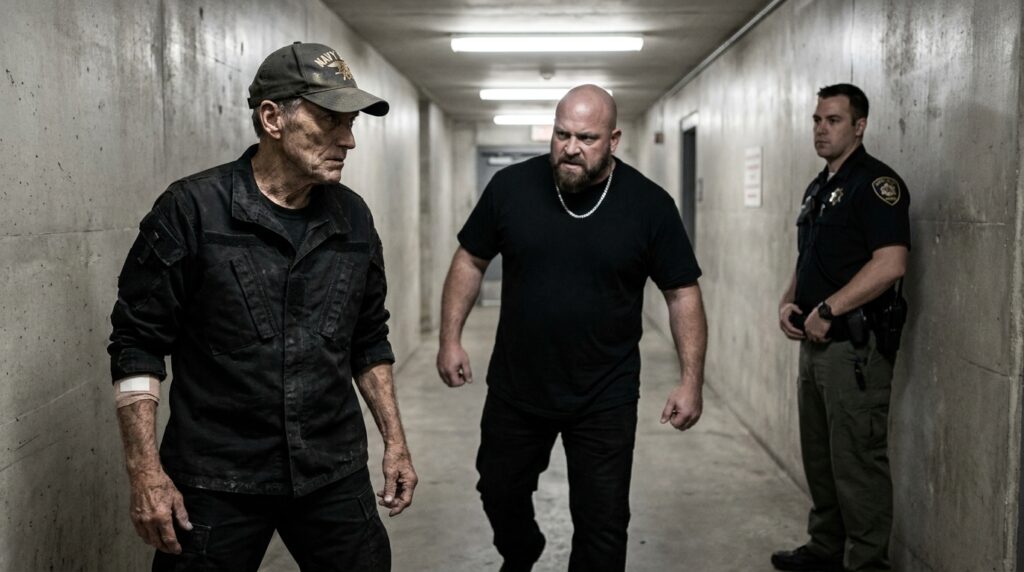
CHAPTER 4: THE PROPERTY VAULT BREACH
The second impact didn’t just rattle the wood; it sheared the cheap brass latch straight out of the frame. Splinters drifted through the cold air like snow, catching the white light of the medical bay before settling on the tile. John Vance didn’t flinch. He had already memorized the trajectory of the door’s swing. He pulled his hand cleanly from the secondary diagnostic terminal, leaving the blinking terminal screen active, a glowing green beacon designed to capture the retrieval team’s immediate focus.
“Harris,” Vance said, his voice dropping into that tight, unyielding gravel that tolerated no debate. “Floor.”
The young officer didn’t look back to check Vance’s position. The sheer mass of the tactical breach behind them was enough to make his internal survival matrix make the choice for him. Harris dropped, his knees clattering hard against the white tiles, his arms locking over the back of his neck as the door frame finally gave way entirely.
A gray-clad operator burst through the opening, the short muzzle of his carbine snapping down to cover the center of the room. The weapon swung toward the glowing terminal screen—exactly as Vance had calculated.
Vance was already moving along the blind side of the door’s arc. His old knee ground like sand inside a dry bearing, a deep, nauseating ache that radiated into his hip, but he used the momentum of his falling weight to drive his elbow backward. The hard, angular bone caught the operator directly beneath the lower edge of his ballistic visor, striking the mandibular nerve with the force of a hammer.
The man didn’t scream. His breath left him in a wet, metallic whistle as his head snapped back against the door frame. His grip on the carbine loosened just enough for Vance to clamp his forearm down on the weapon’s optical sight, forcing the muzzle toward the floor before the operator’s trigger finger could complete its automated sequence.
The weapon fired once—a muffled, compressed thwip that shattered a bottle of saline on the counter, sending a shower of glass and sterile water across the floorboards.
Vance didn’t try to take the rifle. In a closed space against multiple entry elements, committing both hands to a weapon struggle was a death sentence. Instead, he ripped the small, purple-stamped intake folder from his waistband and shoved it directly into the operator’s visor, blocking his vision for the single micro-second required to step past him. He reached down, grabbed the loop of Harris’s heavy duty belt, and dragged the dazed young guard through the open threshold of the property vault at the back of the medical bay.
The vault door was a solid slab of reinforced steel, held by an older mechanical deadbolt that didn’t rely on the central security grid. Vance slammed it shut, throwing his weight against the iron wheel until the internal rods dropped into the masonry with a heavy, final thud.
The air inside the vault was completely dead. It smelled of preserved cardboard, old copper coins, and the heavy plastic sheen of confiscated property bags. Rows of metal shelving stretched into the dark, illuminated only by a faint, amber safety strip running along the floor.
“They’re going to bypass the hinges,” Harris whispered, his voice cracking as he leaned against a shelf of canvas inmate sacks. He was bleeding from a tiny scratch on his cheek where the saline glass had flying-cut him. “They have mechanical cutters in those gear bags. I saw them.”
“They have to find the right breaker first,” Vance muttered. He didn’t look at the door. He was already moving down the central aisle of shelves, his fingers tracing the plastic labels attached to the heavy security bins. Each bin was marked with an intake date and a barcode, but three cages at the very back were wrapped in heavy steel wire, secured with a separate, non-standard padlock.
Vance reached into his pocket and pulled out the brass key he had taken from Miller. The code SEC-SYS-09-ALPHA matched the small, circular plate on the side of the center cage. He turned the key, the internal tumbler releasing with a sharp, dry click.
Inside the bin lay a single, heavy Pelican case—the kind used for transporting high-grade military encryption modules. It wasn’t inmate property. It was marked with the logistics seal of the Norfolk Maritime Command, but someone had hand-scrawled a secondary tracking number across the top in permanent marker: H. ROURKE – RET-04.
Vance popped the heavy plastic latches. The interior wasn’t filled with Rourke’s personal effects. Tucked into the custom-cut foam was a small, black tactical transponder, its power light pulsing a steady, rhythmic green. Beside it sat a stack of unredacted operational manifests detailing the systematic transfer of seven other retired specialized operators from various military hospitals directly into this federal facility over the last eighteen months.
It wasn’t an administrative error. It was a harvest.
“Chief,” Harris said, his boots crunching on the dry floor as he crept up behind Vance. “What is that? That doesn’t look like processing gear.”
“It’s a decoy,” Vance said, his face hardening as he picked up the transponder. His thumb traced the small, silver seal on the base of the device. The transponder was actively broadcasting an tracking beacon, but the destination wasn’t an external rescue node. The data loop was being routed directly through the building’s own internal communication trunk.
The realization hit Vance with the cold precision of a sniper’s bullet. The transponder had been placed here to be found. Whoever was running this facility wanted Vance to break into this vault; they wanted him to find Rourke’s supposed location parameters so they could trap him within the lower subterranean levels of the cell block under the guise of an attempted escape.
Before Vance could drop the device, the amber safety strip along the floorboards blinked out, plunging the vault into absolute, velvety darkness.
Through the thick steel of the vault door, the muffled, high-pitched whine of a hydraulic circular saw began to chew into the upper hinge.








