
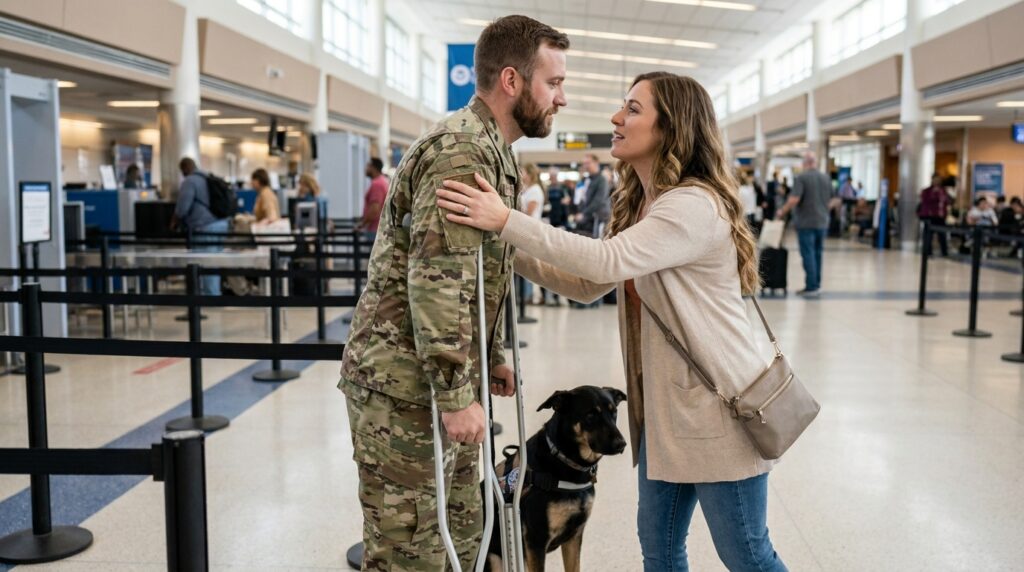
CHAPTER 7: THE TRANSITION TO THE OPEN LOUNGE
The desaturated gray carpet of the arrivals concourse didn’t mask the hard concrete underneath; it merely muffled the rhythmic, forward thud of Vance’s crutches. Every yard of progression down the long corridor felt like an exercise in tactical navigation. The air out here was less compressed than it had been inside the bottleneck, but it carried a different kind of weight—the hollow, multi-directional draft of a public terminal space where people moved without standard military intervals.
Vance kept his right elbow tucked tight against his ribs, his palm absorbing the constant, vertical impact of the aluminum frame. The fire in his shin was down to a dull, chemical burn, a steady baseline he could manage as long as he didn’t catch a rubber tip on the seam of an expansion joint.
Ranger stayed pinned to his left flank. The dog’s pace didn’t alter as they passed the rows of empty passenger benches and the low-backed vinyl chairs of the smoking lounges. His black-and-tan ears remained swiveled backward, tracking Vance’s breathing pattern to calculate exactly when the veteran’s stride would stagger from a sudden surge of physical pain.
“Garrett.”
The name didn’t drop from the overhead speakers. It was a soft, ragged vocal line that cut through the low-frequency rumble of the baggage carousels thirty yards ahead.
Vance swung his frame to a stop, his forearms locking against the crossbars to stabilize his base. He didn’t turn his head quickly. He mapped the space through a slow, deliberate sweep of his eyes, his gaze passing the silver stanchions of the exit queue until it settled on the low chrome railing of the baggage claim barrier.
Claire was standing beside the second steel pillar. Her long, wavy brown hair was slightly tangled from hours of waiting against the industrial drafts of the arrival gate, her light cardigan pulled tight across her chest as her hands gripped the strap of her crossbody bag. She didn’t move forward into the corridor; she stood exactly at the border of the secure exit line, her face pale under the desaturated terminal lighting, her eyes tracking the scuffed canvas of his camouflage sleeve with a quiet, terrified focus.
Vance felt his hand tighten inside his pocket, his thumb pressing so hard against the serrated edge of the challenge coin that the brass metal threatened to puncture his skin. He saw the subtle tremor in her chin—the silent, emotional calculation of a person who had spent six months counting days against a casualty manifest, now looking at the physical consequence of that manifest standing on two aluminum shafts.
“Claire,” he said. The word was sparse, an unhurried baritone that carried no administrative buffer.
She took her first step across the line, her denim jeans scraping against the edge of the chrome railing. But before her hand could reach the coarse fabric of his jacket, Vance’s gaze caught a reflection in the polished glass panel of the baggage console behind her shoulder. A man in a dark, civilian field jacket was leaning against a vending terminal twenty paces back, his right hand holding a small black communication pad, his eyes fixed on the exact seam of Vance’s inner coat lining where the third-platoon deployment ledger was secured.
The digital tracer Briggs had cleared from the screening gate hadn’t been an isolated system error. The people tracking the manifest hadn’t abandoned the metric; they had simply waited for him to exit the secure zone, knowing that a man on crutches, reunited with his family, would drop his guard the moment his boots hit the public floor.
Vance didn’t pull back his frame, but his body settled into a harder, defensive geometry. He looked directly at Claire, using his torso to block her view of the terminal floor behind her. The small, scuffed markings of his military past were still active assets, and the homecoming wasn’t a clean resolution—it was a tactical shift from an absolute threshold into an open, hostile territory where every victory had to be paid for with a deeper level of vigilance.








