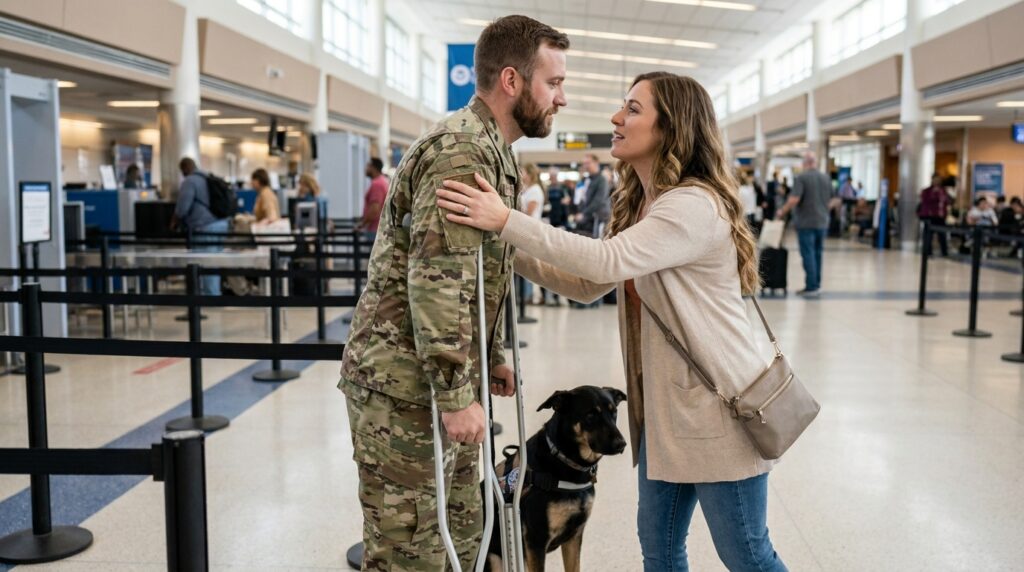
CHAPTER 1: THE FAULT LINE
The metal rollers under the grey plastic bins didn’t roll smoothly; they caught on grease and lint, sending a rhythmic, metallic chatter upward into the low acoustic tiles of the ceiling. Staff Sergeant Garrett Vance watched a stray plastic coin tray slide down the track toward his thumb. The air inside the screening lane smelled precisely of what it was—recirculated aviation exhaust, dry carpet fibers, and the sour, chemical tang of five hundred damp winter coats packed into a single bottleneck.
He didn’t look at the faces in the parallel lines. He didn’t need to. He calculated the queue the way he had calculated standard convoy intervals along the ring routes out of Bagram: six yards between the baggage rollers and the body scanner; three paces of open linoleum where a man on underarm aluminum crutches was entirely exposed to the lateral drift of the crowd; and one thick, textured yellow safety strip that marked the boundary of civil authority.
Ranger’s left shoulder pressed against the coarse fabric of Vance’s trousers, a steady, localized furnace of heat against an aching knee joint that had spent the last fourteen hours locked into an economy-class bulkhead seat. The dog’s harness—heavy black webbing stitched with a single, unwashed tactical flag patch—was rigid under Vance’s left palm. Every three seconds, Vance’s fingers tightened over the small brass challenge coin in his pocket, its milled edge cutting into his skin to anchor him against the throbbing vertical fire radiating from his tibia.
“Step forward into the frame. Not the dog. Just you.”
The voice belonged to the blue shirt behind the glass partition. TSA Supervisor Miller didn’t look up from his monitor when he spoke; his right hand was busy clicking a plastic stylus against the corner of a keyboard, the sound sharp and aggressive like a failing fuel injector. His uniform shirt was stiff with laundry starch, the silver collar pins aligned with a geometric precision that suggested a man who spent his mornings practicing authority in a mirror.
Vance shifted his weight, his forearms bearing down on the worn rubber grips of the crutches until the aluminum tubes gave a faint, clean ping. “He’s a designated medical asset, sir. The transit paperwork is affixed to the front of the folder.”
“The folder stays in the bin,” Miller said. He finally raised his eyes, his gaze sliding down Vance’s camouflage sleeve, skipping the unit patch entirely, and settling on the thick leather handles of the crutches. A small, dark smudge of tarmac grease was visible on Miller’s left cuff. “We don’t read folders while the lane is backed up to the escalator. Send the animal through with the female officer on Lane Three, then step into the box for a manual sweep.”
The family behind Vance shifted. A child’s heavy nylon backpack scraped against the metal stanchion, the sound loud enough to make Ranger’s ears twitch back. The dog didn’t move his paws; he remained locked into Vance’s left flank, his breathing a shallow, rhythmic pulse against the veteran’s boot.
“The dog remains on my left side through the portal,” Vance said. His tone didn’t rise; it dropped an octave, flattening out until the transactional noise of the surrounding lanes seemed to lose its edge. “That’s the standard Department of Defense clearance protocol for active-duty medical transport.”
Miller stood up from the stool. The movement was deliberately slow, designed to use the physical elevation of the platform to look down across the yellow line. He tapped his plastic ID badge against the edge of the metal detector frame, a dull thwack that drew the eyes of three junior screeners two lanes over. “This isn’t a military base, Sergeant. This is my lane. And in my lane, I handle the line.”