CHAPTER 10: THE EXTRACTION TO THE SAFE HOUSE
“Drop it into reverse, Claire. Now,” Vance said. His voice was a flat, low-frequency command that didn’t leave room for an administrative buffer.
The sedan’s starter motor caught with a wet, metallic wheeze, the engine vibration sending a sharp ripple through the back seat cushion that struck Vance’s fractured tibia like a cold hammer. Claire didn’t look back; her knuckles were white against the artificial leather of the steering wheel, her right foot forcing the transmission selector down into the reverse detent with a heavy, plastic clink. The vehicle rolled backward by six inches before her heel hit the brake pedal, the tires barking on a dry grease patch on the parking deck floorboards.
Outside the rear tinted glass, the dark utility vehicle adjusted its vector instantly. The driver didn’t flash his high beams; he allowed the massive front bumper to drift forward another yard, the cold chrome grille cutting off the primary access lane until they were boxed within three inches of a structural concrete pillar. Through the reflection of the sedan’s side mirror, Vance watched the man in the civilian field jacket step out from the rear stairwell door, his fingers tapping a sequence into a handheld communication pad that emitted a faint, high-pitched digital whine.
“Garrett, the exit gate is completely blocked,” Claire said, her voice dropping into a shallow, panicked rhythm that filled the enclosed cabin like steam. She stared at the unlit SUV in front of them, her foot trembling against the brake pad until the brake lights flickered against the damp pillar.
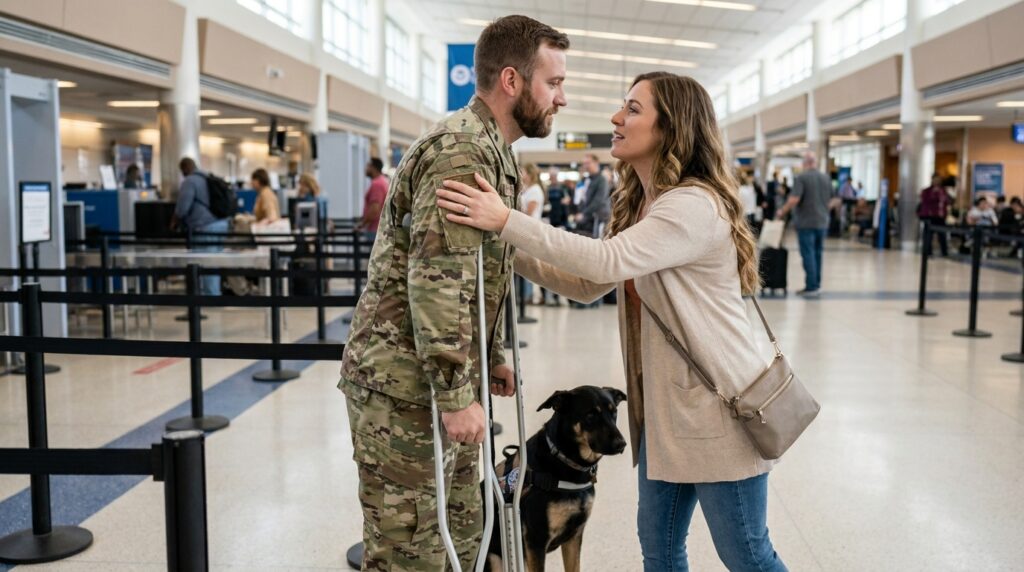
“They aren’t going to initiate a hard breach inside the airport perimeter,” Vance said, his left hand coming down to pin Ranger’s shoulder webbing against the floorboard. The dog didn’t whine; his body remained stiff, his jaw pressed tight against the carpet as he monitored the external footsteps through the floorpan. Vance used his right arm to wedge the aluminum crutches beneath the front passenger seat rail, forming a solid, cross-braced arch that would keep the metal frames from rattling if the vehicle took an impact. “They want the oilcloth packet, Claire. They don’t want a civil police response on Level Two. Cut the wheel hard right and use the maintenance lane behind the wash rack.”
The sedan’s tires squealed as she dropped the throttle, the front bumper clearing the concrete pillar by less than two inches. The acceleration was a violent, uncoordinated lurch that forced Vance’s weight deep into the seat lining, the localized fire in his right leg blooming into a white-hot spike that made his thumb press into the milled rim of his challenge coin until the skin split. He didn’t look at his hand. He tracked the mirror layout as the dark SUV fell behind by three car lengths, its transmission catching with a delayed hydraulic clank as it attempted to reverse into the maintenance corridor.
Twenty minutes later, the desaturated gray tones of the airport terminal had vanished, replaced by the broken, sodium-lit blacktop of the industrial transit district three miles west of the perimeter fence. The rain had started again—a cold, needle-thin drizzle that left a greasy sheen on the windshield. Claire turned the sedan down an unpaved service alley between two abandoned freight transfer sheds, the tires splashing through deep potholes filled with stagnant oil-water.
She brought the vehicle to a dead stop behind a rusted corrugated steel garage gate. The structure was a former military logistics sub-station, its brick facade cracked and covered in soot, completely isolated from the standard civilian commercial tracks.
“We have exactly twelve minutes before the regional network logs our vehicle token at the intersection camera,” Vance said, his forearms bearing down on the rubber grips of his crutches as he dragged his frame out into the wet gravel. The cold rain hit his face like iron filings, but he didn’t adjust his collar. He swung his weight toward the heavy wooden door of the office locker, Ranger tracking his heel with absolute, silent precision.
Inside, the room smelled of cold floor wax and dead copper wires. A single green monitor terminal sat on a bare steel desk in the corner, its internal cooling fan emitting a high, dry scream that filled the concrete space. Vance didn’t take off his deployment jacket. He dropped his crutches against the edge of the desk, his hands moving to the inner lining to extract the coarse, double-stitched oilcloth envelope.
The fabric was stiff from his body heat, the wax-sealed twine across the flap intact. He tore the seal with his thumbnail, pulling out the single, encrypted third-platoon after-action ledger. He didn’t look at the casualty statistics on the first page; his eyes traveled directly to the technical appendix at the back—the raw satellite transit logs from the morning of the ambush.
On the third line of the data grid, beneath the automated command routing flags, a specific hardware address was printed in blue grease pencil: OP-LOC-OFF-KREIGER.
The realization struck him with the cold weight of an incoming mortar round. Major Kreiger wasn’t a civilian clerk at the Ramstein transit hub—he was the regional logistics director who had overseen the ammunition manifest for the valley deployment. The digital tracer on Vance’s profile hadn’t been an automated security error; it had been an intentional administrative block authorized by the very man who had signed the short-supply order that left the third platoon without a secondary machine-gun line on the ridge. The flag code at the TSA checkpoint was the final layer of a systematic institutional cover-up, designed to seize the physical telemetry data before it could ever cross a domestic judicial desk.
“Garrett,” Claire said, standing by the rusted window frame, her fingers pulling the blind back by a fraction of an inch. A small, blue digital light was flashing on the dash receiver of the car outside—a dynamic ping from an unverified cellular tower. “The gray sedan… the tracking module in the onboard console just re-established its network link. They aren’t looking for the car anymore. They’re dialing the address directly into this sector.”
Vance didn’t close the ledger. He reached down to grab his aluminum crutches, his frame settling back into the triangular geometry of an active position. The false victory at the airport gate was completely shattered, and the true enemy wasn’t an arrogant screening supervisor—it was the administrative architecture that had sent his men into the valley without bullets, and the counter-pursuit had just entered its second phase.