CHAPTER 3: THE INVASION OF SPATIAL SECURITY
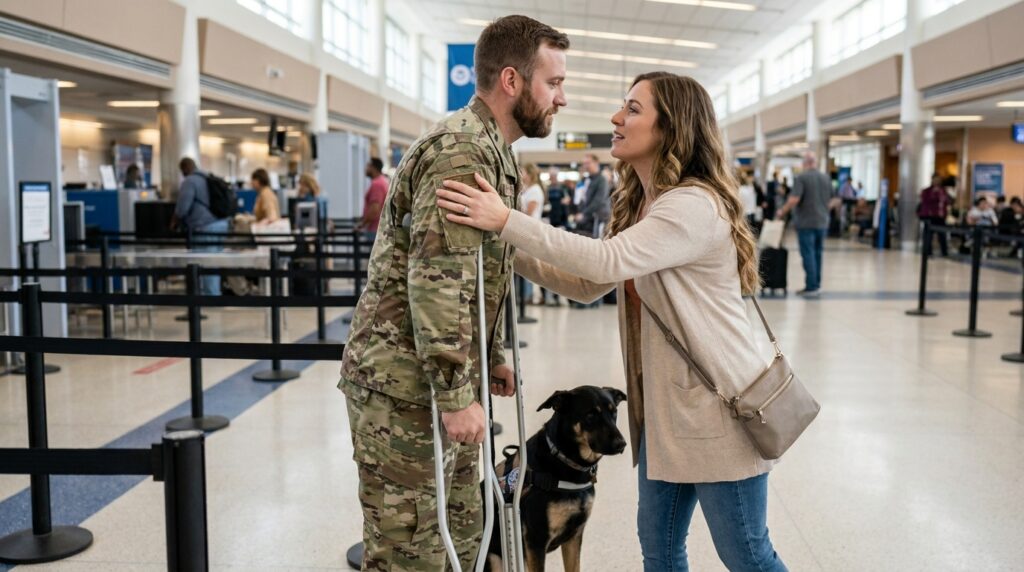
Miller’s fingernail caught the edge of Ranger’s heavy nylon chest strap, a small, scraping sound that vibrated directly up the leash into Vance’s palm. The supervisor’s shoulders leaned forward, his torso breaking the vertical plane of the yellow line with the reckless confidence of a man backed by a badge and an institution. He didn’t see the slight rotation of Vance’s left hip, nor did he register the way the aluminum tip of the left crutch dug into the linoleum floor to form an unyielding triangular base.
Vance shifted his weight, his left forearm snapping downward in a micro-movement that carried the clean, dense momentum of an active lever. He didn’t strike. He simply dropped his arm across the vector of Miller’s approach, using the rigid bone structure between his wrist and his elbow to seal the perimeter. When Miller’s wrist collided with the thick, olive-drab canvas of Vance’s sleeve, it wasn’t a violent collision; it was the sudden, absolute cessation of movement, like an unbraked vehicle hitting a concrete barrier.
“Step back from the dog, sir,” Vance said. The words were quiet, but they held the calculated weight of an officer establishing a firing line. His chest didn’t heave; his eyes remained fixed on the small, silver name badge pinned to Miller’s chest, watching how the thin metal reflected the cold glare of the ceiling fixtures.
Miller pulled his hand back, his fingers trembling slightly from the sudden impact against Vance’s rigid arm. His face flushed a dark, mottled red beneath the brim of his supervisor’s cap. He took half a step backward, his boots squeaking in a frantic double-time rhythm as his heel clipped the base of the metal detector frame. “You just touched a federal officer,” Miller hissed, his hand dropping directly to the black radio casing at his hip. “We are in a terminal lockdown situation on Lane Two. Step away from the crutches now!”
The whisper of rolling luggage throughout the terminal vanished instantly. Two lanes to the left, a junior screener dropped a plastic bin onto the rollers with a loud, hollow crash that seemed to echo off the far glass walls of the tarmac lounge. The tired holiday travelers in Vance’s queue recoiled, their bodies leaning away from the stanchions as the atmosphere in the bottleneck turned clinical and dangerous. A woman in a long wool coat grabbed her child’s arm, pulling the boy back until his nylon backpack thumped against the metal divider.
Vance didn’t look at the crowd. His eyes traveled over Miller’s shoulder, mapping the blue digital display mounted to the side of the screening console. On the screen, a solid block of amber text was pulsing beside his scanned military transit number: FLAG CODE: ALPHA-NOVEMBER-FOUR. It wasn’t a civil travel warning. It was a restricted tactical routing flag, the precise designation used by the Department of Defense to halt cargo manifests containing sensitive foreign-theater intelligence material.
The data mismatch wasn’t a simple clerical error. Miller hadn’t just misread the form—he had triggered an encrypted protocol that had been waiting for Vance’s biometric profile to cross a domestic gateway.
“I have a non-compliant passenger who just initiated physical contact on Lane Two,” Miller barked into his shoulder microphone, his voice cutting through the heavy stillness of the terminal. His thumb remained clamped on the talk button, his knuckles turning white. “Need armed response at the checkpoint immediately. Suspend passenger flow on the eastern corridor.”
“The passenger has not moved his feet, Supervisor,” Vance countered, his voice flat, retaining its rhythmic, unhurried cadence. He adjusted his palms against the rubber grips of his crutches, absorbing the sharp ache in his right tibia without a single flinch. “The physical contact was an encroachment violation of a registered service asset under Title 28 of the United States Code. I suggest you look at your console screen before your team executes an unauthorized detainer.”
Miller didn’t turn his head to look at the monitor. His arrogance had become a physical trap, locking him into a defensive posture in front of fifty people who were now holding up their phones, the small glass lenses tracking every line of his face. He could feel the witness pressure shifting; the initial annoyance of the travelers had vanished, replaced by the uncomfortable realization that they were watching an aggressive bureaucrat attempt to corner a wounded soldier on his first day back on American soil.
A junior officer at the end of the roller track quietly stepped away from the terminal, her hands rising to her belt as she looked back toward the security supervisor with a faint, nervous headshake. She knew the code on the screen wasn’t a standard domestic violation, and she knew the man standing on the crutches wasn’t moving like a target who was about to break. He was moving like a man who was holding a position until the real weight arrived.