
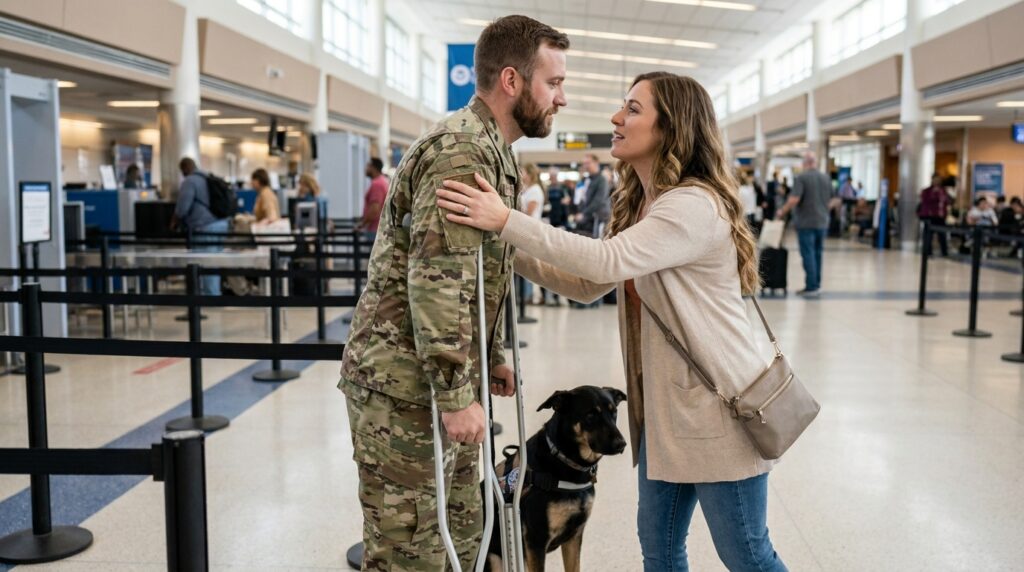
CHAPTER 5: THE ARRIVAL OF INSTITUTIONAL WEIGHT
“Supervisor Miller, step three inches back from that yellow marker line,” the voice said. It wasn’t loud, but it carried the flat, industrial density of a closed cell block door.
Lieutenant Briggs didn’t look at Miller as he spoke. He walked into the bottleneck from the secure side of Lane One, his dark blue law enforcement uniform tailored with heavy, stiff seams that completely absorbed the flickering fluorescent reflections. His leather duty belt gave a single, muffled squeak as his hand came down onto the metal edge of the glass partition. Beside him, a commercial airline captain stood motionless, his gold sleeve bands catching the cold light like flat brass rulers.
Miller’s shoulders jerked. His thumb came off the talk button of his belt radio with a sharp, plastic pop, his face draining of its dark red flush until it matched the industrial grey paint of the metal detector frame. “Lieutenant, we have a code-four obstruction here. The passenger refused a clear compliance directive regarding his animal, and we have an amber alert on his—”
“I didn’t ask for your report yet, Miller,” Briggs interrupted. He stepped directly between Miller and Vance, his massive physical frame severing the thin vector of tension that had locked the two men together. Briggs turned his head by three degrees, his eyes sliding down the sleeve of Vance’s camouflage jacket until they fixed on the muted olive-drab unit crest stitched below the shoulder line.
Briggs’ left hand raised a heavy leather-bound clipboard. On the top sheet, a printed military transit roster was secured under a flat steel clip. Vance’s fingers remained tightly clamped onto the brass coin inside his pocket, his forearms rigid as he maintained his triangular brace on the aluminum crutches. He could see a small, blue water-seal stamp on the corner of Briggs’ paperwork—the exact classification mark used by the Provost Marshal General’s office at the domestic terminal command.
“Staff Sergeant Vance,” Briggs said, his tone shifting into a sparse, disciplined rhythm that immediately neutralized the chaotic energy of the surrounding queue. “Your medical transport from the Rhine-Main corridor was logged through our transit terminal three hours ago. Why is your manifest documentation still inside a plastic bin?”
“The supervisor flagged the routing code on page three, Lieutenant,” Vance replied. His voice was steady, a clear baritone that cut through the low hum of the conveyor rollers. “He initiated a separation order on the service dog before verifying the Department of Defense logistics number.”
Briggs reached into the grey bin with two fingers, lifting Vance’s transit folder without touching the surrounding plastic. He opened the folder against his forearm, his eyes scanning the data lines with the rapid, practiced tracking of a former military policeman. He stopped at the amber notification text flashing on Miller’s display console.
“Miller,” Briggs said, his head still turned toward the folder. “What code did you pull when you scanned this manifest?”
“Alpha-November-Four,” Miller stammered, his hand remaining frozen over his radio holster. His eyes shifted toward the passengers behind the ropes, who were still holding up their phones, the small glass lenses recording every crack in his posture. “It’s an automated federal block. The system locked the lane. I was following standard protocol for an unverified security variance.”
“You skipped the secondary routing line, Supervisor,” Briggs said. He turned the folder around, slamming the flat of his thumb against the paper with a dull thud that vibrated through the metal rollers. “Look at the logistics string below the primary flag. That’s not a civil travel variance. That’s a military priority courier marker. This transport was pre-cleared by the terminal authority before the aircraft touched the tarmac.”
The airline captain stepped forward, his eyes scanning the blue display monitor over Miller’s starched shoulder. “The lieutenant is correct. That manifest number matches the encrypted logistics line for the Ramstein medical bird that landed at gate twelve. The flag wasn’t put there to stop him from flying, Miller. It was put there to notify my office to clear his arrival lounge.”
Vance’s thumb rolled over the milled edge of the brass coin in his pocket, his mind locking onto the data layout with absolute clarity. The captain was wrong about one detail—the flag wasn’t a standard arrival notice. If it were a routine clearance, the code would have processed through Lane One without triggering an administrative shutdown. Someone had intentionally buried a deep digital tracer in his travel profile, using the loud, clumsy apparatus of civil security to force a physical confrontation at the border of the gate. They wanted his bag checked, and they wanted it done in a space where everything was recorded on federal camera tracks.
Briggs closed the folder with a sharp snap that made the junior screener by the rollers jump. He turned his full frame toward Miller, his posture unyielding as he blocked the supervisor’s access to the terminal console. “You closed a priority clearance lane during a peak holiday traffic window because you didn’t read the bottom four inches of a transit document. You’re going to step out of this portal right now, Miller. You’re going to hand your log stylus to Officer Davis, and you’re going to wait in the sub-station until the terminal director reviews this video track.”
Miller’s mouth opened, then clicked shut without a sound. The administrative kingdom he had used to terrorize the bottleneck for three hours dissolved in the span of five seconds under the heavy, institutional weight of the local jurisdiction. He reached down with trembling fingers, dropping his scuffed plastic stylus into the junior officer’s hand before turning his back on the line.
“Staff Sergeant Vance,” Lieutenant Briggs said, stepping aside to open the two-foot gap through the metal detector frame. He raised his right hand to the brim of his cap in a sharp, quiet salute that made the entire fifty-person queue go completely dead silent. “Your clearance is verified. Welcome home, sir.”








