CHAPTER 4: THE APPLICATION OF STRUCTURAL LEVERAGE
“Drop your arm, Sergeant, or my team will clear it for you,” Miller said. His boots didn’t shift forward this time. Instead, he leaned his weight into his heels, his torso vibrating with a shallow, rapid breath that made the plastic clip-on badge on his pocket click against his blue uniform button. His right thumb remained clamped onto the rubber button of his belt radio, the internal speaker emitting a high, rhythmic hiss that cut through the silent queue.
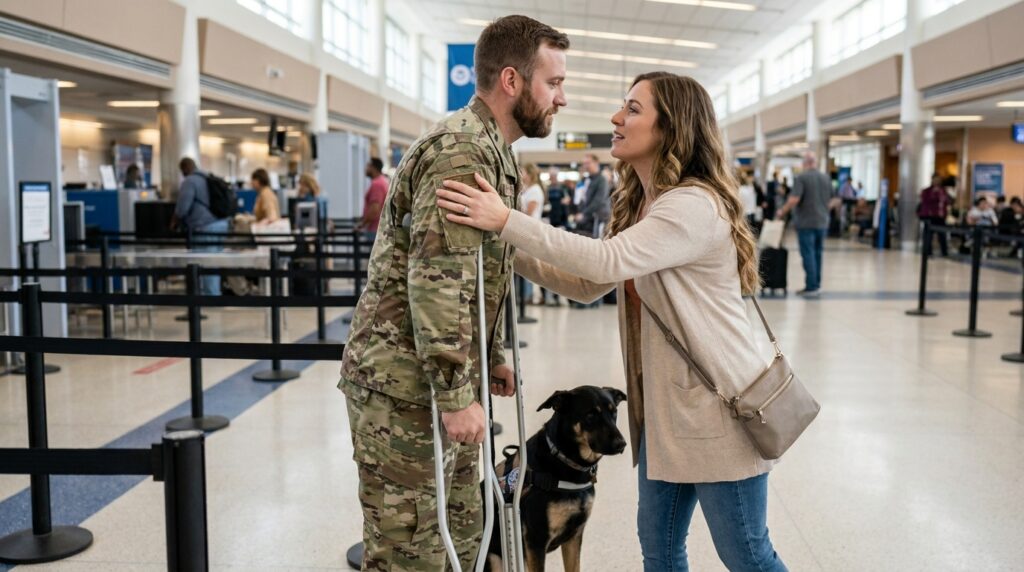
Garrett Vance did not lower his forearm. The angle of his elbow stayed locked at precisely ninety degrees, his camouflage sleeve forming an unyielding bar between Miller’s hand and Ranger’s harness. To the travelers watching behind the black nylon queue ropes, it looked like a static standoff—a wounded man braced on aluminum tubing refusing to budge. But Vance could feel the structural truth of the lane. Every ounce of downward force he exerted through his palms traveled straight through the scuffed aluminum shafts into the rubber tips, biting into the worn linoleum exactly where the yellow perimeter tape had begun to peel.
He had learned to map stress lines long before a mortar shell tore through the floorboards of his vehicle outside Forward Operating Base Apache. In a tight space, authority wasn’t a matter of volume; it was a matter of who owned the leverage point.
“The arm is a passive defensive block, Supervisor,” Vance said. His voice was too low to register on Miller’s shoulder microphone, but it traveled clearly to the junior officer standing three feet away by the x-ray conveyor. “If your personnel step inside this perimeter while the medical asset is engaged, you are initiating a standard custody breach under joint transit regulations. Run the bypass code on your screen, or wait for the shift supervisor to clear the gate.”
Miller’s jaw tightened, the skin over his cheekbones turning the color of wet chalk. He didn’t look at the console monitor pulsing behind his shoulder, where the amber flag code—ALPHA-NOVEMBER-FOUR—continued its steady, silent oscillation. His focus had narrowed down to the single square yard of floor space between his polished black shoes and the rubber tips of Vance’s crutches. To back away now, under the steady glare of forty smartphone lenses held by silent, staring passengers, would dissolve the minor administrative kingdom he had spent three years building in this terminal.
“You don’t dictate protocol to my team,” Miller whispered, his voice cracking from the strain of suppressed rage. He released the radio button, his hand dropping toward his hip. “We have an active red-flag on your profile. That means you don’t move until I say you move.”
Behind them, the dead air of the bottleneck seemed to expand. The man in the business suit who had been checking his watch three minutes ago slowly lowered his wrist, his face softening into a heavy, uncomfortable stillness. The collective irritation of the line had curdled into something older and darker—the deep, public shame of witnessing a bureaucratic machine grind against a man who still bore the dust of a deployment on his boots.
Vance felt Ranger’s ribcage expand against his left shin, a smooth, deliberate breath that remained completely unhurried. The dog’s jaw was closed, his ears pinned flat against his skull as he tracked Miller’s hands. Ranger wasn’t preparing to strike; he was waiting for the command cue that would never come, trained to treat civilian hostility as nothing more than background wind.
Vance’s thumb rolled over the milled edge of the brass challenge coin inside his pocket. The metal had warmed from his body heat, but it remained sharp enough to ground him against the white-hot fire blooming in his right tibia. He checked the display again over Miller’s starched shoulder. Below the primary flag, a secondary string of digits had populated the terminal: LOG-TRANS-026.
The realization hit him with the cold precision of an incoming round. That wasn’t an airport security code. It was a restricted cargo manifest number from the logistics hub at Ramstein—the exact transport line that had carried his personal gear bag across the Atlantic. The encrypted flag on Miller’s screen wasn’t an automated error. Someone had placed a digital tracer on his travel profile, a specific administrative trap designed to trigger the moment his boots touched a domestic port of entry.
“Supervisor,” the junior officer by the rollers said, her voice small and tight as she stepped forward from the conveyor track. She didn’t look at Miller; her eyes were fixed on the pulsing console screen. “The airport police lieutenant just cleared the lower escalator. He’s coming through the secure side of Lane One right now.”
Miller didn’t turn around. He kept his eyes locked on Vance’s face, his body rigid as he waited for the first sign of compliance. But Vance merely adjusted his grip on the rubber handles, his frame settling deeper into the triangular brace of his crutches. He had survived six months in a medical ward with less leverage than he held right now, and he had no intention of surrendering the threshold before the real authority arrived to read the data.