CHAPTER 6: THE RYTHMIC CLEARING OF THE GATE
“The lane belongs to you now, Davis,” Lieutenant Briggs said, his hand dropping from his cap brim to lay flat against the top steel rail of the queue barrier. The metal hummed under his palms, vibrating with the distant, heavy drone of a regional jet taxiing past the glass terminal face.
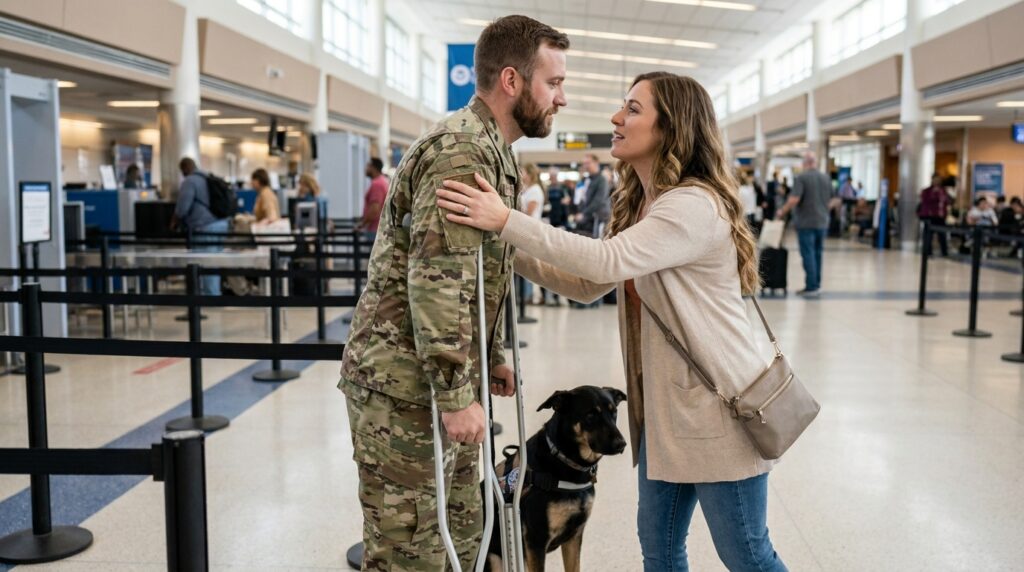
Garrett Vance did not offer a verbal acknowledgment. He shifted his weight, pulling the scuffed rubber tips of his crutches back by two inches until they cleared the outer seam of the yellow safety tape. The movement required an immediate, sharp contraction of his shoulder blades—a localized knot of physical exhaustion that radiated down his spine to meet the dull, persistent hammering in his fractured tibia. He leaned forward, allowing the padded underarm cradles to bear the sudden momentum of his torso as he crossed the threshold of the metal detector frame.
The dog moved with him. Ranger stayed precisely three inches behind Vance’s left heel, his black-and-tan coat brushing the vertical steel casing of the scanner box without triggering the internal sensor array. His jaw remained dry and closed, his ears pitched forward to filter the sharp, overlapping clicks of thirty smartphones finally dropping back into the pockets of the waiting crowd.
Behind them, the dense queue of holiday travelers broke its long, frozen stillness. The man in the business suit stepped into the open lane, his leather loafers making a loud, scraping sound on the linoleum as he hurried toward the empty plastic bins. He didn’t look at Vance as he passed; his eyes stayed fixed on the floor, his face tightened into a stiff, pale mask of collective embarrassment that seemed to infect the rest of the moving line. The initial anger that had driven the bottleneck had vanished, replaced by the heavy, silent rush of people trying to put distance between themselves and the threshold where a bureaucrat had broken protocol.
Vance swung his right leg forward, his boot heel hitting the polished tile with a flat, hollow thud. He didn’t slow his pace down the exit corridor. His eyes scanned the small slip of paper Briggs had tucked into the front pocket of his transit folder during the document verification—a secondary printout from the terminal data link. On the very bottom margin, below the authorized signature block, a tiny string of alphanumeric text was pulsing in faint red ink: TR-TRACER-09-OFFLINE.
The data mismatch was gone, scrubbed from the local console by Briggs’ administrative override. But Vance’s gaze locked onto the timestamp affixed to the log line. It didn’t align with his arrival schedule; it had been generated twelve hours prior, while his medical transport bird was still taking on fuel at the staging field in western Europe.
The security bulletin hadn’t been an automated trigger caused by an airport network error. The trap had been engineered before he even crossed into the domestic flight region, a deliberate digital marker set to force his transit file into a high-visibility terminal shutdown where every piece of his personal gear would be laid out on a civil screening table under federal tracking cameras. They hadn’t been looking for contraband; they had been checking to see if he was carrying the physical copy of the third-platoon after-action ledger from the valley deployment.
“Staff Sergeant,” the airline captain said, keeping pace with Vance until they reached the glass-walled divider that marked the transition to the civilian terminal lounge. His gold sleeve lace looked dull under the lower, desaturated lighting of the corridor. “My crew is holding the arrival manifest for your connection at gate nine. We can bypass the public tram if your leg needs a cart.”
“I have my transit parameters, Captain,” Vance said, his voice flat, retaining its measured, unhurried cadence as he swung his frame forward another three paces. “The dog has a relief schedule to maintain before the final leg. I’ll clear the terminal on foot.”
The captain stopped at the boundary line, his hand rising in a brief, civilian nod of respect before he turned back toward the secure side of the gate. Vance didn’t look back. He tracked the long, desaturated expanse of the arrival lounge ahead, where the high fluorescent glare of the screening zone faded into a muted pattern of grey industrial carpet and low-backed passenger benches.
His left hand remained clamped over the brass coin in his trouser pocket, the milled edges now smooth against his skin from twenty minutes of continuous, high-friction pressure. The physical pain in his leg was a stable asset now, something he could calculate and budget against the remaining distance to the baggage claim barrier. He knew the digital tracer on his profile hadn’t been killed by Briggs’ override—it had simply gone dark, waiting for his biometric token to ping the next civil network node on his route home. The people who had planted the flag code weren’t in this airport, but they were still tracking the metric of his movement, and the final ledger was still hidden inside the lining of his deployment jacket.