Chapter 1: The Sign That Hit the Concrete
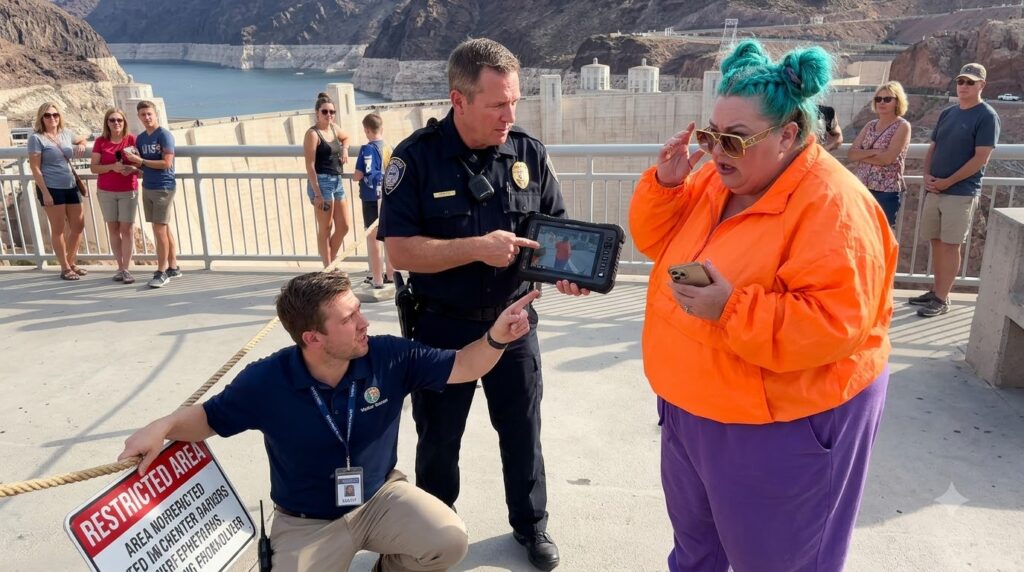
The warning sign struck the concrete with a crash loud enough to turn every head on the observation terrace.
A metal frame bounced against the pavement. Its heavy base scraped across the walkway, and the words RESTRICTED AREA flashed in the afternoon sunlight before the sign settled on its side.
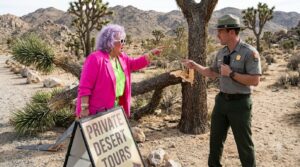
Standing over it was a woman in a fluorescent-orange jacket, purple pants, and enormous gold sunglasses.
Her turquoise hair had been twisted into two oversized braided buns. Her face was flushed, her breathing heavy, and her thick arms were still extended from the shove.
“I GO WHERE I WANT!”
For a moment, nobody moved.
Beyond the terrace, the enormous concrete walls of the Blackstone Federal Hydroelectric Dam stretched across a narrow canyon. Water thundered through the spillway far below. Families had gathered along the observation railing to admire the engineering marvel, take photographs, and enjoy the mountain air.
They had not come to watch a stranger destroy federal property.
The woman, fifty-five-year-old Patricia Hensley, was accustomed to getting attention.
In her hometown, she chaired a neighborhood association, managed several rental properties, and frequently reminded people that she knew influential individuals. She had learned that a raised voice could sometimes accomplish what patience could not.
Today, however, she had encountered something that refused to bend to her demands.
A restricted walkway.
Patricia wanted to use it to photograph herself against the dam’s enormous spillway gates. The designated public overlook offered nearly the same view, but she considered the approved location insufficiently impressive.
When a visitor-center employee explained that the walkway was closed to unauthorized visitors, she interpreted the restriction as a personal insult.
Now the warning sign lay on the ground.
Daniel Mercer, a thirty-four-year-old tour guide, hurried toward it.
He had worked at Blackstone for nearly six years. A former high-school science teacher, Daniel enjoyed explaining how the dam generated electricity and why its maintenance procedures mattered.
He especially liked visitors who asked questions.
Patricia had not asked questions.
She had issued demands.
Daniel crouched beside the fallen sign, examining its bent mounting bracket. The impact had loosened one corner of the metal frame, leaving a sharp edge exposed.
He carefully reached beneath it.
That was when Patricia pulled out her phone.
She stepped directly in front of him, raised the camera, and began recording.
“LOOK WHAT YOU DID!”
Daniel froze.
The accusation was so unexpected that he initially thought he had misunderstood.
Patricia moved closer, positioning her camera to capture Daniel holding the damaged sign.
From that angle, the scene told a different story.
A federal employee appeared to be struggling with a warning sign that had just been knocked down.
The woman filming him appeared outraged.
Daniel slowly stood.
“YOU KNOCKED IT DOWN!”
Patricia smiled.
It was a small, satisfied expression that disappeared almost immediately when she realized several tourists were watching.
She adjusted her sunglasses and continued recording.
Behind her, an elderly couple stepped away from the railing.
The husband, seventy-two-year-old Walter Bennett, had spent thirty-eight years maintaining electrical systems at industrial facilities. His wife, Elaine, had been a public-school librarian.
They had driven nearly four hours to visit the dam.
Walter had seen the entire confrontation.
He also noticed something Daniel had not.
A small boy in a blue baseball cap had been standing beside the warning sign seconds before Patricia shoved it.
The child had jumped backward just in time.
Walter looked toward the boy, who was now clinging to his grandmother’s hand.
The grandmother’s face was pale.
Meanwhile, Patricia continued pointing her phone at Daniel.
She accused him of damaging government property, mistreating visitors, and attempting to conceal his mistake.
Her voice carried across the terrace.
Daniel could feel people watching him.
He had spent years building a reputation for patience and professionalism. Now a stranger was recording him while making accusations that could follow him far beyond the visitor center.
He knew how quickly a misleading video could spread.
He also knew that arguing with Patricia would only give her more footage.
Then a security officer approached from the checkpoint.
His name was Marcus Reed.
He was fifty-eight, broad-shouldered, and quiet in the way of someone who had spent decades handling difficult situations.
Marcus carried a handheld monitoring device.
He had already received an alert from the terrace camera.
Patricia immediately turned toward him.
She began explaining that Daniel had destroyed the sign and threatened her when she tried to document the incident.
Marcus listened without interrupting.
Then he turned the monitoring screen toward her.
The footage showed the observation terrace from above.
It showed Patricia approaching the barrier.
It showed her planting both hands against the warning sign.
And it showed her shoving it to the ground.
“THE CAMERA CAUGHT YOU.”
Patricia’s expression changed.
Her mouth opened, but no words came.
She lowered her sunglasses, stared at the screen, and then looked around at the tourists.
Daniel remained beside the fallen sign.
Marcus held the evidence steady.
For the first time that afternoon, Patricia appeared to understand that shouting might not be enough.
But the confrontation was far from finished.
Because the security footage had captured something else.
Something Marcus had not yet shown her.
And it concerned the little boy standing only inches from the falling sign.