Chapter 8: What the Dam Could Not Teach Her
The letter Patricia eventually wrote was not elegant.
It contained crossed-out sentences and awkward phrases.
At first, she tried to explain why she had been angry.
Then she removed those explanations.
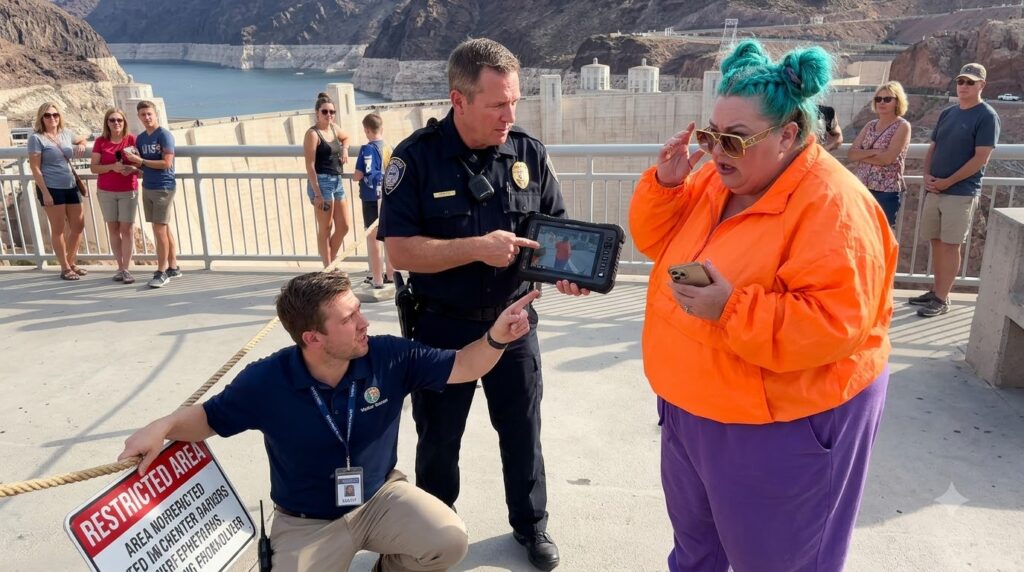
She had been frustrated about the restricted walkway.
She had felt embarrassed when Daniel refused her request.
She had believed she deserved an exception.
None of those feelings justified what followed.
After several attempts, she wrote a simple acknowledgment.
She had pushed the sign.
She had falsely accused Daniel.
She had failed to consider the safety of nearby visitors.
She regretted her behavior.
Patricia sent the letter through the facility’s administrative office, asking that it be forwarded only if the recipients wished to receive it.
She did not request a reply.
She did not ask for the letter to be published.
She did not claim that the apology erased what had happened.
Daniel received his copy on a Tuesday afternoon.
He read it in his office.
The words surprised him.
He had expected Patricia to remain defiant.
He had imagined her blaming the facility until the controversy faded.
Instead, she had admitted responsibility.
Daniel appreciated the apology.
But he did not immediately feel forgiving.
The weeks of anxiety had been real.
The damage to his reputation had been real.
He had watched his mother worry about him.
He had spent evenings wondering whether years of careful work could be undone by one misleading recording.
An apology could acknowledge those consequences.
It could not make them disappear.
Daniel placed the letter in his desk drawer.
He decided he did not need to respond immediately.
Meanwhile, Ruth received a separate letter.
Patricia had apologized for frightening Noah and for minimizing what had happened.
Ruth read it twice.
She had spent most of her life teaching children that responsibility meant recognizing the effect of one’s actions on others.
She believed in second chances.
But she also believed that second chances required change.
She did not know whether Patricia would change.
She could only judge the letter for what it was.
An acknowledgment.
Ruth decided not to share the details with Noah immediately.
Instead, she asked whether he wanted to return to Blackstone Dam someday.
The boy hesitated.
Then he asked whether the warning sign had been fixed.
Ruth told him it had.
He asked whether Daniel still worked there.
She smiled.
Yes, Daniel still worked there.
Noah thought for a moment.
Then he asked whether they could see the turbines.
Ruth felt tears gather in her eyes.
She promised they could.
Several weeks later, Daniel received an email from Ruth.
She explained that Noah wanted to finish the tour they had interrupted.
She asked whether the facility could accommodate a return visit.
Daniel immediately contacted Helen.
Together, they arranged a regular guided tour on a quiet weekday morning.
No special access.
No exceptions to safety procedures.
Just an opportunity for a child to experience the dam without fear.
Walter and Elaine decided to join them.
When the day arrived, the sky was clear and the mountain air carried the first hint of autumn.
Noah stepped onto the observation terrace holding Ruth’s hand.
The warning sign had been replaced.
Its new metal frame stood securely beside the rope barrier.
The words RESTRICTED AREA were clean and bright.
Noah looked at it for several seconds.
Then he turned toward Daniel.
He asked whether the sign was supposed to keep people safe.
Daniel nodded.
He explained that the dam contained powerful machinery, deep water, and areas where only trained personnel could safely work.
The barriers were not there to make visitors feel unwelcome.
They were there so everyone could enjoy the facility and return home safely.
Noah listened.
Then he looked toward the spillway.
“Can we see how the electricity gets made?”
Daniel smiled.
They began the tour.
Walter walked beside Elaine, pointing out equipment that reminded him of his working years.
Ruth followed Noah, watching his confidence return with every question.
At the visitor-center exhibit, Daniel demonstrated how water moved through a turbine.
Noah leaned forward eagerly.
He asked about generators.
He asked about transformers.
He asked whether electricity from the dam could reach his grandmother’s house.
Daniel answered every question.
By the end of the visit, Noah was talking so quickly that Ruth could barely keep up.
At the gift shop, he selected a small model turbine.
Walter bought him a booklet about hydroelectric power.
Before leaving, Noah approached Daniel.
He thanked him for the tour.
Then he said something Daniel would remember for years.
“I think I want to build things that help people.”
Daniel crouched to meet his eyes.
He told Noah that was a wonderful reason to become an engineer.
As the family walked toward the parking lot, Daniel watched them go.
For weeks, the observation terrace had reminded him of humiliation.
Now it reminded him of something else.
A frightened child had returned.
A grandmother had kept her promise.
An elderly couple had stood up for the truth.
And a young boy had rediscovered his curiosity.
Daniel realized that the incident no longer needed to be the defining memory of his work at Blackstone.
There were better memories still being made.