Chapter 2: The Boy in the Blue Baseball Cap
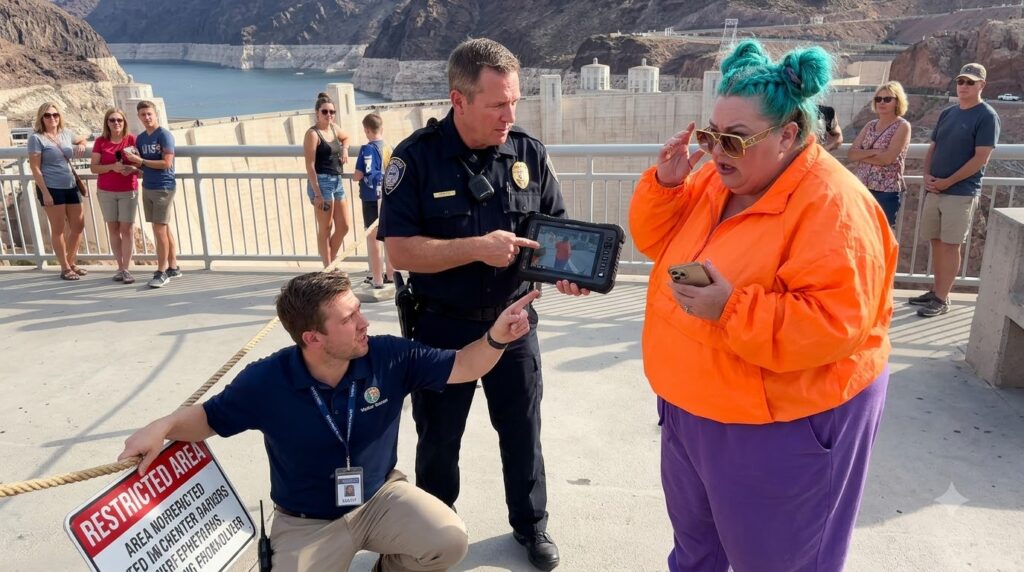
Marcus enlarged the security footage.
The image was clear enough to show the warning sign, the restricted walkway, and the visitors standing nearby.
But his attention was no longer on Patricia.
It was on the child.
Seven-year-old Noah Collins had been visiting Blackstone Dam with his grandmother, Ruth.
Noah loved machines.
He collected miniature construction vehicles, watched documentaries about bridges, and could spend an entire afternoon asking questions about how electricity reached the houses in his neighborhood.
His grandfather had once worked as an electrician, and although the man had died two years earlier, Noah still carried a small plastic flashlight that had belonged to him.
The dam tour was supposed to be a special birthday outing.
Ruth had promised him they would see the enormous turbines and buy a souvenir from the visitor center.
Instead, Noah had nearly been struck by a falling metal sign.
The footage showed him standing beside the barrier, looking toward the spillway.
Patricia had been arguing with Daniel several feet away.
Then she turned.
Without checking who was nearby, she shoved the sign.
Its upper edge swung toward Noah.
The boy stumbled backward.
Ruth caught his shoulder and pulled him away.
The sign struck the concrete where he had been standing.
Marcus watched the sequence twice.
Then he looked toward Ruth.
She was seated on a bench with Noah pressed against her side.
The boy’s hands were trembling.
Marcus approached them.
He asked whether Noah had been injured.
Ruth shook her head.
Physically, he appeared unharmed.
But she had spent forty years raising children, grandchildren, and occasionally the children of neighbors who needed help.
She recognized fear when she saw it.
Noah had stopped talking.
That frightened her more than anything.
A few minutes earlier, he had been asking Daniel whether the dam’s turbines were larger than school buses.
Now he stared at the pavement.
Ruth gently rubbed his back.
Marcus asked whether she would be willing to provide a statement.
She agreed.
Across the terrace, Patricia watched the conversation with growing irritation.
She had expected the security officer to scold Daniel, perhaps apologize for the inconvenience, and allow her to continue her visit.
Instead, Marcus was speaking privately with an elderly woman and a frightened child.
Patricia approached them.
Daniel stepped into her path.
He did not touch her.
He simply explained that Marcus was collecting witness statements and that she needed to remain near the checkpoint.
Patricia demanded to know why the grandmother was being interviewed.
Daniel refused to speculate.
That only made her angrier.
She began insisting that the entire situation was being exaggerated.
The sign had fallen, she argued, but nobody had been hurt.
The child had merely been startled.
In her mind, the absence of an injury meant the incident was insignificant.
Ruth heard enough to stand.
She was a small woman with silver hair, a faded denim jacket, and the steady posture of someone who had learned not to confuse loudness with authority.
She looked directly at Patricia.
“My grandson was standing there.”
Patricia glanced at Noah.
For one brief moment, her expression softened.
Then she looked toward the security officer and hardened again.
She claimed she had not seen the boy.
That part might have been true.
But she followed it with another accusation.
Daniel, she said, should never have allowed a child near the barrier.
Ruth felt her stomach tighten.
The warning sign had stood inside the designated public terrace. Noah had remained on the visitor side of the rope.
He had done nothing wrong.
Daniel had done nothing wrong.
Yet Patricia seemed determined to find someone else to blame.
Walter Bennett approached with Elaine.
Walter explained that he had witnessed Patricia shove the sign and had seen Ruth pull Noah away.
Elaine confirmed his account.
Marcus recorded their statements.
He then asked Patricia to accompany him to the visitor-center office.
She refused.
She claimed she had important connections and would not be treated like a criminal over a fallen sign.
Marcus calmly explained that she was not being asked to confess to anything.
The immediate concern was documenting property damage and ensuring visitor safety.
Patricia finally agreed to walk inside, though she continued complaining.
Daniel remained behind to help maintenance personnel secure the damaged sign.
As he examined the broken bracket, he noticed a deep scrape across the concrete.
The sign had not simply tipped over.
It had landed with considerable force.
He looked toward the spot where Noah had been standing.
For the first time since the confrontation began, Daniel felt something stronger than embarrassment.
He felt anger.
Not because Patricia had accused him.
Not because she had filmed him.
But because she had nearly injured a child and still seemed more concerned about winning an argument.
Inside the visitor center, Patricia sat opposite Marcus.
She placed her phone on the desk.
Its screen displayed the video she had recorded of Daniel holding the damaged sign.
Marcus asked whether she intended to share it.
Patricia folded her arms.
She said she could post whatever she wanted.
Marcus did not argue.
He simply asked her to preserve the original recording.
Patricia stared at him.
She had expected a lecture.
Instead, he was treating her phone as evidence.
And that made her uneasy.
Because she had already sent the video to someone.
Someone who had promised to make Daniel famous before the afternoon was over.