Chapter 3: A Video Without a Beginning
By four o’clock, Daniel Mercer’s face was circulating online.
The video lasted twenty-three seconds.
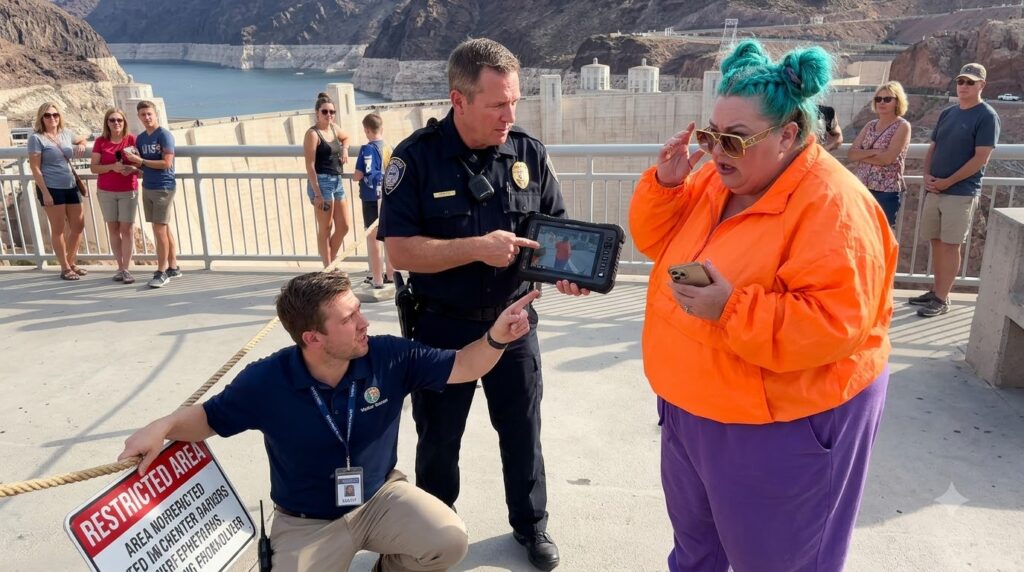
It began with Daniel crouching beside the damaged warning sign.
Patricia’s voice filled the recording, accusing him of destroying federal property and mistreating a visitor.
Daniel stood and protested.
The clip ended before the security officer arrived.
There was no footage of Patricia shoving the sign.
No image of Noah jumping backward.
No explanation of why Daniel had been holding the damaged frame.
Patricia had sent the recording to her cousin, Brenda Lawson, who operated a local community commentary page.
Brenda had posted it with a provocative headline suggesting that a federal dam employee had been caught damaging a safety barrier.
Within an hour, strangers were commenting.
Some questioned Daniel’s professionalism.
Others demanded that the dam investigate him.
A few viewers noticed that the video began after the sign had already fallen.
But their questions were buried beneath louder reactions.
Daniel learned about the post from his younger sister, Emily.
She called while he was completing his incident report.
At first, he assumed she was asking whether he was coming to dinner.
Instead, her voice sounded strained.
She had seen his face online.
Daniel opened the link.
He watched himself lift the sign.
He heard Patricia’s accusations.
Then he read the comments.
His chest tightened.
Daniel had never enjoyed public attention.
He was a private man who preferred hiking trails, old books, and Sunday dinners with his family.
His father had died when Daniel was twenty-six, leaving him to help his mother manage a small house and the responsibilities that came with aging.
His mother, Margaret, was seventy-one.
She lived alone, drove carefully, and still insisted on mowing her own lawn.
Daniel visited her several times a week.
He knew she would eventually see the video.
The thought troubled him more than the strangers’ insults.
At the visitor center, supervisor Helen Price reviewed the incident.
Helen was sixty-two and had spent most of her career managing public facilities.
She understood the difference between a genuine complaint and an accusation designed to create confusion.
She also understood that organizations could make serious mistakes when they responded too quickly to public pressure.
Helen called Daniel into her office.
She had already reviewed the security footage.
She knew he had not damaged the sign.
But she explained that the facility needed to preserve evidence, document witness statements, and coordinate any public response through the appropriate administrative channels.
Daniel nodded.
He wanted to defend himself immediately.
He wanted to post the security video beneath Patricia’s recording and let everyone see what had happened.
But the surveillance footage belonged to the facility.
He had no authority to release it.
Helen assured him that the evidence would be preserved.
She also made one thing clear.
He would not be disciplined merely because someone had published a misleading video.
Daniel appreciated her support.
Still, he worried.
Public accusations had a way of lingering long after the facts became clear.
Meanwhile, Patricia was sitting in her hotel room, watching the number of views climb.
She had left the visitor center after providing identification and contact information.
Marcus had informed her that the incident would be reviewed and that she might be contacted again.
No arrest had occurred.
No final determination had been made.
Patricia interpreted this as proof that the matter was minor.
Brenda called to congratulate her on the attention.
Patricia laughed.
She said the guide had learned a lesson about disrespecting visitors.
Then Brenda mentioned that several commenters were asking why the video began with the sign already on the ground.
Patricia dismissed the concern.
She insisted that people believed what they could see.
And what they could see was Daniel holding the sign.
But that evening, Brenda received a private message.
It came from a woman named Elaine Bennett.
Elaine had been standing on the terrace when the sign fell.
She explained that the video was misleading.
She had witnessed Patricia push the sign.
More importantly, her husband Walter had recorded part of the incident while photographing the dam.
Brenda stared at the message.
She had known Patricia for years.
She knew her cousin could be demanding, impatient, and unnecessarily confrontational.
But she had never seriously considered that Patricia might deliberately frame an innocent employee.
Brenda asked Elaine whether she had proof.
Elaine replied that Walter was reviewing his phone.
Several minutes passed.
Then another message arrived.
It contained a short video.
The recording showed Patricia in her fluorescent-orange jacket.
It showed her turning toward the warning sign.
And it showed the moment her hands struck the frame.
Brenda watched it three times.
She suddenly understood that the story she had published was missing its most important scene.
She called Patricia.
There was no answer.
She called again.
Still nothing.
Then Brenda looked at the growing number of comments beneath her post.
The accusation had already spread.
And now she faced a decision.
She could protect her cousin.
Or she could correct the story before an innocent man’s reputation suffered further damage.