Chapter 9: The Line That Matters
Six months after the confrontation, Patricia Hensley returned to Blackstone Dam.
She did not announce her visit.
She did not bring a camera crew.
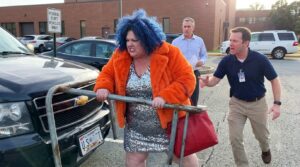
She did not wear the fluorescent-orange jacket that had made her instantly recognizable in the security footage.
Instead, she arrived in a plain navy coat, dark trousers, and comfortable walking shoes.
Her turquoise hair had been replaced by a natural silver-brown shade, worn in a simple shoulder-length style.
She looked like an ordinary visitor.
That was exactly what she wanted.
The previous six months had been uncomfortable.
Patricia had paid the documented property-damage costs and her legal expenses.
She had stepped down from her neighborhood association leadership position after several members expressed concern about the incident.
Her property-management business continued operating, but she had delegated more responsibility to a longtime employee.
For the first time in years, she had fewer opportunities to control other people’s decisions.
At first, the change had made her resentful.
Then it had made her lonely.
Allison still visited, but she no longer tolerated insults disguised as advice.
Michael had begun calling more often after Patricia stopped criticizing every decision he made.
Their relationships had not magically healed.
There were still awkward conversations.
There were still moments when Patricia felt the old impulse to interrupt, demand, or accuse.
Sometimes she succeeded in stopping herself.
Sometimes she failed.
But she had begun recognizing the difference between being respected and being obeyed.
That distinction had once seemed meaningless.
Now it mattered.
At Blackstone, Patricia purchased an ordinary admission ticket and joined a scheduled public tour.
Daniel was not leading it that day.
A younger guide named Sarah explained the facility’s history and safety procedures.
Patricia listened.
She did not interrupt when Sarah reminded visitors to remain behind the barriers.
She did not demand access to the restricted walkway.
When the group reached the observation terrace, Patricia stopped.
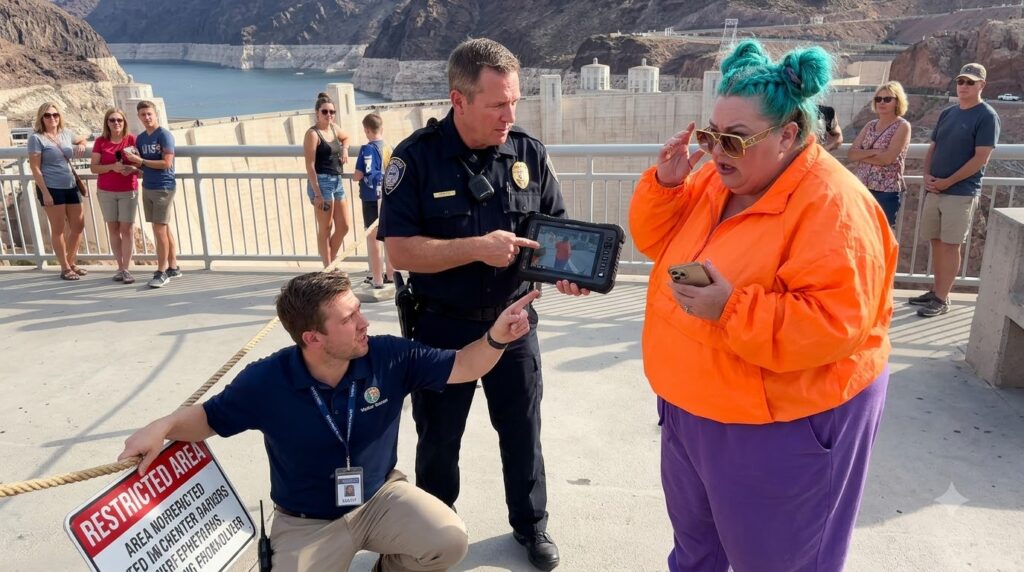
The replacement warning sign stood in the same location.
Its metal frame was clean.
Its base was secure.
Beyond it, the massive dam stretched across the canyon.
Patricia remembered the sound of the original sign striking the concrete.
She remembered Daniel’s shocked expression.
She remembered Marcus turning the security screen toward her.
Most painfully, she remembered the little boy jumping backward.
For months, she had tried to think of that moment as a mistake caused by anger.
Now she understood that anger had not moved her hands.
She had.
Her decisions had consequences.
And those consequences had reached people who had done nothing to deserve them.
After the tour, Patricia approached the visitor-center desk.
She asked whether Daniel Mercer was working.
The employee checked and explained that he was assisting with an educational program.
Patricia nodded.
She did not demand to see him.
Instead, she left a short note.
It thanked him for his professionalism during the incident and acknowledged that he had been treated unfairly.
Then she walked outside.
She had almost reached the parking lot when she heard someone call her name.
Daniel stood near the entrance.
He had received the note.
For a moment, neither spoke.
Patricia looked uncomfortable.
She seemed smaller without the bright clothing and angry gestures.
Daniel did not mistake that appearance for proof of change.
He knew that people could behave politely for a few minutes.
Character revealed itself over time.
Still, he approached her.
Patricia apologized again.
This time, she did not mention the rules she had disliked or the frustration she had felt.
She acknowledged that she had tried to damage his reputation to avoid responsibility for her own actions.
Daniel listened.
Then he told her that the incident had been difficult for him and his family.
Patricia nodded.
She did not defend herself.
Daniel said he appreciated her acknowledgment.
He also told her that he hoped she would treat people differently in the future.
Patricia accepted that.
There was no embrace.
No dramatic reconciliation.
They shook hands.
Then Daniel returned to his work.
Patricia walked to her car.
Before opening the door, she looked back toward the dam.
She had come there six months earlier believing that rules were obstacles placed in her way.
She had returned believing something different.
Some boundaries existed to protect people.
Others existed to protect fairness.
And respect could not be demanded from someone while refusing to offer it in return.
As Patricia drove away, another tour group gathered on the observation terrace.
Parents lifted children to see the enormous spillway.
Retired couples photographed the mountains.
A guide explained how the dam supplied electricity to surrounding communities.
Near the restricted walkway, the warning sign stood quietly in the sunlight.
Most visitors barely noticed it.
They saw the towering concrete structure, the rushing water, and the extraordinary work of generations of engineers.
They did not know what had happened there months earlier.
They did not need to.
The barrier was secure.
The walkway was safe.
And the people who had been wronged had been heard.
That afternoon, Daniel finished his educational program and returned to the terrace.
He stood beside the railing, watching sunlight move across the water.
His phone vibrated.
It was a message from Ruth Collins.
Noah had won a school science competition with a small working model of a hydroelectric generator.
Attached was a photograph of the boy standing proudly beside his project.
He wore the same blue baseball cap.
Daniel smiled.
He showed the picture to Helen, who had come outside to check on the afternoon tours.
They stood together for a moment, looking at the boy’s delighted expression.
Then Daniel slipped the phone into his pocket and returned to work.
Far below, water continued flowing through the turbines.
The dam performed its purpose without applause.
Its barriers protected people who might never understand the dangers beyond them.
And Daniel thought about how much of a decent life depended on that same quiet principle.
Doing what was right, even when nobody was watching.
Telling the truth, even when a lie would be easier.
Protecting someone vulnerable, even when it required confronting someone powerful.
Walter and Elaine had done that.
Ruth had done that.
Marcus and Helen had done that.
And Daniel had done his best to do it, too.
The incident had begun with a woman determined to cross a line because she believed nobody had the right to stop her.
It ended with something far more important than a damaged sign or an embarrassing video.
An innocent man’s name had been cleared.
A frightened child had found his confidence again.
A family had begun rebuilding its relationships.
And a woman who once believed that authority meant getting her own way had finally begun learning that dignity required something else.
The strongest people are not those who can force others to step aside. They are those who know when to stop, when to listen, and when to take responsibility for the harm they have caused.
At Blackstone Dam, the warning sign remained where it belonged.
And this time, everyone walked safely past it.