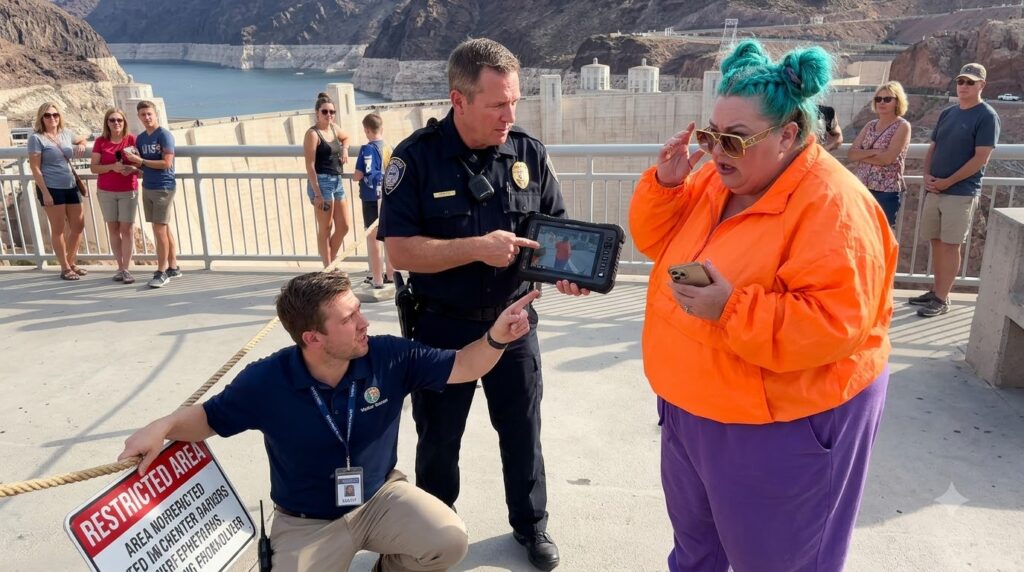
Chapter 7: The Truth Comes Into the Open
The administrative review concluded three weeks after the incident.
By then, the original confrontation had attracted far more attention than anyone at Blackstone Dam wanted.
Daniel had received supportive messages from former students, coworkers, and visitors who remembered his patience.
He had also received cruel comments from people who had seen only the edited video.
The experience had changed how he thought about his work.
He still loved explaining the dam’s engineering.
But he had become more aware of how easily an ordinary moment could be distorted when separated from its context.
Helen Price arranged a meeting with Daniel and Marcus before the facility issued its final internal findings.
The evidence was consistent.
Security footage showed Patricia pushing the warning sign.
Walter’s independent recording confirmed the action.
Multiple witnesses described the same sequence.
Maintenance records documented the resulting damage.
The review found no evidence that Daniel had caused the sign to fall or mistreated Patricia.
Helen informed him that the complaint against him was unsupported.
Daniel felt relief so powerful that he had to sit down.
For weeks, he had carried the uncertainty into every part of his life.
He had wondered whether visitors recognized him.
He had worried whenever his phone rang.
He had struggled to sleep.
Now the official record reflected what had actually happened.
Helen also explained that the property-damage matter had been referred for appropriate follow-up.
The reviewing authorities would determine whether any further action was warranted.
The facility itself would not pretend to make decisions outside its authority.
That mattered to Daniel.
He did not want special treatment.
He wanted a fair process.
A few days later, the facility issued a limited public clarification.
It stated that the employee accused in the widely circulated video had not caused the warning sign to fall and that the incident had been reviewed using surveillance footage and witness accounts.
The statement did not reveal unnecessary personal information about visitors.
It did not publish Noah’s name.
It did not turn the child’s frightening experience into entertainment.
Instead, it corrected the central false accusation.
Brenda published a second correction on her community page.
This time, she placed it prominently.
She acknowledged that her original post had presented an incomplete account.
She explained that independent footage and the facility’s findings contradicted the accusation against Daniel.
She apologized for publishing the misleading material.
The correction did not reach every person who had seen the original video.
Some viewers had already moved on.
Others continued arguing despite the evidence.
But enough people saw it to begin repairing Daniel’s reputation.
Patricia watched the correction from her kitchen.
She felt humiliated.
Her attorney had advised her not to respond publicly.
For once, she followed that advice.
The financial consequences arrived soon afterward.
The property-damage claim required her to address the cost of replacing the sign and repairing the affected area.
Through her attorney, Patricia ultimately agreed to reimburse the documented repair costs as part of resolving the property-damage matter.
She also withdrew her unsupported complaint against Daniel.
No dramatic courtroom confrontation occurred.
No judge delivered a theatrical speech.
The consequences were quieter.
There were invoices.
Written agreements.
Legal fees.
An official record.
And the uncomfortable knowledge that her own actions had created the problem.
But one issue remained unresolved.
Ruth Collins had received no apology.
Neither had Noah.
Patricia had avoided thinking about the boy because his presence made the incident harder to excuse.
The damaged sign could be replaced.
The financial loss could be calculated.
But a frightened child was not a line item on an invoice.
One evening, Allison visited Patricia again.
Their conversation was calmer than before.
Patricia admitted that she had paid for the damage.
Allison asked whether she had apologized to the people involved.
Patricia said the matter had been settled.
Allison shook her head.
She explained that settling a claim and accepting responsibility were not necessarily the same thing.
Patricia looked tired.
For once, she did not argue.
Allison suggested that her mother write a letter.
Not a public statement.
Not a performance for social media.
A private apology that acknowledged what she had done without demanding forgiveness.
Patricia resisted at first.
She said she would not know what to write.
Allison told her to begin with the truth.
That night, Patricia sat at her kitchen table with a blank sheet of paper.
She wrote Daniel’s name.
Then Ruth’s.
Then she stopped.
For nearly an hour, she stared at the page.
She had spent years believing that apologies weakened a person’s authority.
Now she faced a harder question.
What if refusing to apologize had weakened everything else?