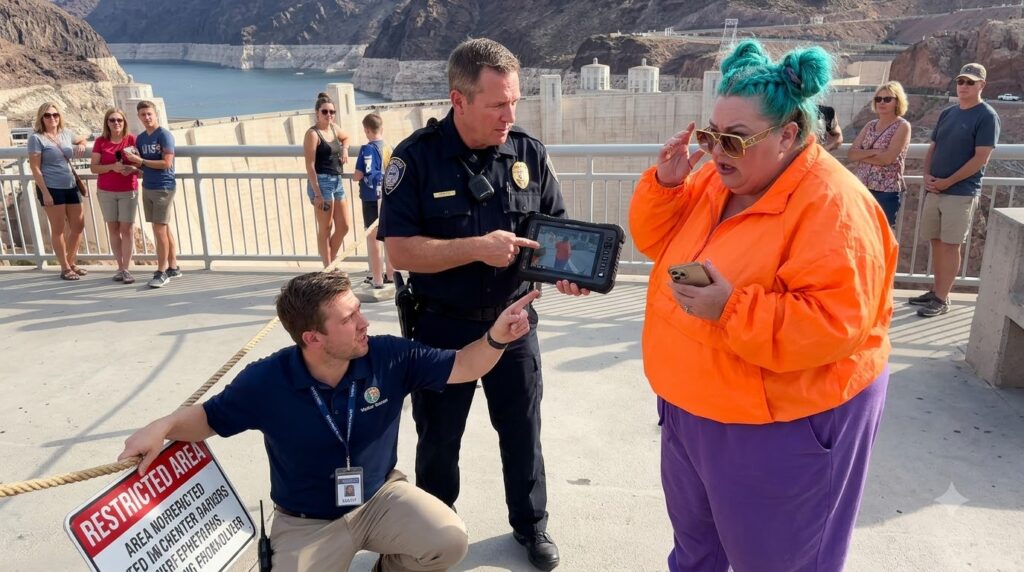
Chapter 5: The Complaint That Changed Everything
Patricia’s complaint arrived at the dam’s administrative office the next morning.
It was six pages long.
She alleged employee misconduct, discrimination against visitors, improper surveillance, intimidation, and deliberate damage to federal property.
She demanded a written apology.
She demanded that Daniel Mercer be removed from public-facing duties.
She also demanded compensation for what she described as emotional distress.
Helen Price read the document carefully.
Then she read it again.
Patricia had included a detailed timeline.
That timeline created a problem.
In her complaint, Patricia claimed Daniel had knocked over the warning sign before she began recording.
But the facility’s surveillance system showed that Daniel had been standing several feet away when Patricia pushed it.
The contradiction was not a minor difference in perspective.
It concerned the central event.
Helen forwarded the complaint to the appropriate facility administrators and preservation staff.
She also ensured that the original surveillance footage, incident reports, maintenance photographs, and witness statements were retained.
The matter was no longer simply a dispute between a visitor and an employee.
It involved damaged government property, a potential visitor-safety hazard, and written allegations contradicted by available evidence.
Helen refused to rush the process.
She knew that fairness required more than believing the person who appeared most sympathetic.
It required examining the facts.
Daniel, meanwhile, continued working.
Some coworkers encouraged him to ignore the online controversy.
Others suggested he should speak publicly.
Daniel appreciated their concern but found the uncertainty exhausting.
At home, his mother Margaret had already seen the video.
A neighbor had shown it to her during a grocery-store visit.
Margaret called Daniel that evening.
She did not ask whether he had damaged the sign.
She knew her son.
Instead, she asked whether he was eating properly.
Daniel laughed despite himself.
His mother had always approached difficult situations through ordinary acts of care.
When his father lost his job decades earlier, Margaret had kept the household steady with careful budgeting and quiet determination.
When Daniel struggled through his first year of teaching, she had reminded him that one difficult student did not define an entire classroom.
Now she listened as he explained what had happened.
He admitted that the accusations frightened him.
He worried that strangers might believe Patricia.
He worried that the controversy could affect his career.
Margaret let him finish.
Then she reminded him of something his father used to say.
A person’s character was built through years of ordinary choices, not a single stranger’s opinion.
Daniel sat quietly after the call.
He wanted to believe her.
But the next morning brought another complication.
A local blogger contacted the visitor center seeking comment.
The blogger had seen Patricia’s complaint and wanted to know whether the facility was investigating Daniel.
Helen declined to discuss personnel matters or release unverified allegations.
She confirmed only that an incident had occurred and that appropriate procedures were being followed.
The blogger published a short article.
Although the article avoided declaring anyone guilty, it repeated several of Patricia’s accusations.
The controversy grew.
Daniel’s name appeared in more comments.
Patricia celebrated the attention.
She believed that enough public pressure would eventually force the dam to apologize.
But she had overlooked a practical detail.
The warning sign had not been inexpensive.
It was a heavy-duty, weather-resistant assembly designed for a high-traffic federal facility.
Its damaged frame required replacement.
Its base needed inspection.
The concrete surface beneath it had been scraped, and maintenance personnel had temporarily closed a portion of the terrace while they assessed the area.
The incident had created costs.
More importantly, it had interrupted normal visitor operations.
Helen received the maintenance report that afternoon.
The sign’s metal bracket was bent beyond safe reuse.
The replacement assembly, installation labor, and related repairs were estimated at several thousand dollars.
Helen forwarded the documentation to the reviewing office.
Patricia had insisted that the sign was a trivial object.
The maintenance report demonstrated otherwise.
Then Marcus Reed discovered another important detail.
While reviewing the surveillance footage, he noticed that Patricia had approached the restricted walkway twice before the confrontation.
During the first approach, she had tested the rope barrier with her hand.
Daniel had politely redirected her.
She walked away.
Several minutes later, she returned.
This time, she pushed the warning sign.
The earlier footage mattered because it showed Patricia had received a clear explanation before the damage occurred.
She had not accidentally wandered into an unfamiliar area.
She had been told where visitors were permitted to stand.
She had chosen to return anyway.
Marcus preserved the additional footage.
The following day, Patricia received a formal request to provide further information about the incident.
She read the letter in her kitchen.
For the first time, the matter felt less like an argument she could win through persistence.
It felt like a process she could not control.
And when she reached the section concerning potential responsibility for property damage, her hands began to shake.