Chapter 1: The Sound of Metal Against Metal
The first sound was a violent metallic crash that echoed across the parking lot.
Then came the scraping.
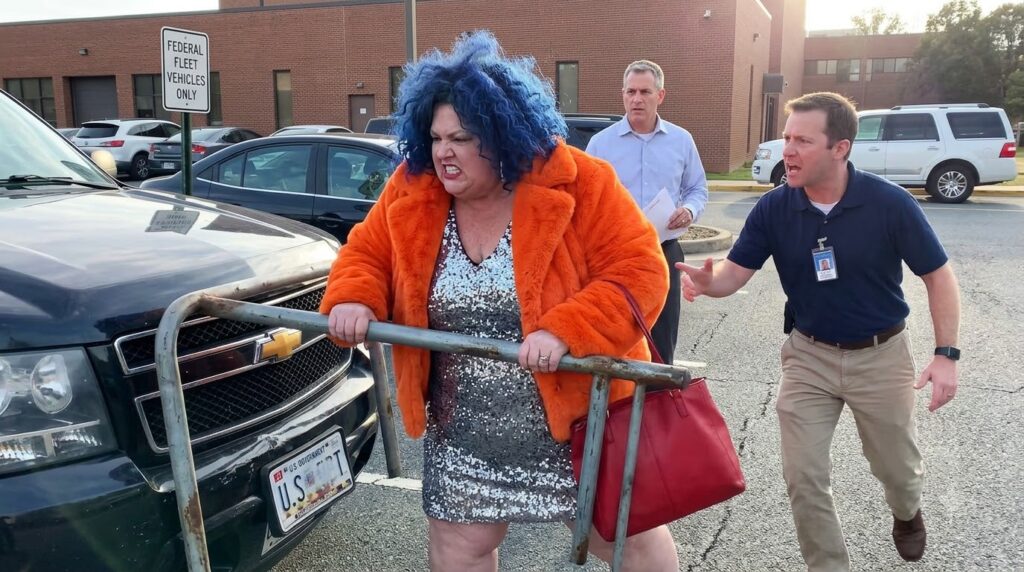
A heavy steel parking barrier dragged across the front fender of a dark government SUV, carving a long silver wound through its polished paint. The front license plate bent outward with a sharp crack, its mounting bracket hanging loose.
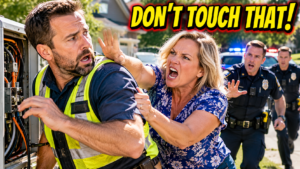
Behind the barrier stood a woman who looked as though she had dressed for a celebration and arrived prepared for war.
Her name was Patricia Whitmore.
At fifty-nine, Patricia was the president of the Willow Creek Estates Homeowners Association, an upscale residential community outside Annapolis, Maryland. She was an exceptionally large woman with a commanding physical presence, thick arms, and a broad frame that made her difficult to overlook.
Her wild cobalt-blue curls bounced above a sparkling silver dress. A bright-orange faux-fur jacket hung over her shoulders, and an enormous red designer handbag swung against her hip.
She had spent eleven years making sure everyone in Willow Creek knew who was in charge.
And today, she intended to teach the federal government the same lesson.
With both hands gripping the steel barrier, Patricia planted her feet and shoved again.
KRRRANG!
The barrier slammed against the SUV’s damaged bumper.
“Get your government junk out of MY spot!”
Forty-two-year-old Daniel Mercer heard the collision from the entrance of the Chesapeake Federal Operations Center.
He had worked at the Maryland facility for nearly seventeen years, managing transportation schedules, government fleet vehicles, and the daily logistics that kept several federal offices functioning.
He was accustomed to difficult visitors.
He was not accustomed to watching someone deliberately damage a government vehicle in broad daylight.
Daniel hurried toward the parking area, his navy polo shirt fluttering in the afternoon breeze.
“Ma’am! Stop!”
Patricia barely glanced at him.
Instead, she leaned into the barrier once more.
The metal frame shifted against the already damaged grille.
Daniel grabbed the opposite end and pulled it away.
“You just damaged a federal vehicle!”
Patricia released the barrier and slammed her open palm against the SUV’s hood.
The impact rang across the lot.
“That vehicle is parked where it doesn’t belong!”
Daniel stared at her.
Behind Patricia stood a clearly marked government fleet charging station. A blue-and-white sign read:
FEDERAL FLEET VEHICLES ONLY
The SUV was parked inside the designated government parking area, beside the charging equipment.
There was no ambiguity about who controlled the space.
“You’re on federal property,” Daniel said, struggling to keep his voice steady. “You have no authority to move these vehicles.”
Patricia stepped toward him.
Her orange jacket filled his view.
“I run this neighborhood! Nobody moves until I say so!”
Daniel glanced toward the security cameras mounted above the building entrance.
He knew the entire confrontation was being recorded.
But what worried him more was the oversized white luxury SUV parked sideways across the driveway exit.
It belonged to Patricia.
And it was blocking the only unobstructed vehicle route out of that section of the lot.
A second federal employee appeared near the building.
His name was Robert Hayes, forty-eight, a senior administrative supervisor with short graying hair and a reputation for remaining calm under pressure.
He carried a folder containing the day’s vehicle movement orders.
Robert took one look at the damaged SUV, the displaced barrier, and Patricia’s white vehicle.
Then he pointed toward the blocked driveway.
“Daniel,” he said quietly, “we have a problem.”
Patricia turned.
Her expression hardened.
“Don’t you dare tell me where to park.”
Robert did not argue.
He simply looked at his watch.
A government transport vehicle was scheduled to leave that parking area in less than fifteen minutes.
Its departure was connected to a time-sensitive delivery of equipment to another federal facility.
And Patricia’s SUV was directly in its path.
Daniel looked back at the woman who had just damaged government property.
For the first time, he realized this was no longer merely a parking dispute.
It was an operational obstruction.
“Mrs. Whitmore,” he said, “you need to move your vehicle. Now.”
Patricia folded her arms.
“Make me.”
She had no idea that those two words would begin the collapse of everything she had spent eleven years building.