
CHAPTER 2: THE BOTTLENECK
“Your folder doesn’t overrule a terminal red-flag, Sergeant,” Miller said. The stylus in his right hand stopped clicking against the keys. He pointed the plastic tip directly at Ranger’s chest harness, tapping it against the top of the glass divider with a dull, rhythmic snap. “I have a data mismatch on Lane Two. Until that clears, your animal belongs to civil screening.”
Garrett Vance did not shift his boots. The weight of his entire frame remained balanced through the padded underarm cradles of his crutches, his palms steady against the coarse rubber grips. In his left trouser pocket, his fingers locked onto the brass challenge coin, his thumbnail tracking the raised, serrated edge of the unit crest. The pain in his right tibia was no longer a dull ache; it had become a sharp, structural pulse, timed perfectly to the flickering of the white fluorescent tube directly above the metal detector frame.
“The mismatch is a routing code, sir,” Vance said. His voice remained flat, a low baritone that stayed beneath the high-pitched din of rolling luggage and crying children three lines over. “It’s a standard transit marker for medical evacuations coming out of the Ramstein staging hub. If you run the Department of Defense logistics code on page three, the system will bypass the local civil queue.”
“I don’t run military codes,” Miller replied. He stepped out from behind the safety glass, his boots clicking sharply on the polished linoleum. He was close enough now that Vance could smell the sour residue of cold airport coffee and the distinct, burnt-sugar scent of his over-starched collar. Miller’s eyes narrowed as they swept across Vance’s camouflage jacket, pausing on the scuffed Velcro where his name tape was stitched. “And I don’t take instruction from people trying to push past a federal line because they have a dog and a patch on their arm.”
Behind them, the bottleneck tightened. The family of four had stopped moving entirely, their heavy nylon bags slumping against the grey security stanchions. A man in a dark business suit three paces back checked his watch, his tongue clicking against his teeth with an unmistakable, sharp impatience that rippled through the rest of the queue. The collective friction of fifty travelers, trapped between a dead escalator and a static gate, settled over the lane like heavy dust.
Vance watched Miller’s right hand. The supervisor’s fingers were twitching toward his belt, where a heavy plastic radio casing sat hooked to his hip. On the side of Miller’s plastic stylus, Vance noticed a small, irregular sequence of hand-scratched letters—X-44—marring the factory print. It wasn’t standard TSA issue; it was a military logistics marker, the kind used by cargo handlers to identify transient equipment bags in a loading zone.
“The lane is closing,” Miller announced to the queue, his voice rising to capture the junior screeners on Lane Three. “Everyone in this line, back up and move to the left. We have a non-compliant passenger delaying the portal.”
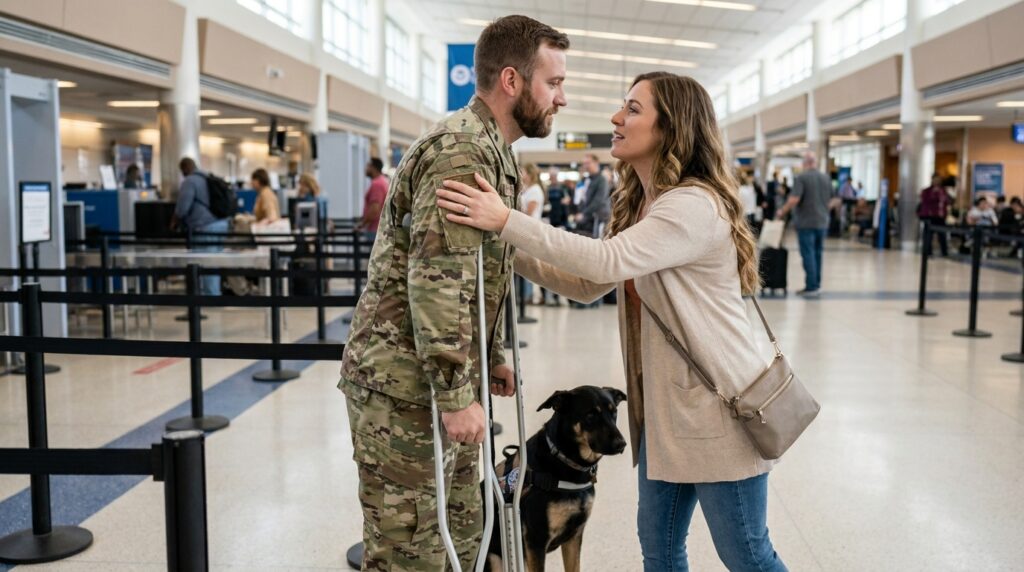
A low murmur broke out among the holiday travelers. A woman near the baggage rollers muttered something about missing her connection to Denver, her eyes darting angrily toward Ranger. The service dog remained completely stationary, his tail tucked clean against his hocks, his jaw closed as he tracked the shifting weight of Miller’s boots. The animal’s ribs expanded and contracted against Vance’s shin—a steady, silent mechanism of pure discipline that contrasted sharply with the chaotic energy of the terminal.
“I am compliant, Supervisor,” Vance said, his left forearm tightening against the horizontal bar of his crutch until the metal frame creaked against his sleeve. “I have presented my ID. I have presented my transit orders. I am standing exactly where your officer directed me to stand.”
“You’re refusing a separation directive,” Miller countered. He took another step forward, entering Vance’s three-foot perimeter. His hand came off his radio and hovered two inches above Ranger’s leather handle. “That makes you an active obstruction. If I put my hands on this leash, Sergeant, you’re going to step through that frame alone, or you’re going to spend your homecoming in a local holding cell.”
The air in the lane went entirely dead. The junior screener on Lane Three stopped sliding grey plastic bins, her hands freezing on the edge of a roller track. The small brass coin in Vance’s pocket felt ice-cold against his thumb. He could see the slight tremor in Miller’s jaw—not from fear, but from the intoxicating rush of minor institutional power being challenged in front of a captive audience. Miller wasn’t looking at a wounded soldier; he was looking at a metric that was ruining his afternoon processing average.
Vance shifted his weight by a fraction of an inch, his left shoulder dropping slightly to brace the crutch against the floor. He didn’t pull back. He watched the precise angle of Miller’s fingers as they began to descend toward Ranger’s harness. The cold geometry of the checkpoint had narrowed down to the space of a single human breath, and Vance knew exactly how much resistance it would take to break the threshold.








