
CHAPTER 7: THE UNBROKEN PACT
“What do you mean, the crates never existed?” Vance’s voice shook, the copper grounding rod slipping slightly against his sweating palm. He stepped away from the terminal, the yellow light catching the hard, unmoving lines of his jaw. “The records Miller left detailed structural manifests. He had numbers, Arthur. Serial numbers for equipment that went dark.”
Arthur looked at the screen, where the amber indicator CRITICAL SYSTEM PURGE FAILURE cast a pale, geometric shadow across the dust-covered desk. The air was thin, each breath requiring a conscious, calculated effort that made his ribs ache under his faded grey jacket.
“They were numbers for empty casings, son,” Arthur said softly. He reached down and scooped the torn piece of canvas-bound ledger from the floorboards, carefully folding the fraying fibers back over the split spine. He treated it like a piece of broken glass that could still hold water. “Your father, Miller, and the others didn’t lose any supplies. There was an engineering defect in the underground fuel distribution ring. A valve cracked beneath the concrete floor of the main hangar. It had been leaking thousands of gallons into the shale below the base for six months before that fire ever started.”
Vance’s hand dropped entirely, the copper rod striking the floor with a hollow, metallic ring that drifted away down the long concrete tunnels. “A leak.”
“An unrecorded structural disaster,” Arthur explained, his voice rich with the quiet, crushing empathy of a man who had carried the structural secrets of the base like a second skin. “If the inspectors found out the ground under the runway was soaked in volatile fuel, the entire installation would have been closed, and the logistics division—the kids who signed the weekly facility safety logs—would have faced criminal negligence charges. The command structure didn’t burn the depot to hide a theft, Vance. They burned it because an explosion was the only way to sanitize the ground without revealing the failure of the infrastructure.”
He moved toward the younger man, his sneakers dragging slightly over the cross-hatched pattern of the footprint in the dust. The world seemed to slow to a crawl, the low, rhythmic groan of the locked ventilation system sounding less like an alarm and more like a heartbeat.
“Your father didn’t run from his duty,” Arthur continued, putting his calloused hand gently on Vance’s shoulder. The rough fabric of his sleeve met the soft, unblemished skin of the young captain’s arm, a bridge built over forty years of institutional dust. “He stayed behind with me and Miller to manually bleed the pressure lines so the fire wouldn’t track back to the primary base reservoirs. We made a choice. We let them call it a supply error. We let them call it a logistics failure. We took the blame for a phantom theft because a missing crate doesn’t put twenty-year-old clerks in a federal penitentiary.”
Vance looked up, his eyes glassy under the amber glow of the terminal. The rigid posture he had worn during the ceremony was entirely gone, his shoulders dropping into the same heavy, defensive curve that Arthur remembered his father wearing on that midnight bus four decades ago.
“He never told me,” Vance whispered. “He let me think he was just an ordinary worker who survived an ordinary accident.”
“He was protecting you from the weight of it,” Arthur said. He turned back to the terminal, his fingers finding the triangular head of Miller’s old supervisor key. With one slow, deliberate pull, he disengaged the key from the slot. The screen flickered once, the pale green phosphor fading into an empty black mirror that reflected only the faint outline of two men standing together in the dark. “Just like I spent forty years protecting this base by wearing this grey jacket. You don’t fix the machines because you want a medal, Captain. You fix them so the people living over them don’t have to look at the cracks in the floor.”
The red emergency lamps in the upper corridor suddenly stopped their rotating sweep, replaced by the steady, white glare of the auxiliary backup generators kicking in. The low-pressure whine of the alarm ceased, leaving only the profound, dripping silence of the sub-basement.
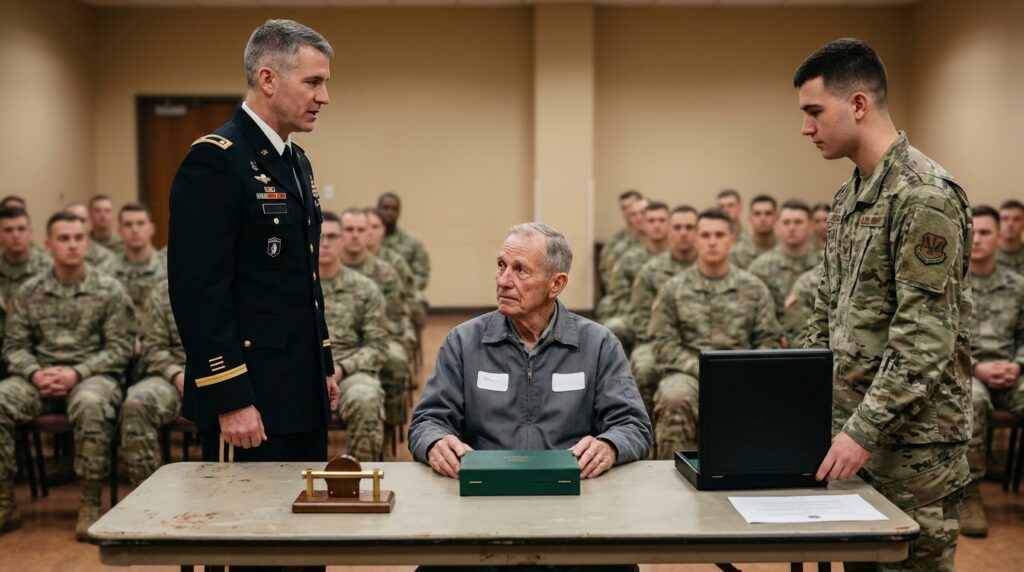
Arthur slid the green presentation box into Vance’s hands, his thumbs lingering for one last second on the polished brass corner. The keepsake device was empty now, its secrets stripped away down to the raw wood and the faded velvet lining.
“Take it,” Arthur murmured, his voice transactional but soft, a final settlement of accounts. “The ceremony is over. Go back upstairs and tell the commander that the lower levels are secure. Tell them the old infrastructure held.”
Vance looked down at the box, his fingers tracing the small, deep pit near the hinge where his father’s old crew had once dropped it. He didn’t ask another question. He didn’t need to. The subtext between them was clear, an unbroken pact passed from a dead supervisor to an old civilian worker, and finally to the officer who would keep the ledger clean for the next generation.
Arthur didn’t wait for him to move. He turned toward the service elevator shaft, his hands deep within the pockets of his frayed jacket, his small, quiet steps carrying him back into the shadows of the maintenance corridors where he could fade into the background once more.








