
CHAPTER 5: THE VACUUM CHAMBER
The air in the utility shaft didn’t vanish all at once; it thinned with a steady, high-pitched whistle that sounded like steam escaping a cracked boiler. With every ten steps Arthur took down the narrow iron rungs, the atmospheric pressure dropped a fraction of a millibar, pulling the moisture from his tongue and leaving the taste of old zinc and scorched copper behind.
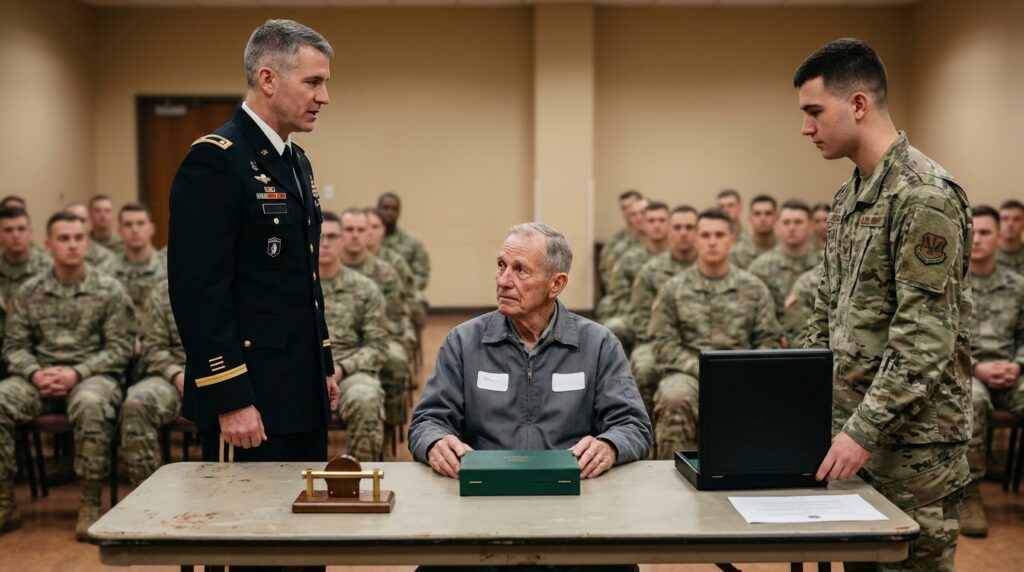
His grey zip-front work jacket pressed tight against his chest, holding the green keepsake box flat against his ribs. His ribs felt brittle now, a cage of old bones resisting the massive suction of the primary intake fans three levels below. Above him, the grated hatch he had bypassed remained a square of dull, strobing red; below him, there was only the desaturated gray of unpainted structural concrete.
“Think, Artie,” he muttered to himself, his voice coming out as a flat, reedy whisper that the thinning atmosphere immediately swallowed. “The intake dampers in Sector 4 always leaked at the seals. There’s twenty minutes of breathable air in the dead space behind the main transformer if the pressure valves hold.”
His sneakers hit the bottom landing with a dull, rubbery thud that vibrated through his knee joints. The floor here was cold, coated in a fine, undisturbed silt of pulverized stone and disintegrated insulation that hadn’t seen a broom since the Berlin Wall was still standing. A lone emergency lantern on the bulkhead flickered with a dying, amber pulse—not connected to the modern base security grid, but tied to an ancient lead-acid battery bank hidden in the crawlspaces.
He reached into his pocket, his fingers tracking the stiff edge of the cut NCO card. The six-digit maintenance codes on the reverse side weren’t just inventory tags; they were a physical coordinates map for the pneumatic control lines.
To his left, a massive steel conduit pipe ran along the ceiling, stenciled with the faded lettering: SYS-ANX-4. He placed his palm against the iron surface. The metal was dead cold, but he could feel the faint, rhythmic shuddering of a hydraulic piston deep within the wall—the mechanical hand of the automation system systematically sealing the heavy fire doors of Vault 4.
The system wasn’t hunting him. It didn’t know he was there. It was simply executing an old piece of logic, a forty-year-old protocol written to ensure that if the Kilo-Pier incident ever leaked into the lower sub-levels, the evidence would be quarantined until the air ran out and the ink on the documents turned to dust.
A heavy clack-whump echoed through the corridor ahead.
Arthur froze, his hand dropping to the brass latch of the keepsake box. The sound hadn’t come from the automated valves. It was too uneven, too heavy—the unmistakable drag of a physical weight being hauled across a steel deck plate.
He moved forward, his back scraped against the rough concrete wall, his grey sleeve picking up white streaks of old lime wash. The corridor turned a sharp forty-five degrees, opening into the secondary transformer vault. There, under the sickly yellow glow of a secondary circuit board, sat the automated control terminal for the lower tier.
A small, matte-black console had been spliced directly into the ancient terminal housing, its modern fiber-optic cables contrasting sharply against the thick, cloth-insulated wiring of the original structure. In the center of the panel, plugged directly into the mechanical override slot, was a heavy brass key with a triangular head—the exact shape of the supervisor keys Master Sergeant Miller had carried on his heavy ring until the day he died.
The terminal screen was scrolling through lines of pale green phosphor text, listing the sealed storage compartments one by one. Each entry ended with the same three-letter designation: PRG. Purged.
Arthur’s chest tightened, a sharp pain blooming behind his breastbone as his lungs struggled to find oxygen in the thinning air. He stepped toward the console, his hand reaching for the triangular key, when a small, low-pressure hiss released from the maintenance duct behind him.
The air didn’t blow out; it sucked inward. The canvas-bound logbook slipped from his fingers, its pages turning frantically in the sudden draft, revealing the hand-inked signature of Captain Miller over and over until the paper caught against the edge of the terminal framework, tearing a clean white strip through the center of the old ledger.
Arthur didn’t look at the paper. He looked at the base of the terminal, where a single, fresh footprint had cleared a circle in the forty years of dust—a small, narrow print from a standard civilian utility boot, identical to the ones Arthur wore every single morning.








