
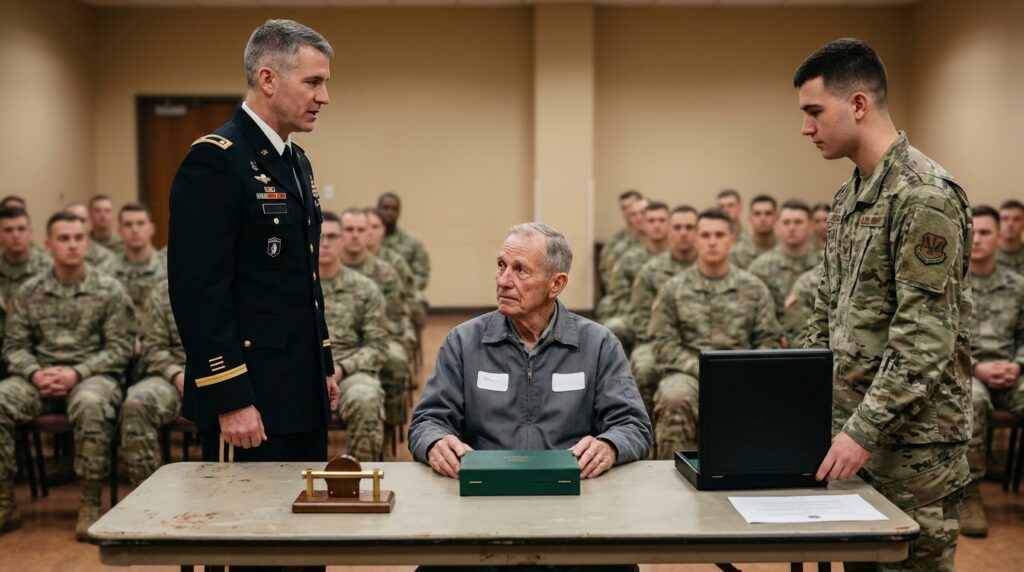
CHAPTER 3: THE SHADOW ARCHIVE
“You shouldn’t have that,” the presenter said. The formal composure that had carried him through the ceremony in the auditorium didn’t shatter, but it frayed at the margins. He took a single step closer to the laminate table, his boots clicking sharply against the damp concrete. The sharp light from the flickering tube overhead highlighted the slight dampness at his temples. “Arthur, give me the card.”
“I asked you a question, Captain,” Arthur said. He didn’t lower his hand. His fingers, stiff from decades of working the base’s oldest machinery, remained locked around the fragment of paper. The faded red ink of the NCO stripes looked like dried blood in the sickly yellow illumination of the breakroom. “This card didn’t come from a capital archive. The central repository doesn’t hold personal property from an officer who died in a structural fire forty years ago. This was saved. Locally.”
The presenter let out a slow, measured breath, the starched fabric of his shirt tightening across his chest. He looked at the old green box, then back at Arthur’s eyes, finding the hard, unyielding baseline of a man who had survived by noticing every loose bolt in the institution.
“It was Master Sergeant Miller’s personal locker,” the presenter said, his voice dropping into a quiet, transactional register. “Your old supervisor. Before he passed away last winter, he didn’t clear his station. He left a locked green footlocker in the maintenance annex under a manifest for obsolete plumbing fixtures. He knew the logistics division wouldn’t audit a pile of rusted pipes.”
Arthur felt a dull, familiar ache flare in his shoulder. Miller. The man who had given him the grey zip-front work jacket on his first day as a civilian laborer. The man who had told him to keep his head down and his mouth shut whenever the officers from the upper tiers came down to check the fuel lines.
“He left a paper trail,” Arthur murmured, the realization settling into his chest like cold water. “He didn’t just leave the box. He left the ledger.”
“He left everything,” the presenter confirmed. He reached inside his dress uniform jacket, drawing out a small, pocket-sized logbook with a frayed canvas cover. The edges were soft, rounded by years of friction against a utility belt. “He tracked every shipment that came through the Kilo-Pier airfield during the month of the incident. He tracked the names of the three logistics clerks who were assigned to the fuel depot—the ones who disappeared from the morning rosters without a transfer order.”
Arthur’s thumb tightened against the card in his palm. The world was narrowing down to the hum of the generator behind the wall and the smell of old paper. “They didn’t disappear, Captain. They were sent home. On a midnight bus with clean discharges and enough severance to buy their silence.”
“Because of an operational failure?” the presenter asked, his eyes leaning hard into Arthur’s face. He was hunting for the narrative that made sense to a modern officer—a story of a cover-up, of institutional negligence that could be corrected with a public plaque and a formal apology. “Miller’s notes say the fuel lines were compromised before the fire started. He wrote that the command structure ordered the manifests destroyed to hide a multi-million-dollar supply discrepancy.”
Arthur let out a low, humorless sound that was half-cough, half-laugh. He looked down at the six-digit maintenance codes written on the back of the cut ID card. Layer 1. The decoy was beautiful. It was exactly what a young, idealistic investigator would look for—a story of greed, of bureaucrats burning a warehouse to cover a broken budget. It was a truth that could be managed. It was a secret that had a category in the regulations.
“Is that what you think happened?” Arthur asked, his voice softening into a guarded, melancholic vulnerability. “You think we burned the Kilo-Pier depot to hide a deficit in the logistics ledger?”
“The documents point to it, Arthur. The paper trail Miller left leads directly to Vault 4 beneath the old administration building. The inventory numbers on the back of that card match the sealed storage crates that were moved the night before the fire.” The presenter reached out, his hand open, waiting for the fragment of paper. “If we open that vault, we can clear your name completely. We can show the whole base that you weren’t a clerk who ran from a fire—you were the man who saved the institutional integrity of this command.”
“You don’t know what you’re asking for,” Arthur said softly. He looked at the presenter’s immaculate dark dress uniform, the bright silver badges that hadn’t ever been scratched by the gravel of a real deployment. The presenter believed that the light could heal anything. He believed that if you brought a secret out into the sun, the rot would stop.
“I’m trying to give you your life back, Arthur,” the presenter said, his voice rising slightly, carrying the heavy weight of a moral obligation that was becoming a burden. “Forty years in a grey jacket. Wiping oil off machines that should have been decommissioned before I was born. You paid the price for their mistake.”
“We all paid,” Arthur said. He turned his back to the presenter, his eyes fixed on the dripping sink. The small, rhythmic clink of the water felt like a countdown. He knew what was in Vault 4. He knew why Miller had kept the card hidden in the false bottom of the box rather than using it to clear his own conscience before he died. The decoy secret—the missing supply crates, the financial fraud—was a shield. It was a protective wall built to keep people from looking at the second layer. The layer that didn’t have any paper left to track it.
He slid the card back into his pocket, his hand remaining inside the fabric, his fingers feeling the frayed lining where the stitches had given way. “The codes don’t open a supply vault, Captain. They open a grave.”
Before the presenter could answer, the red emergency light above the breakroom door flared to life, its silent, rotating beam casting long, bloody arcs across the yellowing laminate of the walls. A low, rhythmic horn began to sound from the upper corridor—the base security override.
The presenter’s hand went instantly to the radio unit clipped to his formal belt, his posture snapping back into the rigid lines of an active officer. “This is Captain Vance. What’s the status on the lower tier?”
The radio sputtered, a blast of static filling the small room before a frantic voice broke through the noise. “Sir, we have an unauthorized breach in the old administration annex. Someone used a maintenance override code on the old service elevator. They’re moving toward the sealed vaults.”
Arthur didn’t move. He looked down at the green presentation box on the table, the polished brass reflecting the rotating red light of the alarm. The past wasn’t waiting for the presenter’s archive to finish opening. It was already moving in the dark.








