
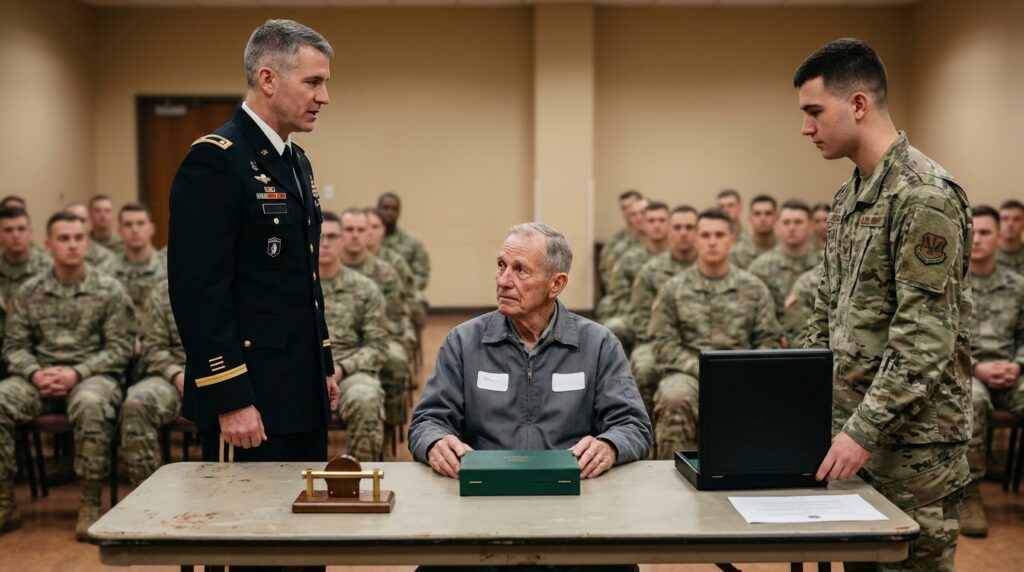
CHAPTER 6: THE GHOST AT THE WHEEL
The footprint in the silt didn’t belong to a phantom. It was sharp around the heel, the distinct cross-hatched pattern of standard-issue civilian work boots pressing deep into forty years of accumulated dust. Arthur looked down at his own feet. The wear on his own left sole was slightly heavier at the arch, a carbon copy of the indentation staring back at him beneath the flickering amber light of the terminal.
“Miller,” Arthur murmured, the name catching in his throat like broken glass. But Miller was dead. He had sat in the front row of Miller’s small, unpretentious funeral just eight months ago, watching the flag get folded into a tight, crisp triangle by two kids who didn’t even know how to march properly.
A shadow shifted at the far edge of the transformer bank. It wasn’t the fast, aggressive silhouette of an intruder fleeing a crime scene. It was slow, heavy, moving with the rhythmic, favoring hitch of a bad right knee—the exact stride of a man who had spent forty years walking the hard concrete corridors of the lower maintenance tiers.
“You always were too smart for your own good, Artie,” a voice rasped from the darkness behind the coolant lines.
The voice didn’t belong to a ghost, either. It belonged to the presenter.
Captain Vance stepped out from behind the heavy steel frame of the primary transformer, his immaculate dark uniform jacket now discarded, hanging loosely from an iron pipe nearby. He wore a simple, faded grey undershirt, his shoulders bowed, his posture stripped entirely of the rigid, institutional authority he had displayed on the auditorium stage. In his right hand, he held a heavy copper grounding rod, its tip coated in a dark, greasy smudge where he had manually shorted out the electronic logic gates of the security panel.
“You,” Arthur said, his hand tightening around the green presentation box until the brass corner bit deep into his calloused palm. “You used Miller’s key.”
“Miller gave it to my father thirty years ago, Arthur,” Vance said, his voice dropping into a soft, melancholic resonance that filled the narrow space between the concrete pillars. He didn’t look like a predator; he looked like a man carrying an old heirloom that had grown too heavy to hold. He pointed the copper rod toward the terminal screen, where the pale green phosphor continued its relentless scroll. PRG… PRG… PRG. “My father was one of those three logistics clerks you sent away on that midnight bus.”
The air in the room seemed to drop another three degrees. Arthur’s chest burned, the lack of oxygen making his vision fray at the margins, turning the yellow light into a soft, vibrating blur. The shared burden of the past wasn’t a secret held by dead men; it was a living cord tied around the neck of the next generation.
“Your father was a good kid,” Arthur whispered, his voice sparse, guarded with forty years of protective silence. “He had a family back in Ohio. If his name had stayed on those cargo manifests after the fuel depot went up, the command would have broken him. They were looking for a scapegoat to cover the structural failure of the main line.”
“I know,” Vance said, taking a step closer, his utility boots crunching softly on the grit. The desaturated gray of the basement walls seemed to close in around them, casting long, heavy shadows that met at the base of the terminal. “He spent the rest of his life waiting for the other shoe to drop. Every time a military vehicle drove past our house, his hands would shake. He died believing he was a thief because he thought he ran from a fire to hide a budget deficit.”
“He didn’t run,” Arthur said, the subtext heavy with a deep, aching empathy. He reached into his pocket and pulled out the cut NCO card, holding it out between them like a shield. “We cut the cards to prove we were all in it together. Me, Miller, your father, and the other two. We burned the manifests because the manifests were the only thing keeping the upper echelons from blaming the crew for a faulty valve the base engineers refused to fix.”
“Then why open the vault now?” Vance’s voice cracked, the cool veneer of the investigating officer completely gone, replaced by the raw pain of a son trying to clean a stained legacy. “Why leave the logbook for me to find? Why let me build this whole ceremony just to drag you into the light?”
“Because Miller didn’t think you’d come looking for revenge,” Arthur said softly, his finger giving the card one steadying tap before lowering his hand. “He thought you’d look for the truth. But you didn’t look deep enough, son. You stopped at the first layer. You thought you could open Vault 4, show the missing crates, and prove your father was innocent of fraud.”
“He was innocent,” Vance insisted, his knuckles turning white around the copper rod.
“There are no crates in Vault 4, Captain,” Arthur said, his voice dropping into an absolute, chilling stillness that cut through the low whine of the secondary purge fans. “The crates never existed. The supply deficit was a lie we invented to give the investigators something simple to find. If they thought it was a robbery, they stopped looking for the real failure.”
The terminal behind them gave a long, continuous chime. The green text stopped scrolling. A single, amber notification flashed in the center of the phosphor screen: CRITICAL SYSTEM PURGE FAILURE: SECTOR 4 MANIFESTS QUARANTINED.
The override hadn’t destroyed the records. It had locked them into an automated loop, trapped between an ancient mechanical lever and a modern fiber-optic cable. The decoy secret had broken under the weight of Vance’s intervention, leaving both men standing on the precipice of a much deeper, colder dark.








