
CHAPTER 2: FRAYING ARMOR
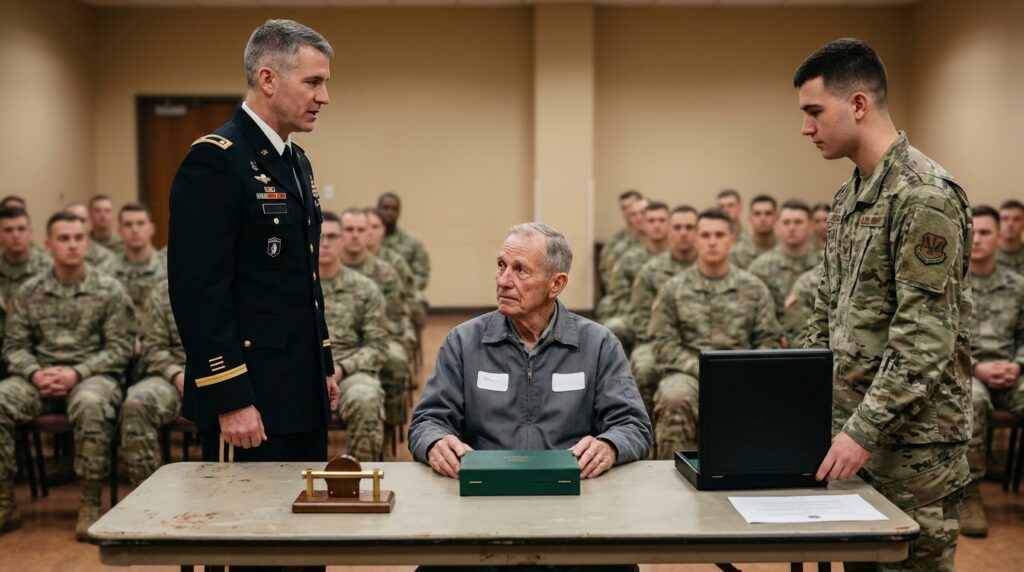
The edge of the cardstock was stiff, a tiny sliver of rigid white slicing against the meat of Arthur’s thumb. He didn’t pull his hand away. To the two hundred service members watching from the dim tiers of the auditorium, he was merely lingering over the brass box, a weathered man caught in the heavy current of old memories. Only the presenter, standing close enough to catch the sudden, rhythmic hitch in Arthur’s breathing, noticed the slight shift in the old man’s posture.
Arthur’s thumb rubbed the frayed velvet lining back just a millimeter more. The faded red stripes of a non-commissioned officer’s ID card peered out from the false bottom. And there, written in the unmistakable, left-leaning cursive of Captain Miller—a man whose lungs had supposedly filled with ash at the Kilo-Pier airfield forty years ago—was a signature that looked as fresh as if the ink had dried yesterday.
“Arthur?” the presenter murmured, the voice low, meant only for the square meter of space around the table. The immaculate dark wool of his dress uniform brushed against the edge of the table as he leaned in. “Is there something else?”
Arthur snapped his fingers back, his hand retreating into the deep, grease-stained pocket of his grey zip-front work jacket. The fabric felt thin now, the fraying edges around the cuffs scratching his wrists like wire brush. “No,” Arthur lied, his voice a dry scraping sound. “Just… the brass. It’s colder than I remember.”
The presenter studied him, the sharp lines around his eyes tightening with a quiet, analytical scrutiny. He didn’t look like a man who believed in ghosts, but he looked like a man who knew how to read a ledger. He nodded once, a brief, functional movement, and turned back to the crowd to signal the conclusion of the formal presentation.
The rows of young service members rose in unison, a synchronized thunder of starched fabric and heavy leather boots that made the floorboards vibrate beneath Arthur’s sneakers. They didn’t see the man; they saw the myth the presenter had constructed over the last twenty minutes. As the formation dissolved into a sea of camouflage uniforms moving toward the rear exits, Arthur grabbed the handle of the green presentation box, his knuckles turning a pale, bloodless white. He needed to get out of the light. He needed the specific, dim silence of the maintenance corridors where the air smelled of floor wax and old copper pipes.
He turned toward the backstage exit, his steps short and heavy, the weight of the keepsake box pulling at his shoulder.
“Mr. Vance,” a voice called out from the side doors. It wasn’t the presenter. It was one of the younger logistics clerks from the rear rows, a kid with a fresh haircut and a uniform that still smelled of the base laundry. He stood in the doorway, blocking the path to the quiet outer hallway, his eyes wide with a mixture of reverence and curiosity that felt like a physical barrier. “Sir, I just… we didn’t know. The records from the Kilo-Pier incident are mostly redacted in the base library. Did you really pull the manifests out before the fire reached the fuel line?”
Arthur stopped. He could feel the small piece of cut cardstock burning a hole in his mind, the ghost of Miller’s handwriting hovering in the air between them. The kid wanted a story about a hero. He wanted a clean piece of history to polish, something to write home about.
“The manifests were already gone when the fire started, son,” Arthur said. His voice was sparse, guarded, the subtext heavy with a warning the young clerk was too green to understand. “The only thing left in that shed was smoke.”
“But the presenter said—”
“The presenter reads paper,” Arthur interrupted, his tone sharpening into the transactional edge he used when a private tried to tell him how to fix a compressor. “I clean the floors. If you want to know about the manifests, ask the archives. I’ve got a boiler in Sector 4 that needs a gasket before the shift change.”
He didn’t wait for the boy to move. Arthur used the bulk of his shoulder to guide his way past the frame, the rough texture of his grey jacket brushing against the clerk’s crisp sleeve. The contrast was total—the faded, oil-spotted fabric of a laborer scraping against the bright, unblemished future of the institution.
He hurried down the concrete corridor, the sound of his rubber-soled shoes a hollow rhythm against the walls. The air grew cooler here, losing the warmth of the auditorium’s crowd and taking on the familiar, damp chill of the subterranean passages. He found his way to the small breakroom behind the generator pool—a room with a single flickering fluorescent bulb, two plastic chairs, and a sink that dripped with a steady, metallic clink.
Arthur set the green presentation box on the laminate table. His hands were shaking violently now, the adrenaline of the stage fading into a cold, hollow exhaustion. He reached into the velvet interior of the keepsake, his fingers finding the split seam. He pried the velvet up, his breath rattling in his throat as he pulled the half-card out into the dim light.
It wasn’t just a signature. On the reverse side of the red-striped card, written in the same precise, faded ink, was a string of six-digit maintenance codes—the specific inventory numbers for the underground storage vaults beneath the old administration building, vaults that had been welded shut and declared structurally unstable the exact week Arthur had transition from active duty to a civilian maintenance contract.
The door behind him creaked open, the rusted hinges grooving into the quiet. Arthur didn’t turn around. He didn’t need to. The scent of starch and heavy wool filled the small room.
“You left before the reception, Arthur,” the presenter said softly, his shadow stretching across the laminate table, touching the edge of the brass box. “The commander wanted to shake your hand.”
Arthur slid his thumb over the handwritten codes, hiding them against his palm. “The commander has a base to run. And I have forty years of dust to keep track of.” He turned slowly, his eyes locking onto the younger man’s face. “Where did you really get this box, Captain?”
The presenter didn’t blink. He stepped further into the room, the light from the dying fluorescent tube catching the polished badges on his chest, casting a pale, fragmented glow over his features. “I told you. The central repository at the state capital. It took four months of requests.”
“You’re a good officer,” Arthur said, his voice dropping into a low, dangerous register of guarded vulnerability. He took his hand out of his pocket, holding the half-card up between two fingers, the white paper stark against the dim room. “But you’re a terrible liar. This didn’t come from a state repository. This was in a desk on this base. Who gave it to you?”








