
CHAPTER 1: THE WEIGHT OF POLISH
“He kept it in the bottom drawer of a grease-stained rolling cabinet for thirty-four years,” the presenter’s voice cut through the stagnant air of the recognition room, devoid of the usual theatricality of a formal commendation. It was sharp, clear, and weighted with the gravity of a man who had dug through too many layers of dead ink to find a single living name.
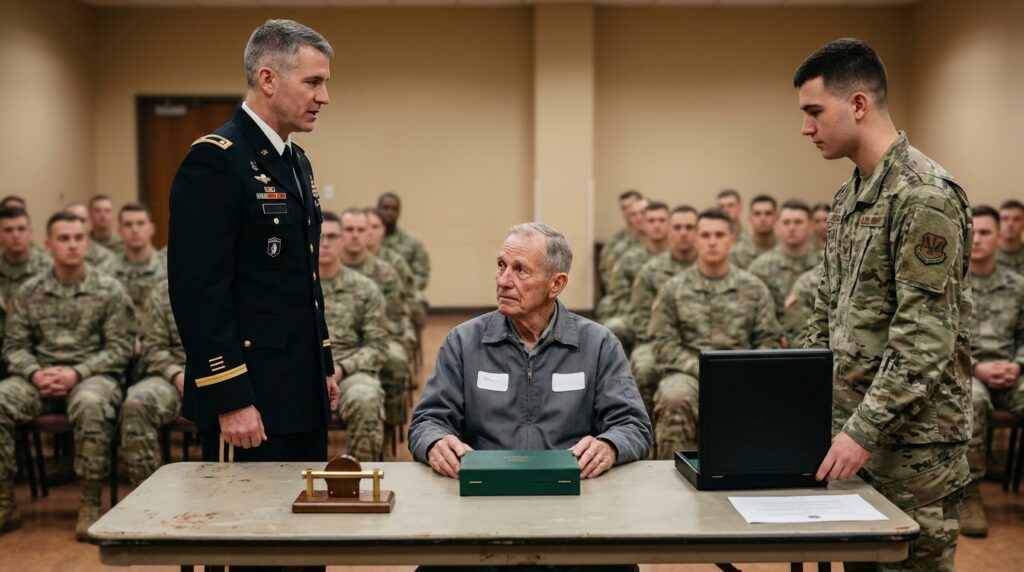
Arthur did not look up at the badges or the immaculate dark wool of the presenter’s dress uniform. His focus remained fixed on the table edge, where his own thumb—calloused from decades of tightening structural bolts and wiping hydraulic fluid off the base generators—was pressed against the veneer. The wood grain under his fingernail felt reassuringly rough, a sharp contrast to the absolute, suffocating stillness of the two hundred service members sitting in the tiered seats behind him.
To his right, the young camouflage-clad assistant didn’t blink. The black case in her hands was lined with velvet that looked too clean, the kind of material that swallowed light. Inside it sat the small wooden box, its brass fittings dull despite what must have been hours of careful polishing by someone who didn’t understand that the tarnish was the only thing holding the wood together.
“We brought it here today,” the presenter said, leaning down slightly, his posture breaking just enough to narrow the world down to the old man sitting at the table, “so everyone could see what you carried, Arthur.”
Arthur’s breath caught, a dry, rattling sound in the back of his throat that felt loud enough to echo off the high concrete rafters. His grey zip-front work jacket felt heavy, the faded name tag over his left breast pocket pulling down like lead. For forty years, that grey fabric had been a shield. If you wore the jacket, you were just the man who fixed the heating vents or cleared the gravel after a storm. You didn’t have a history. You didn’t have a shadow.
“I never thought…” Arthur’s voice was a thin rasp, a low murmur that barely carried past the table. He lifted his hand from the veneer, the skin cross-hatched with old scars and white lines from winters spent working with cold iron. “I never thought I’d see that little box again. I told them to burn it.”
“They didn’t,” the presenter replied. He straightened his back, his shoulders squaring as he turned his face toward the darkened rows of the audience. The private space between them vanished, replaced by the heavy, demanding mantle of institutional memory. “Every person in this room knows exactly why it belongs with you. They know what it took to keep the logs clean when the tracking lines went dark.”
A collective shift went through the rows behind them—the subtle rustle of heavy starched fabric and the dull thud of combat boots adjusting on the floorboards. They didn’t know the whole truth, Arthur realized with a sudden, cold clarity. They knew a name and a date on a plaque, a sanitized version of a night when the sky over the ridge had turned the color of bruised plums. They didn’t know about the three clerks who had been sent home without papers, or the way the grease smelled when they burned the cargo manifests in the back of the maintenance shed.
The pressure in the room grew, thick and demanding, pressing against his chest until his lungs felt small. They wanted the gesture. They needed the old man to validate the history they were building around him.
Arthur’s hand hovered over the open velvet case. The brass corner of the keepsake device had a small, deep pit near the hinge—the exact spot where he had dropped it against the bumper of a flatbed truck while running for the perimeter fence. His skin was trembling, the small muscles in his forearm twitching under the frayed cuff of his grey sleeve.
He dropped his hand. His index finger made contact with the cold, hard brass. He didn’t lift it, didn’t hold it like a trophy. He gave the metal one slow, deliberate, steadying tap, the dull thunk of his nail against the plate acting as a silent seal on a contract he had tried to break for half his life.
The presenter exhaled, a tiny movement of his chest, and began to reach for the document folder on the podium.
But as Arthur’s finger slipped off the brass edge, his nail caught on the small seam where the lining met the wood. The velvet inside the keepsake box didn’t just sit flat; it shifted slightly, revealing a small, stiff corner of white cardstock tucked beneath the padded bottom—a piece of an old, red-striped non-commissioned officer’s identification card that had been cut in half, showing only the distinct, hand-inked signature of a commander who had supposedly died in an airfield fire three years before Arthur ever took the maintenance job.








