
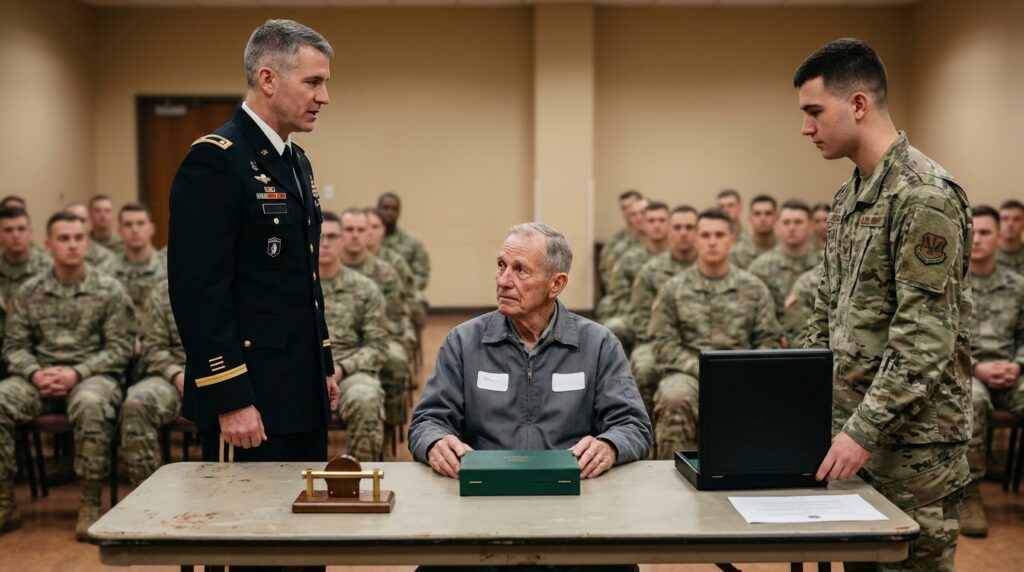
CHAPTER 4: THE HORIZON CHECK
The concrete tunnel felt tighter under the rhythmic pulse of the emergency lamps. Each sweep of red light stained the peeling paint of the corridor like fresh ink on old parchment, then pulled back to plunge the space into a suffocating, desaturated gray.
The presenter moved with a sharp, practiced velocity, his polished leather boots striking the floor in an aggressive cadence that echoed far ahead. His immaculate dark uniform jacket was already losing its rigid, ceremonial perfection, the shoulder fabric wrinkling under the weight of his rapid stride. He checked his service sidearm with a short, metallic snap that cut cleanly through the low, weeping moan of the base security siren.
“Stay here, Arthur,” the presenter commanded without looking back. His voice was taut, hard, stripped entirely of the reverent warmth he had projected on the auditorium stage. “The security detail is pulling up from the main gate. I need to secure the vault entrance before whoever is down there breaches the primary pressure seal.”
Arthur didn’t stop. The green presentation box was clutched against his ribs, the heavy wooden corners digging through the thin fabric of his grey zip-front work jacket. His sneakers made almost no sound on the grit-strewn floor—a phantom cadence trailing the officer’s heavy boots. For forty years, he had known every hairline fracture in these lower foundations, every unmapped bypass where the steam pipes ran parallel to the old communications wiring.
“You don’t know how to open that elevator shaft if the electronic grid locks down, Captain,” Arthur rasped, his lungs burning with the damp, chill air of the sub-basement. “The administrative annex doesn’t run on modern relays. It runs on rusted iron and old levers. If the breaker blows, you’ll be trapped in the dark with a door you can’t blast through.”
The presenter reached the iron-grated checkpoint at the end of the corridor and slid his keycard through the terminal slot. The machine buzzed, a harsh red negative tone chiming over the radio static. The indicator light remained dead. The override had already taken effect from the main terminal downstairs.
“Damn it,” the presenter muttered, his gloved hand striking the steel housing of the gate. He turned, his eyes catching Arthur’s under the sweeping red glare. There was a raw, unfiltered frustration in his face now—the look of a man who realized the institution he trusted was an unmanageable beast with too many hearts. “The logic gate is closed from the inside. Someone is systematically cutting off the access corridors.”
“Give me the logbook,” Arthur said, stepping forward. He didn’t ask; his voice carried the quiet, absolute authority of the senior craftsman who had built the very walls they were standing within. He held out his lined hand, the frayed fabric of his cuff brushing against the silver insignia on the presenter’s sleeve.
The presenter hesitated for a fraction of a second, his gaze dropping to the old man’s steady fingers, before drawing the canvas-bound journal from his jacket and placing it in Arthur’s palm.
Arthur opened the soft, rounded cover. He didn’t look at the lists of cargo manifests or the redacted names of the three logistics clerks whose futures he had bought with a box of ashes forty years ago. Instead, he flipped to the very back page, where the texture of the paper changed from rough utility stock to a thin, yellowed vellum.
There, stamped in blue ink that had faded until it was barely visible against the grain, was a second set of maintenance numbers—codes that matched the ones on the cut NCO card in his pocket, but with an additional prefix: OM-00-CLR.
“The intruder isn’t trying to steal anything, Captain,” Arthur whispered, the world slowing down around him as the true architecture of the trap became clear. Time dilated; he could see the individual flakes of rust vibrating on the security gate hinges with every pulse of the siren. He could smell the sharp, metallic tang of the generator pool mingling with the scent of forty-year-old dust. “They aren’t pulling a file. They’re triggering the automated decontamination purge for the lower vaults. The system thinks there’s a structural breach from the old fuel line leak.”
The presenter’s face went pale. “The purge resets the atmosphere in the sealed compartments to zero oxygen. If there’s anyone down there—”
“If there’s anyone down there, they’re turning the ledger into dust,” Arthur finished. “And they’re doing it using Miller’s old supervisor key. The person downstairs isn’t a thief. It’s the archive itself cleaning its own teeth.”
He stepped up to the bypass junction box hidden behind a rusted ventilation panel, his fingers moving through the dark interior by touch alone, feeling for the cold, greasy wire that ran to the manual release valve. He didn’t need a map. He didn’t need the light. His hand knew the shape of the mistake they had all agreed to protect.
With a hard, rhythmic pull, he disengaged the manual lever. The iron gate clicked, the heavy locking pins sliding back into the frame with a hollow, metallic groan that sounded like an old man sighing in his sleep.
The path down to the deepest vault was open, but the final truth remained locked beneath a layer of suffocating gray. Arthur looked down at the green box in his arms, then at the young officer who wanted so badly to believe in a clean history.
“Stay here and hold the line for the gate guard, Captain,” Arthur said softly, his voice full of a tired, humanistic grace that offered no victory, only endurance. “Some things don’t belong in a museum. Some things just need to stay in the dark until the wood rots away.”
He stepped through the open grate, his grey jacket swallowed instantly by the long, red-tinted shadows of the descending stairwell, leaving the presenter standing alone beneath the flashing warning lights.








