
CHAPTER 7: THE SETTLING OF THE SHADOW
The glass panes of the diner’s front facade didn’t just rattle; they vibrated at a frequency that sent a steady, fine mist of dried window putty flaking down onto the linoleum sill. The deep, rhythmic thrum of the approaching diesel engine entered the room through the floor joists, traveling up the iron frame of the booth and into the base of Silas’s heavy ceramic mug. The small pool of cold coffee inside the cup rippled in concentric, high-friction circles that matched the exact stroke of an unaligned eight-cylinder utility transport flywheel.
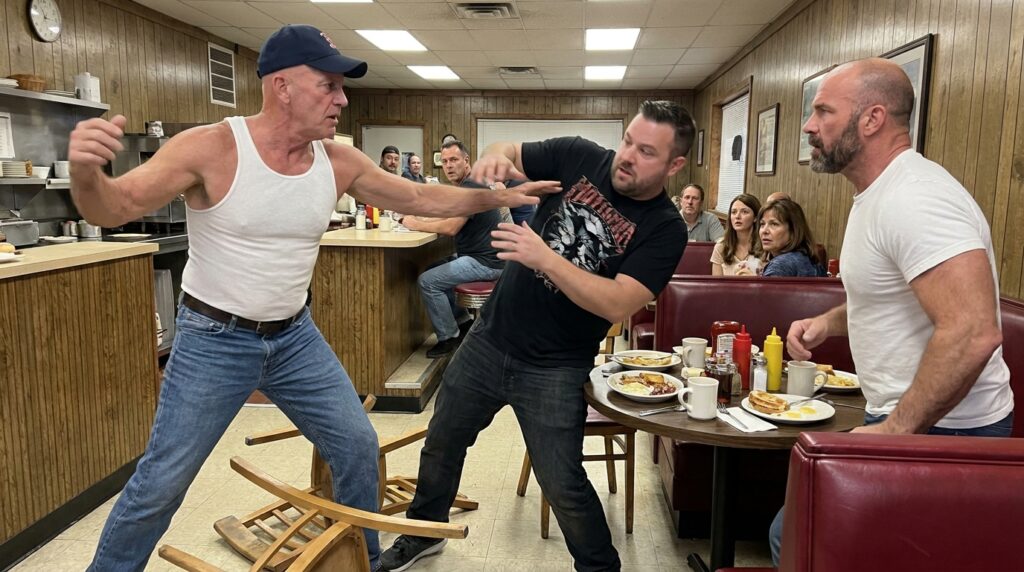
Silas didn’t stand up. He kept his heels locked firmly into the iron crossbar beneath the wood-grained laminate, his broad, tank-top-clad shoulders square against the table lane. Through the salt-pitted glass of the front entry, the white glare of the noon sun was suddenly blocked out by the massive, matte-gray grill of a three-ton field logistics unit. It came to a halt exactly six inches from the concrete apron, its exhaust stack burping a thick, low-sulfur cloud that smelled of hot lubricating oil and scorched iron.
The driver’s side door swung open against its ungreased limiter with a dry, metallic screech that silenced the remaining refrigeration coils inside the diner. A lone man stepped down into the gravel—not a young field hand like Luke or a panicked sub-contractor like Vance, but a fifty-year-old operational manager wearing a crisp, starch-stiff khaki field uniform that bore no local county patches. His boots were clean, black leather with vulcanized soles that left no marks on the limestone chips as he stepped over the threshold and into the dim, grease-weighted air.
“The road’s closed for three miles north, Clara,” the manager said. He didn’t look at the booth where Silas sat pinned by the counter light. He walked directly to the register lane, his hand dropping a heavy leather document pouch onto the Formica surface with a blunt, dead thud that caused the old receipt spindle to jump. “State transit order came through twenty minutes ago. You’ve got until five o’clock to clear the inventory before the security gate locks the right-of-way.”
Clara didn’t touch the pouch. Her fingers remained frozen around the handle of the empty glass carafe, her apron string twitching against the zinc trim of the register base. “The marshal hasn’t signed no transit order, Mr. Henderson. The county commissioners told us the bridge works were pushed to August.”
“The commissioners don’t have jurisdiction over a defense corridor link,” Henderson said. His voice was a thin, level rasp that carried no heat, only the absolute indifference of a corporate ledger. He finally turned his head, his eyes moving past the splintered pieces of the oak chair until they locked onto the faded navy service cap shadowing Silas’s face. “And neither does anyone else living on unrecorded marsh tracts.”
Silas picked up the brass padlock from the laminate table. The metal felt heavy, holding the dull, cold density of government-issued hardware that had survived three deployments in the salt flats. He rolled it once in his calloused palm, the triple-arrow seal of the Land Reclamation Bureau catching the glare of the utility truck’s hazard lights outside.
“The tract isn’t unrecorded,” Silas said. The words came out slow, dried out by decades of range discipline. He didn’t look up from the brass lock. “The master monument is still registered under the ’54 Army Corps survey. It’s sitting exactly three feet beneath the pantry floorboards behind your register, Henderson. Right where your boys were trying to scratch it out last Tuesday.”
The operational manager didn’t blink. He took two steps forward into the table lane, his fingers hooking into the webbed utility belt that held his digital transceiver. The unit was humming, its crimson indicator light flashing in identical sequence with the dashboard scanner in the truck outside. “The ’54 survey was voided when the defense infrastructure bill passed in October, Silas. The corporate title was filed under a blanket reclamation rider. The second your name hits the state assault log for what you did to my field hands out in that lot, the title executes automatically. You don’t have a fence line anymore.”
Silas let out a low, steady breath through his nose. He could hear the structural ticking of the hot diesel manifold outside, the expansion of the iron parts under the direct noon heat. He knew the parameters of the game now. The provocation hadn’t been an error; it was the final required variable in an acquisition equation that had been running since the rail spur was cleared. If he stood up and used his hands a third time, the camera on the truck’s chassis would register the transaction, and the federal marshal would have no choice but to sign the immediate eviction warrant under the public safety mandate.
“I didn’t hit him,” Silas said softly. He laid the brass padlock back down on the blueprint, his thumb resting flat against the red-ink rectangular stamp that read EXEMPT. He looked past Henderson’s shoulder, out through the glass door where the clean chrome survey markers on the gray transport truck were reflecting the blinding white glare of the road. “I just didn’t move. There’s a difference in the code.”
Henderson’s hand went completely still on his transceiver. For the first time since he had crossed the threshold, his eyes flicked down to the silver ring holding the single brass key on the table. He knew the weight of that key. It didn’t belong to a padlock or a trailer door; it belonged to the heavy iron casing that sealed the master section monument beneath the floorboards—the one link the acquisition team needed to destroy before the five o’clock title confirmation rolled through from Fort Meade.
The silence in the diner hardened into something solid, a heavy, unyielding layer of gray air that held every booth in its grip. The old trucker didn’t move his hand from his suspenders. Clara didn’t lower the empty pot. They all watched the two men across the wood-grained laminate, knowing that the boundary hadn’t just been drawn in the dirt outside; it was being held by three inches of unyielding brass and the quiet, immovable mass of an older regular who refused to yield his lane.
“Five o’clock, Silas,” Henderson said, his voice dropping into a cold whisper that barely cut the hum of the truck. He turned on his heel, his vulcanized soles making no sound against the grit as he walked back toward the glass entry. “After that, the machinery doesn’t look for flags.”
Silas didn’t answer. He simply reached out and picked up his heavy mug, his fingers feeling the cool water at the bottom as the heavy gray truck threw its transmission into reverse, flinging a fresh spray of sharp limestone chips against the rusted base of the diner’s outer line.








