
CHAPTER 6: THE HARDENING OF THE SILENCE
“That wasn’t no county crew, Silas,” the old trucker said. His voice came out small, dry, scraping through the stillness of the diner like a rusty nail across a zinc bucket. His fork remained abandoned on the paper placemat, his eyes fixed on the door where the F-250’s tires were still flinging gravel against the base of the outdoor propane tank.
The Veteran stepped back over the threshold, his boots dragging the heat of the noon sun into the cooler, grease-weighted air of the dining room. He didn’t drop the polymer blueprint roll. He kept his large, calloused fingers clamped tightly around its unraveled edge, the heavy sheet creaking against his thigh as he walked back toward his booth. The brass padlock he had retrieved from the stones clinked softly inside his front pocket, a heavy, mechanical rhythmic counterweight to his stride.
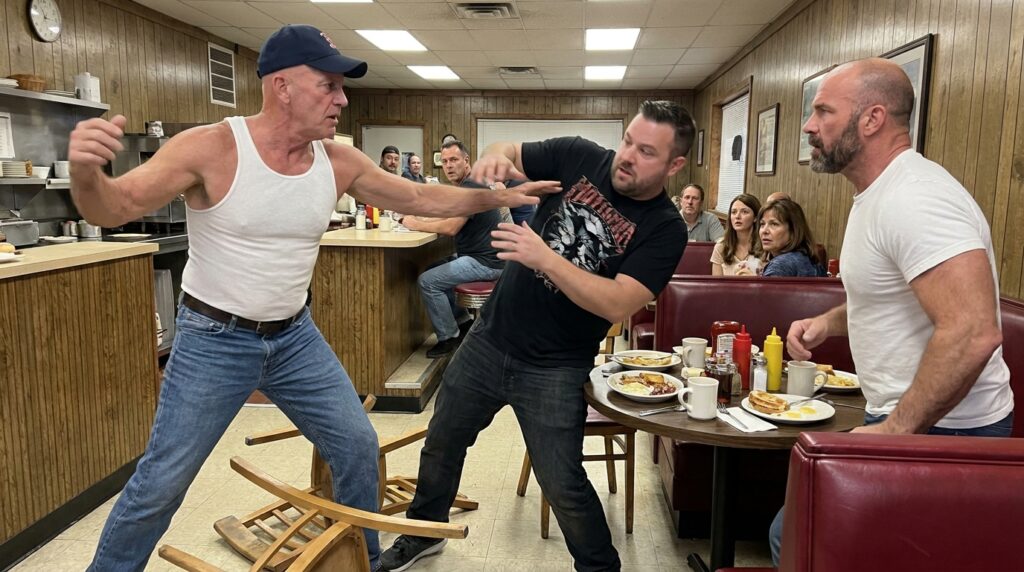
“Clara,” Silas said. He didn’t look at the clerk. He stopped beside the shattered remains of the oak dining chair, his toe nudging a splintered leg until it lay flush against the base of the counter. “Get your book out.”
Clara didn’t reach for the ticket pad right away. Her hands were still wrapped around the black plastic handle of the coffee pot, her breath hitting the glass rim in small, shallow puffs that faded almost instantly. When she finally moved, the motion was stiff, her apron strings snapping against the counter trim as she pulled a worn leather-bound ledger from beneath the old mechanical cash register. The ledger was ancient, its edges frayed down to the gray thread, smelling of forty years of tobacco smoke and spilled grease.
“They’ve been logging the line since April,” she whispered. Her eyes darted from Silas’s navy cap down to the red-ink stamp visible on the unrolled section of the map: EXEMPT – RECORD SEC-12. “Two men from the state land office came through first, looking at the old survey monument beneath the pantry floor boards. They said the county line had drifted three feet east after the ’93 flood.”
Silas settled his bulk into the booth, the vinyl seat groaning under his weight with a familiar, low rattle. He laid the blueprint flat on the wood-grained laminate, using his heavy ceramic mug to pin the top edge down against the vibration of the refrigerator coils. The red rectangular stamp sat directly over the section of the grid that marked his own property line—the three acres of marsh and gravel where his trailer had sat undisturbed for twelve years.
“The line didn’t drift,” Silas said. His voice was a flat, industrial monotone, stripped of any local inflection. He traced the blue-ink line with his thumb, his thick nail tracing the path of the old creek bed until it reached the three intersecting survey hubs. “The state didn’t send them. This is an acquisition layout. Look at the grid orientation. It’s balanced on the military datum line, not the county road system.”
The old trucker rose from his booth, his suspenders pulling taut over his flannel shirt as he scuffed across the gray linoleum to stand a three-foot distance from the table. He leaned his head down, his weathered face tightening as he studied the stenciled initials at the bottom of the claimant column. “Vanguard Development. That’s the outfit that cleared out the old fuel depot down by the rail spur last winter. They don’t build roads, Silas. They build fences.”
“They build corridors,” Silas corrected softly. He reached into his pocket and pulled out the brass padlock, setting it down on the table with a heavy, metallic thud that caused the salt shakers to jump. The triple-arrow seal of the Federal Land Reclamation Bureau caught the yellow light from the window, its brass surface dull and pitted from exposure to moisture. “They bait the owner until he hits someone. Once there’s an assault charge on the local record, the federal rider allows them to execute an immediate title reclamation under the public safety provision. It keeps the acquisition out of the district court.”
The room went entirely cold then, the remaining regulars looking down at their plates as the structural logic of the confrontation settled into the wood. The fight hadn’t been an argument over a booth. Luke hadn’t been an entitled bully looking for an easy mark; he had been an employee executing a specific, calculated provocation designed to generate a defensive reaction on camera. The dashboard scanner in the truck hadn’t been downloading mapping data—it had been logging the physical force transfer of Silas’s forearm check to verify the capability index.
Clara turned a page in her ledger, her finger stopping beside a handwritten notation dated three weeks prior. “The supervisor came in alone last Tuesday, Silas. He didn’t buy nothing. He just sat in your booth for an hour, scraping the grease off the floor bolt with a pocket knife. He said he was looking for the original section marker from the ’50s.”
Silas didn’t look up, but his hand closed around the silver ring holding his brass key. He knew what lay beneath the diner’s foundation. The original section marker wasn’t a standard iron pipe; it was a heavy brass disk stamped by the Army Corps of Engineers before the highway was built—the master anchor point that locked the titles for every acre between the marsh and the state line. If that monument was altered or cleared from the record, his trailer wasn’t just on disputed ground; his entire property line would legally cease to exist.
“They’re coming back,” the old trucker said, his hand twitching toward the door as the low, rhythmic thrum of a heavy diesel engine began to vibrate through the gravel lot outside. It wasn’t the F-250 this time. The sound was deeper, slower, carrying the distinct, unaligned clatter of a heavy utility transport vehicle rolling in from the state highway.
Silas didn’t move from his seat. He turned the brass key over in his palm, his skin feeling the cool, unyielding weight of the iron as the reflection of a second, larger shadow began to stretch across the diner’s glass threshold.








