
CHAPTER 2: THE WEAR AND TEAR OF THE LINE
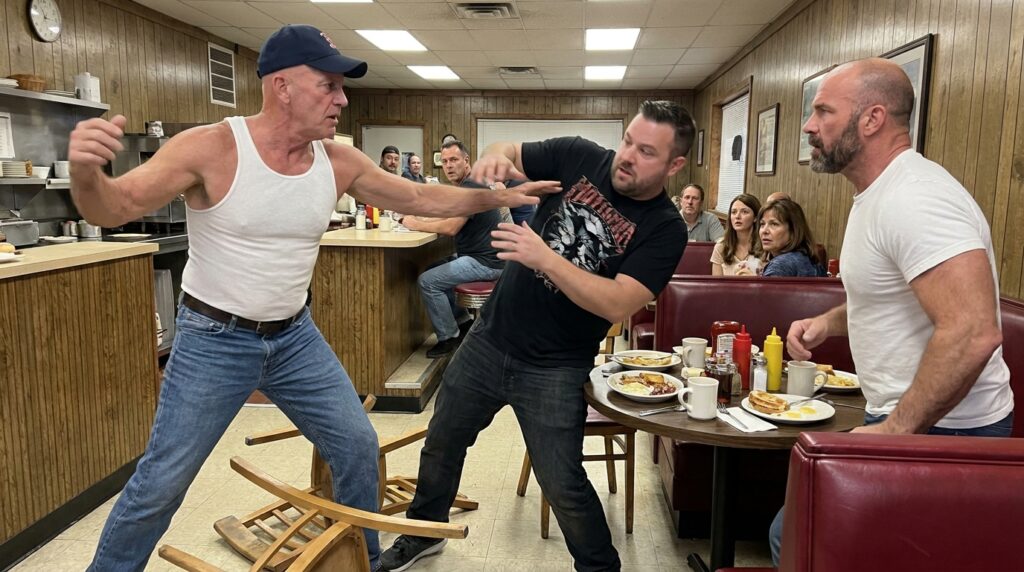
“I don’t think you heard me, old-timer,” the stocky one said. His boots didn’t shift, but his weight drifted forward, his shadow swallowing the remaining three inches of salt-shaker light between them. The black graphic cotton of his shirt was thin, stretched taut across a pair of heavy, unrefined shoulders that had spent more time digging fence posts than learning how to carry an argument. “This isn’t a conversation. You’re moving.”
The Veteran didn’t adjust his navy cap. Through the small, dust-filmed gap of his peripheral vision, he caught the dull reflection of the diner’s stainless-steel counter trim—pitted, scratched by decades of industrial cleaning rags, and rusting where the zinc plating had worn away near the grease trap. The room had dropped its noise the way an old air-brake system drops pressure: all at once, leaving only the low, wet rattle of the refrigeration coils.
“The booth’s empty behind you,” the Veteran repeated. His voice remained level, a flat stone skipped across frozen mud. He kept his index finger resting heavily on the cool brass edge of the key ring. Beneath the metal, he could feel the faint, rhythmic vibration of the fryer units down the line. It was a mechanical reality he understood. Action had a cost. Momentum had a weight. If a machine wasn’t oiled, it sheared its own gears. If a man didn’t know where his boundaries ended, he usually found out by hitting something harder than himself.
The accomplice with the patchy beard shifted his feet, his soles making a dry, scratching sound against the worn linoleum. He wasn’t looking at the Veteran’s face; he was looking at the table. Specifically, his eyes were locked on the small, grease-stained roll of heavy blueprint paper sticking out of his own partner’s rear pocket—the edge of the blue-ink grid lines barely visible beneath a layer of gray field dust. It was a minor detail, a surveyor’s habit, but the paper was high-grade, waterproof polymer, the kind used by state highway crews or utility conglomerates when they were clearing a path through land people didn’t want to leave.
“He’s not moving, Luke,” the accomplice muttered, his hand twitching toward the pocket of his canvas vest. His tone lacked the raw, uncalculated malice of the younger one. It was the voice of a man who worked for an hourly wage and didn’t want a deputy showing up before the midday shift started. “Leave it. We got work down by the creek anyway.”
“He’s moving,” Luke said. The stocky man didn’t look back at his partner. His jaw had hardened into a block of muscle, his skin flushing an angry, sun-baked red beneath the dirt. He wanted the room to see the compliance. He needed the counter clerk—a thirty-year-old woman named Clara whose fingers had frozen over the coffee pot handle—to know that the younger, heavier men dictated the layout of the space. “He’s moving or I’m putting his breakfast in his lap.”
The Veteran took a slow, deliberate breath through his nose. The air tasted of old lard and the sharp, chemical tang of the floor sealant they used on weekends. He could see the structural flaws in Luke’s setup clearly now. The younger man’s center of mass was too far forward, his head extended past his lead knee. He was counting entirely on the psychological weight of his age and his bulk to do the work for him. It was a common error among those who had only ever fought people who were afraid of being hurt.
“You should listen to your friend,” the Veteran said softly. He didn’t lift his hand from the key, but his boots—old, well-greased leather with the steel toes worn down to the dull gray alloy—shifted two inches beneath the table, locking his heels into the structural crossbar of the booth’s iron frame. “He looks like he knows how much a replacement windshield costs.”
The comment didn’t hit Luke’s ears like an insult; it hit him like an obstruction. For a second, the stocky man’s eyes flicked down to the faded blue cap, searching for the tremor or the quick, nervous blink that usually signaled an older regular was ready to yield. He found nothing but the shadow of the brim and the absolute stillness of the Veteran’s shoulders.
The silence in the diner thickened until it felt structural, a heavy, unyielding layer of gray air that held every booth in place. Clara still hadn’t lowered the glass carafe. The old trucker in the corner booth had closed his notebook, his thumb hooked into his suspenders, his eyes measuring the distance between Luke’s broad back and the heavy fire extinguisher mounted near the kitchen doors. Everyone knew the rule along Route 9: you didn’t get involved in county disputes unless the blood started hitting the food, but you didn’t look away either. Public shame was the only currency that counted when the law was twenty minutes away on the state highway.
Luke’s hand came off the table. It didn’t drop back to his side. Instead, his fingers curled into a loose, heavy fist that hovered two inches above the Formica, his knuckles white where the old tool scars ran deep into the skin. “You got a lot of mouth for an old man who lives out of a rusted-out trailer by the marsh.”
“I have the table,” the Veteran said. His finger remained on the brass key, the metal now warm from his own skin. “And I’m still using it.”
The younger man didn’t give a warning signal. He didn’t need to. The sudden, violent contraction of his right shoulder was enough. He lunged forward, his hip slamming into the corner of the wood-grained laminate, his left hand reaching out to grab the collar of the Veteran’s tank top, his boots scuffing hard as he tried to drive his weight into the lane and force the older man back into the corner of the booth.








