
CHAPTER 11: THE FINAL MEASURE
The aluminum framework of the diner’s entryway tore with a dry, high-pitched scream, the zinc-plated rivets shearing out of the header block like programmatic fasteners under load. A single, heavy plate of safety glass didn’t shatter; it dissolved under the flat, dead compression of the gray utility transport’s winch blade, dropping three hundred pounds of square-edged green crystal straight into the front booth aisle.
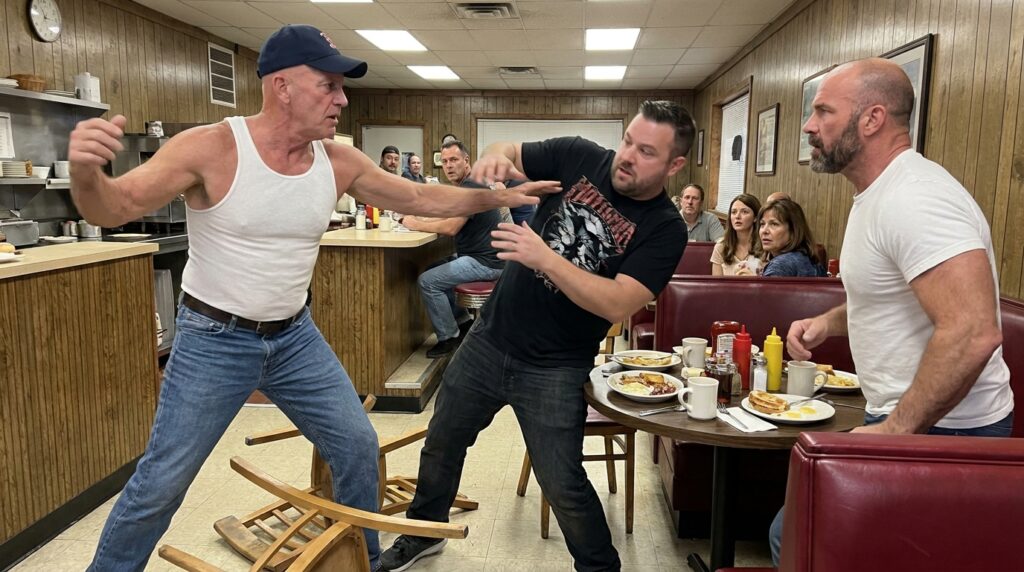
Silas stepped out from the kitchen pass-through, the cord-stitched leather ledger locked beneath his left armpit, his hand resting unhurriedly against his hip. The smell of cold grease was gone, replaced instantly by the raw, industrial wash of unscrubbed diesel exhaust and the heat of an eight-cylinder block running at full compression six feet from the counter stools.
Henderson stood just inside the ruined threshold, his boots planted in the crystal pile, his hand resting flat against the grip of his transceiver. Behind him in the white noon glare, the three-ton logistics vehicle was idling, its hydraulic stabilizer arms lowered until the steel pads had ground two inches deep into the asphalt apron.
“You’re thirty minutes past the marker, Silas,” Henderson said. He didn’t check his watch. He pointed a single, dirt-filmed finger toward the dry-storage door where the torn cedar laths were still weeping pine sawdust into the floorboards. “The regional link is live on the Fort Meade switch. The title executed at seventeen hundred. You’re an occupant on a federal corridor.”
“The title didn’t execute,” Silas said. His voice came out small, flat, a dry iron block dropped into the gravel. He didn’t pull his hand from his waist. He simply turned his shoulder three degrees to the left, allowing the yellow counter light to illuminate the hand-forged lead seal hanging from the ledger’s binding cord. “Your field office ran the extraction protocol against the microfiche records bank, but they didn’t clear the master logbook. The patent isn’t administrative, Henderson. It’s an original Corps assignment linked to the section monument beneath these floorboards.”
The operational manager’s jaw tightened, the skin over his cheekbones turning a dry, clay gray under his sun-baked uniform cap. His fingers twitched against the transceiver button, but he didn’t key the link. “An unindexed book doesn’t hold weight against a live state transit order. The grading blade is coming through that wall in ten minutes, whether your name is in that paper or not.”
“It’s not an unindexed book,” Silas said. He took one step forward, his boot sole grinding a crystal of safety glass into fine white salt against the floor boards. He reached into his tank-top pocket and pulled out the yellowed pieces of the celluloid microfiche card he had snapped in the county basement, dropping them onto the Formica surface of the nearest table lane, right next to the brass padlock. “The index number is matching the Corps stamp on the ledger frame. If your blade touches the foundation piers before a district judge signs the specific validation warrant, your firm loses the defense bond for the entire sector.”
Henderson looked from the celluloid pieces back to the broad, unmoving mass of Silas’s shoulders. The absolute stillness of the old man’s posture was a mechanical reality he couldn’t bypass with mass; it was the composure of a drill instructor who knew the exact yield point of every material in the room. The camera mounted on the truck’s chassis was still rotating, its green lens tracking the transaction, but the data line wasn’t logging a dynamic physical assault profile anymore—it was recording a verified federal title exception, logged in real-time before the local witnesses.
Across the aisle, the old trucker slowly stood up from his booth, his thumb still hooked into his suspenders, his eyes tracking the red-ink stamp visible through the canvas wrap of the book. “He’s got you on the baseline, Henderson. The county marshal’s car just cleared the rail spur down by the marsh line. I heard his radio frequency cut in when your transport killed the local server racks.”
The operational manager didn’t execute a counter-move. He took a single, slow step backward into the crystal pile, his boots making a heavy, crunching sound that died against the deep idling rumble of the diesel block outside. His hand dropped away from his utility belt, the fingers shaking slightly as he pulled his shoulder back out of the diner’s ruined frame.
“We’ll hold the sector at the ditch line,” Henderson whispered, his face darkening until it matched the desaturated color of the road asphalt. “But the trailer’s coming down anyway, Silas. The corridor doesn’t look for flags after the first freeze.”
“I’ll be at the gate,” Silas said. His finger remained resting flat against the cool brass edge of the key ring on his belt, his center of gravity unmovable as the massive gray utility truck threw its transmission into reverse, its tires flinging a final, dry spray of limestone grit across the shattered threshold.
The room returned to its gray stillness, the vibration in the joists dying down until only the steady, wet rattle of the refrigeration coils remained to fill the space. Silas didn’t adjust his navy cap. He tucked the leather book tighter beneath his arm and turned his boots toward his regular booth, his heels scuffing through the white salt of the glass as the noon shadow finally began to settle over the valley.








