
CHAPTER 3: THE COLLAPSE OF THE LANE
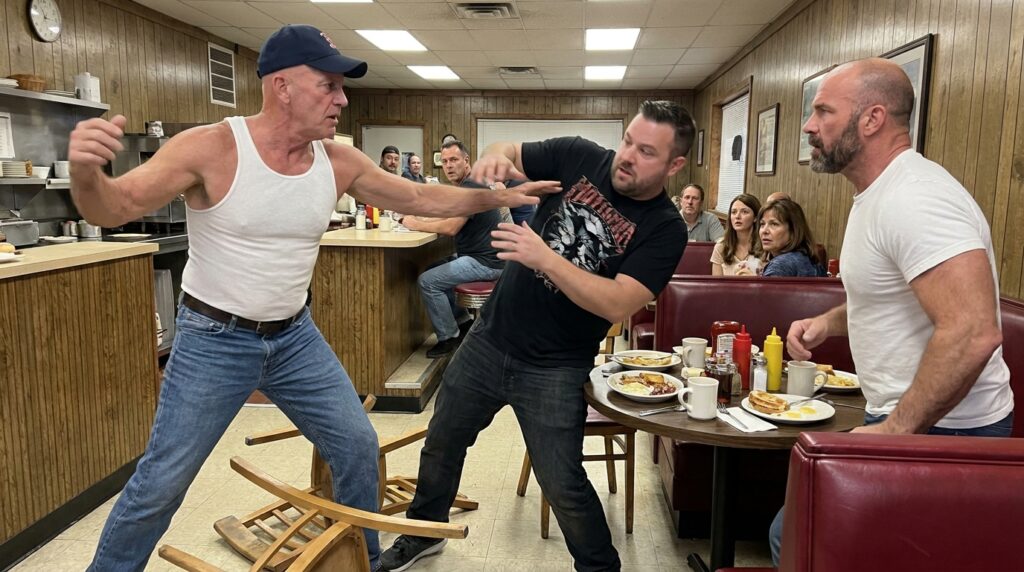
The cotton of the thin black t-shirt bunched as Luke’s lead shoulder dropped, his fingers wide and hooked like a set of ungreased excavation teeth aiming for the Veteran’s throat. It was a movement born of small-town certainty—the conviction that mass alone could dictate the geometry of a room.
The Veteran didn’t pull back into the vinyl padding of the booth. To retreat was to yield the floorboards, and once a man’s heels cleared his baseline, the physics of defense dissolved into a scramble. Instead, his left boot anchored into the iron crossbar beneath the table, the old leather groaning against the weld. He rose a fraction of an inch—not an upward jump, but a forward, level surge that met the Aggressor’s momentum at its narrowest point of transit.
His right hand came off the brass key ring with zero waste, his palm flat and hardened by decades of heavy equipment repair. He didn’t swing for the jaw. A fist was a fragile tool against a thick skull; it broke knuckles and wasted energy. Instead, he drove both heels flat into the gray linoleum, locking his core as he planted his hands directly into the center of Luke’s chest.
The impact was dry, a sharp thud that carried the iron-heavy tang of two solid masses colliding over stale coffee. The force transfer went straight through the stocky man’s center of gravity, arresting his forward lunge instantly. Luke’s boots lost their purchasing on the slick, grease-filmed floor. His knees buckled outward as the momentum he had manufactured was sent directly backward through his own hips.
The stocky man recoiled, his arms flailing to catch the edge of the adjoining table lane. His weight struck a heavy oak dining chair—an old piece of local furniture with rusted iron brackets beneath the seat. The wood didn’t give way with a clean snap; it disintegrated with a low, splitting roar, the legs splintering against the floorboards and scattering dark debris into the aisle. Ceramic plates rattled across the laminate surface, a lone coffee mug sliding three feet before shattering against the zinc baseboard of the counter.
“Luke!” the accomplice barked, his voice losing its flat contractor’s drone and spiking into a sharp, nervous register. His hand, which had been resting near his canvas vest, twitched violently as he took two rapid steps backward toward the diner’s aluminum threshold.
The room remained locked in its gray, desaturated stillness, but the air had changed. The old trucker in the corner booth slowly lowered his fork, his eyes tracking the splintered oak beneath Luke’s thighs. Clara hadn’t dropped the glass pot, but her knuckles were white against the plastic handle, her breath coming in shallow, rhythmic gasps that rattled the dry paper invoices tucked into her apron string.
The Veteran took one single, aggressive step forward out of the booth, his boots grinding a fragment of ceramic plate into a fine white powder against the linoleum. He didn’t drop his hands into a guard. He kept them low, near his hips, his thumbs hooked loosely into the waistband of his jeans, his broad shoulders squared against the entire width of the table lane. He had re-established the boundary line; the space between his lead boot and the shattered chair was now an absolute vacuum that belonged to his utility record.
“Get up,” the Veteran said. The words didn’t carry the heat of an angry man. They had the cold, heavy weight of an operational manual—a set of instructions delivered to a machine that had failed its inspection.
Luke was on his side, his hands flat against the grit of the floorboards as he tried to clear his head from the impact. The black shirt was torn at the shoulder, revealing a pale, thick patch of skin covered in a grey field smudge. As he rolled, his heavy leather tool belt twisted around his waist, exposing the underside of the main holster loop. Stenciled into the unpolished leather was a clean, military-grade identification number: US-ENG-774-V. It wasn’t the marking of a local road crew; it was a standardized federal utility sequence, the kind stamped onto gear issued to civil engineering units operating under government defense contracts.
The Veteran’s eyes fixed on the stencil for less than a second, his mind instantly registering the crisp, unfaded ink of the stamp. This wasn’t local muscle clearing a personal grudge. The weight of that number belonged to an infrastructure firm he had spent twelve years dodging—a corporate entity that specialized in reclaiming rural right-of-ways before the state highway extensions were even drafted.
The accomplice noticed the direction of the Veteran’s gaze. His patchy beard twitched as he lunged forward, not to strike, but to grab Luke by the strap of his canvas vest, dragging the heavier man toward his feet with an awkward, frantic heave that sent another splinter of the oak chair scraping across the floorboards.
“Come on, Luke,” the accomplice muttered, his eyes darting from the stenciled belt back to the grey shadow beneath the Veteran’s navy cap. “We’re outside our sector. Let it go.”
But Luke’s fingers were already curling into the grit, his mouth twisting into a red, sun-baked snarl as he found his footing among the broken wood. He hadn’t read the identification code; he had only felt the iron density of the old man’s hands, and his pride was currently bleeding into the linoleum.








