
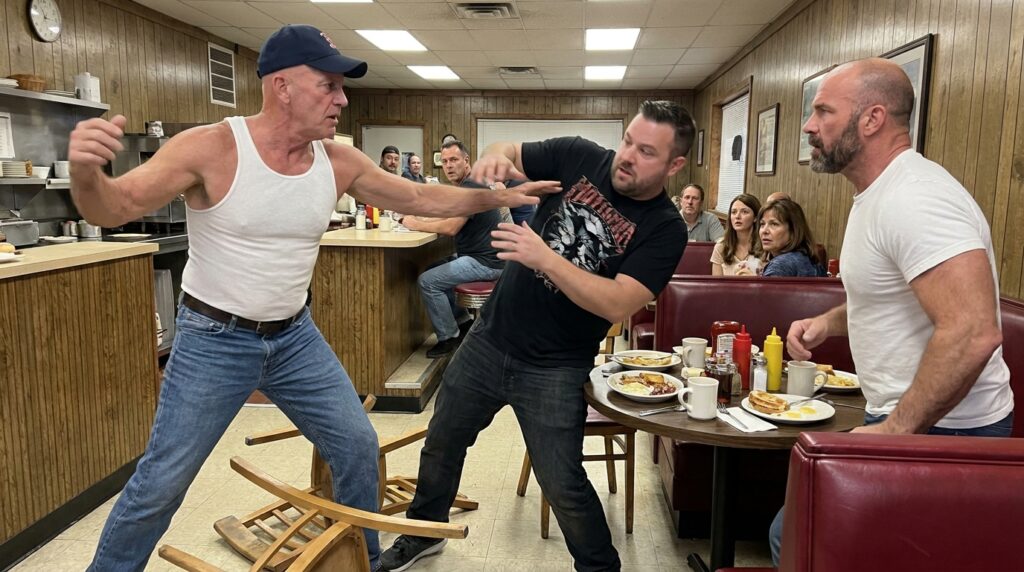
CHAPTER 5: THE SURRENDER AT THE THRESHOLD
The double-paned glass door rattled against its frame, the dry hiss of the diner’s air conditioning cut short by the blinding, white-hot glare of the noon sun. Vance was moving backward, his fingers hooked into the damp canvas armpits of Luke’s vest, dragging the stocky man’s dead weight across the concrete sill. Luke’s boots made a thick, heavy scraping sound over the metal threshold, leaving a twin trail of black rubber marks that smelled instantly of high-friction heat.
The Veteran didn’t stay behind the counter lane. He followed them—not with the hurried stride of a hunter, but with the steady, mechanical pacing of an inspector tracking a faulty cable. His boots hit the sun-baked gravel with a dry crunch that caused Vance to freeze, his hand slipping from Luke’s shoulder as he dropped back against the rusted fender of an unwashed Ford F-250.
“Don’t come any closer,” Vance said. The words were flat, stripped of the contractor’s bravado that had filled the booth five minutes ago. He pressed his palms against the blistering metal of the truck’s truck bed, his heels digging into the loose limestone chips until he hit the solid base of the tire iron. “We’re leaving. I told you, we’re leaving.”
Luke was on one knee now, his head hanging low between his shoulders, a thick bead of dark saliva stringing down from his lip into the white dust. His fingers clutched at the gravel, his chest heaving under the torn cotton of his black shirt as he tried to process the total failure of his balance. The brass padlock he had dropped inside lay three feet behind them, but the stenciled marking on his tool belt was fully exposed to the midday glare: US-ENG-774-V.
The Veteran stopped at the edge of the asphalt apron, where the shade of the diner’s corrugated awning died against the heat of the road. His face remained obscured beneath the navy service cap, but his thumbs were still hooked firmly into the waistband of his jeans. His eyes weren’t fixed on Luke’s face; they were locked onto the cab of the truck, where a small, battery-operated field scanner was humming on the dashboard, its green indicator light flashing in sequence with the high-frequency vibration of an unaligned flywheel.
“You dropped your lock,” the Veteran said. His voice was a low, industrial rasp that carried across the quiet lot. “And you left your alignment keys on my table.”
Vance didn’t reach for his pockets. He raised his hands until his thumbs were level with his collarbone, the palms open and coated in a white film of limestone dust. It was the absolute posture of a sub-contractor who had realized the liability had exceeded the value of the bond. “The keys don’t matter. The lock belongs to the company. Keep it. Just let me get him into the cab before someone calls the county marshal.”
“The marshal won’t come out this far for a broken chair,” the Veteran said, his boots shifting an inch into the stones, the iron-toed soles making a dull, heavy clink against an old muffler bolt buried in the dirt. He took a single, deliberate step past the baseline of the shade, the direct heat of the sun hitting his leathered arms. “But the firm might. If they think you lost the ledger.”
The accomplice’s jaw went slack, his eyes flicking toward the glove box before he could catch the movement. The reaction was small, a mere twitch of the neck muscles, but it was enough for a man who had spent thirty years watching engineers hide asset lists from local tribal boards. The blueprint roll was still hanging from Luke’s rear pocket, but the outer layer had unraveled slightly in the dust, revealing a bright red-ink rectangular stamp across the corner: EXEMPT – RECORD SEC-12.
It wasn’t a state transit code. It was the legal tag used by private acquisition consortiums when they were working under a federal nondisclosure rider to clear family homesteads before the public notice was filed at the courthouse.
“We don’t have a ledger,” Vance muttered, but his boots were sliding sideways, his shoulder pressing into the truck’s door handle as he tried to shield the cab from view. “We’re just doing the line checks for the culvert. That’s all the supervisor gave us.”
“The supervisor doesn’t issue federal padlocks to utility crews,” the Veteran said. He reached down, his heavily calloused fingers grabbing the unraveled edge of the polymer blueprint roll from Luke’s pocket. He didn’t jerk it; he pulled it with a smooth, continuous force that brought the stocky man’s torso flat against the gravel with a low moan.
The sheet unrolled between them, a heavy, waterproof grid of blue-ink lines that mapped out the old creek bed behind the marsh. But it didn’t show the water line. It showed a series of three intersecting survey hubs, each marked with a small brass survey monument symbol, and all three were located precisely inside the western fence line of the Veteran’s three-acre parcel.
The names on the title column at the bottom weren’t local names. The primary claimant was listed as Vanguard Development Infrastructure, with an unlisted field office number based out of Fort Meade.
A sudden, high-pitched mechanical whine cut through the heat—the dashboard scanner in the truck had changed frequencies, its green light turning a solid, unblinking crimson as it began to download a remote telemetry log from a satellite link. Vance reached into the cab through the open window, his knuckles striking the frame as he frantically punched the kill switch on the unit, but the screen had already displayed four lines of fresh, incoming text: ALERT – AREA MON-02 COMPROMISED. DEFENSIVE RETALIATION CONFIRMED.
The Veteran looked from the screen back to the red-ink stamp on the map, his fingers tightening against the tough polymer until the material creaked. The trap wasn’t coming from the highway; it was already sitting in his regular booth, and he had just given them the physical performance they needed to log the profile.








