
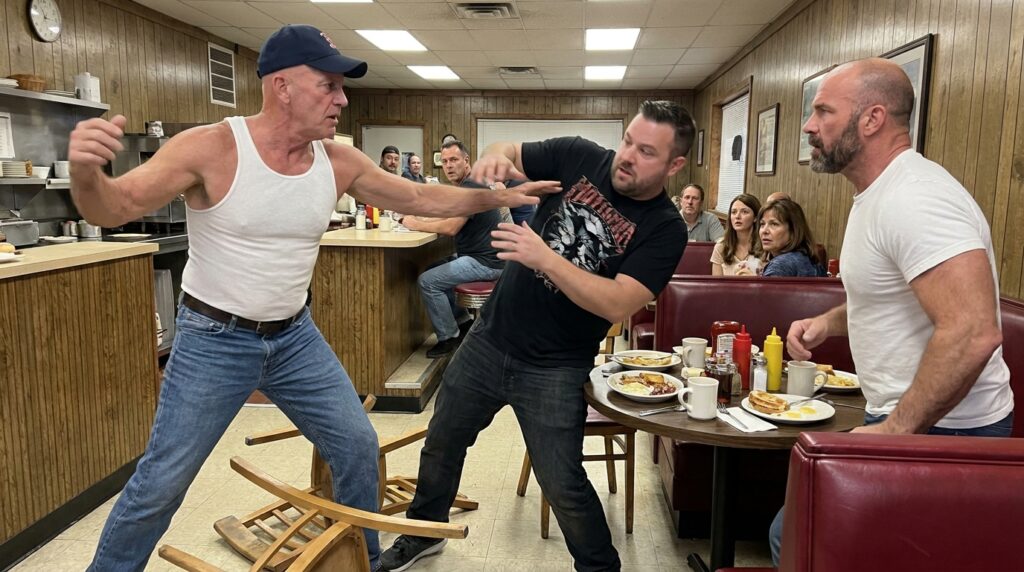
CHAPTER 4: THE UNYIELDING FOREARM
“Get your hands off me, Vance,” Luke hissed. He wrenched his arm out of his accomplice’s grasp, his heavy work boots dragging a jagged arc through the oak splinters on the floor. His eyes were wide, bloodshot at the corners from the sudden spike of adrenaline and the sharp, hot sting of dust in his throat. He looked at the other booths, searching for something to stabilize his pride, but he found only the hollow glare of old men who had seen real winters. “The old bastard got lucky. That’s all it was.”
The Veteran didn’t answer with a threat. He simply re-entered his baseline stance, his feet wide, his left shoulder dropped three degrees lower than his right to shelter his liver. His skin felt cool under the grease-heavy draught from the kitchen doors. This was the mechanical drift of the conflict: once an amateur lost his footing, his subsequent movements were driven by panic rather than leverage.
“Luke, don’t do it,” Vance said, his boots clicking in a rapid, defensive rhythm toward the cash register. “Look at his hands. Just look at his damn hands.”
But Luke was already in motion. He didn’t execute a measured advance; he threw his entire bulk into a desperate, flat-footed charge across the table lane. He dropped his head, his chin tucked behind his collarbone, his heavy arms swinging upward in an uncoordinated attempt to gather the Veteran’s torso and drive him against the sharp, zinc-plated trim of the counter. It was a maneuver that worked in the gravel lots behind the bars, where men were too drunk to read the trajectory of a shoulder.
The Veteran timed the transit by the scrape of Luke’s heel studs against the pine planks. He didn’t drop his weight backward to cushion the impact. Instead, he executed a clean, three-inch pivot on his left toe, clearing his right hip from the center line just as the stocky man entered the vacuum of his space.
The motion was economical, stripped of any cinematic flourish. As Luke’s bulk surged past his chest, the Veteran brought his right arm up, his elbow bent tight, his forearm forming a solid, iron-heavy lever of unyielding bone and muscle. He didn’t strike downward; he simply drove the flat of that lever forward into the junction where Luke’s collarbone met his throat.
The contact was absolute. The energy of Luke’s own momentum was redirected back through his cervical spine with a blunt, bone-dry crack. The physics of the interception were relentless—the stocky man’s head stopped instantly while his lower half continued to travel forward, causing his heels to clear the floorboards entirely. His body rotated three degrees in the air before gravity claimed the mass, sending him crashing sideways into the empty space beneath the menu board.
A loose brass padlock rolled out from his unfastened tool loop, its casing embossed with a small, clean insignia—the triple-arrow seal of the Federal Land Reclamation Bureau. It bounced twice on the linoleum, a bright, metallic clink that died instantly against the grease trap.
The Veteran stood over the space, his breath coming in a single, unhurried measure through his nose. His forearm was red where it had taken the skin off Luke’s neck, the small hairs singed by the friction of the canvas shirt. He didn’t look down at the padlock immediately, but his mind had already processed the seal. The Reclamation Bureau didn’t clear right-of-ways for county pipelines. They cleared boundaries for high-security installation corridors, the kind that required a clean title and the total absence of civilian structures within three miles of the perimeter.
“You’re done, son,” the Veteran said. His voice didn’t have the raspy heat of the local workers. It was the flat, rhythmic tone of a range officer checking a clear chamber. “Your balance is gone. If you try to stand up before that ear stops ringing, you’re going to put your teeth through the floor.”
Luke didn’t answer. He was on his chest, his fingers twitching against the gray grit of the baseboard, his breath coming in wet, shallow wheezes that left a faint circle of condensation on the worn wood. The anger had left his eyes, replaced by the dull, uncomprehending stare of a steer that had taken a bolt between the ears.
Vance had completely backed into the aluminum frame of the exit door, his hands raised to the level of his chin, the fingers shaking against the glass pane. His face had gone the color of skimmed milk, his gaze locked on the small brass padlock that lay between the Veteran’s boots. He knew the designation of that lock. He knew exactly what kind of signature was required to clip it to a field case.
“We’re leaving,” Vance said, his voice dropping into an urgent, dry whisper that barely reached the counter clerk. He reached down, his fingers hooking into the collar of Luke’s torn t-shirt, dragging his partner’s heavy shoulders toward the threshold with a frantic, uncoordinated heave. “We’re leaving right now.”
The Veteran didn’t move to block the door. He simply watched the grease-stained polymer blueprint roll slide further out of Luke’s pocket as the man was hauled through the exit, its blue grid lines catching the hard morning sun from the gravel lot.








