
CHAPTER 1: THE FRICTION OF THE ENTRY
The smell of burnt coffee and low-sulfur diesel always clung to the corners of Route 9’s terminal diner, a heavy film that stayed behind long after the morning haulers had rolled out toward the interstate. At sixty-two, the hum of the old commercial refrigerator unit behind the counter felt less like background noise and more like a companionable ache, a steady vibration that matched the permanent stiffness in his lower lumbar. He didn’t look up when the heavy glass door rattled against its aluminum frame. He didn’t need to. The hinges had a distinct, high-pitched screech when opened with too much speed, a sharp tearing sound that usually belonged to men who hadn’t worked a full shift yet but already wanted a fight.
His fingers remained flat against the cool, pitted surface of a silver ring that held a single brass key. He didn’t turn it. He didn’t adjust the faded navy service cap pulled low enough to cast his eyes into a gray shadow. He simply watched the small pool of melted ice water at the bottom of his heavy ceramic mug tilt three degrees to the left as two pair of heavy, steel-toed work boots scuffed across the gray linoleum.
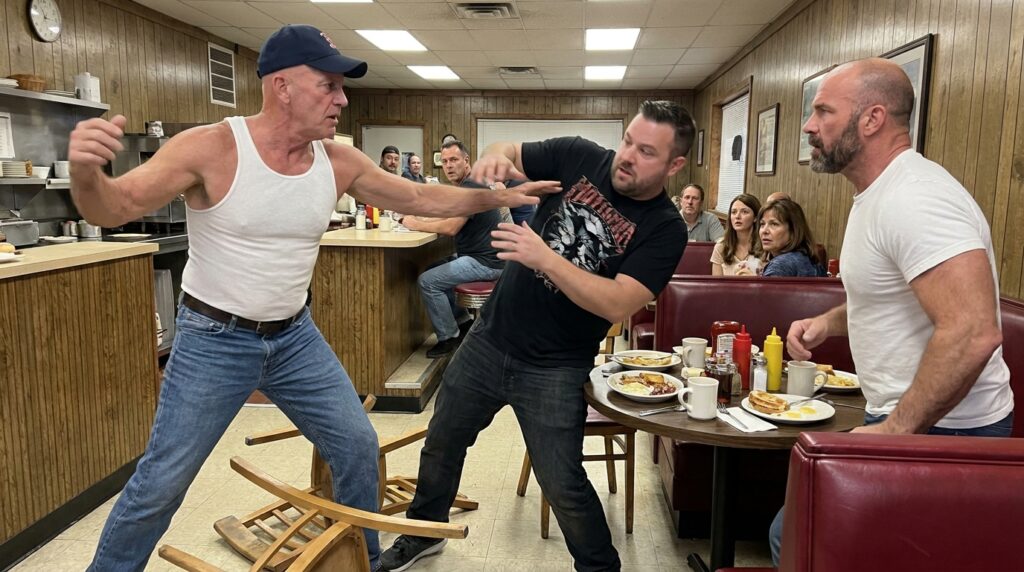
They were loud. Not the loud of men who worked the lime quarries up north—those men carried a quiet, exhausted mass that took up space without trying—but the loud of people who needed the room to know they possessed options. The younger one, short-coupled and thick through the chest in a black graphic t-shirt that smelled of stale laundry detergent and tobacco, stopped three inches from the edge of the round table. His accomplice, older by five years with a patchy beard and a white shirt already damp at the armpits, stayed a half-step back, his eyes moving across the other booths, measuring the reaction of the four regulars who sat frozen over their eggs.
“You’re sitting in our seats, old man,” the stocky one said. His voice had the dry, raspy edge of someone who spent too much time shouting over small-engine machinery. He didn’t wait for an answer. He leaned forward, planting one large, calloused palm flat on the table, right next to the silver key ring. The wood-grained laminate groaned slightly under his weight. “Me and my boy here usually take this corner on Tuesdays. You looks like you’re about done anyway.”
From beneath the stiff brim of his cap, the Veteran observed the alignment of the young man’s knuckles. The skin over the joints was red, scarred from old slips against engine blocks, but the balance was wrong. The Aggressor was leaning entirely on his right hip, his left heel slightly off the floor—an unstable posture chosen for cinematic effect rather than sustainable leverage. In the small-town county system, this was how authority was negotiated: through three inches of uninvited proximity and the assumption that age made a man pliable, like old leather left out in the rain.
“The booth behind you is empty,” the Veteran said. The words came out sparse, dried out by years of desert dirt and institutional silence. He didn’t move his hand from the key. His shoulder blades remained settled firmly against the vinyl padding of his seat, his center of gravity low and immovable. “The coffee’s the same over there.”
“We don’t want the booth behind us,” the Aggressor countered, his face darkening as he pulled his shoulder back, his chest expanding under the thin cotton of his shirt. He took the final three inches of space, his hip pressing against the edge of the table lane, his breath smelling faintly of sour wintergreen. “We want this one. And I’m not asking a second time.”
Across the aisle, a fork clinked sharply against a plate, then stopped entirely. The silence that followed was heavy, desaturated, and smelling of old iron.








