
CHAPTER 8: THE COLD ANCHOR LUGS
The hiss of the truck’s air brakes on the ridge was a sharp, pressurized spike that cut straight through the low hum of the grader’s engine. Above them, the first tri-axle shuddered, its ten tires sliding two inches through the loose flint gravel before the weight of thirty tons of crushed limestone held it static at the pasture gate.
Down in the trench, the shade was already gone. The sun hit the vertical walls of the yellow clay, baking the shale into tiny, sharp flakes that peeled away from the bank and fell onto the top of the blue limestone block.
Silas didn’t lift his iron hammer from the pin. His left thumb remained hooked around the cold lead casing that held the anchor steady in the bedrock. Through the bottom edge of his eye, the world had lost its dimensions; Garrick was just a tall, desaturated column of plaid wool, and Matthew was a shorter, dark square sitting against the massive steel tire of the machine.
“The gate’s too narrow for the turn, Matthew,” Garrick said. He didn’t look up at the truck. He looked at the hexagonal bar still wedged under the stone lug. “If the driver tries to back that rear assembly around the post without the easement cleared, he’ll drop the right side right through the sod into the run. The frame will twist before he can dump.”
Matthew didn’t answer. He reached down into the greasy track assembly of the grader, his fingers coming up with an old brass-capped measuring rod—the one he’d taken from the farmhouse workshop when he was twelve. The metal was dark, coated in an ancient, oil-thickened grease that smelled of lard and old toolboxes. He laid the rod against the limestone block, comparing the hand-scratched inch-marks to the edge of the grader’s steel blade.
“It’s three inches too wide, grandfather,” Matthew said. His voice was flat, devoid of the sharp heat from the kitchen, leaving only the dull, structural resonance of a man who spent his days measuring things that were already broken. “If I don’t turn the blade and back the moldboard into the bank, the left cylinder will catch the iron pin when I lift the ripper. It’ll tear the seal right out of the housing.”
Silas let his thumb slide off the lead casing. His skin felt numb where the metal had pressed into the grain of his thumbprint, leaving a dark, leaden circle that wouldn’t wash out with pump-water.
“Turn the blade,” Silas said.
Garrick’s boots shifted through the shale, a dry, scaling crunch that sounded like teeth grinding on dried corn. He lowered the heavy crowbar until the point rested in the yellow mud between his toes. “You’re signing the waiver then?”
“The paper’s on the kitchen cloth,” Silas said. He stood up from the stone, his spine making that same dry, splintering sound as the cedar posts under the ridge. He didn’t use his right eye at all now; the wool ball had grown until the gray field reached the very margin of his brow, leaving only a tiny prick of white sun-glare at the far corner of his vision. “But the machine doesn’t touch the anchor.”
He reached out, his hand finding the hot, grease-crusted hydraulic line on the grader’s frame to balance his weight as he climbed out of the ditch. The steel was hot from the engine, the oil leaking from the fitting leaving a sticky, sulfurous glaze across his palm.
“Matthew,” Silas called out through the roar of the idling diesel.
The boy stood up from the track, the brass measuring rod held tight against his thigh. “Yeah, grandfather?”
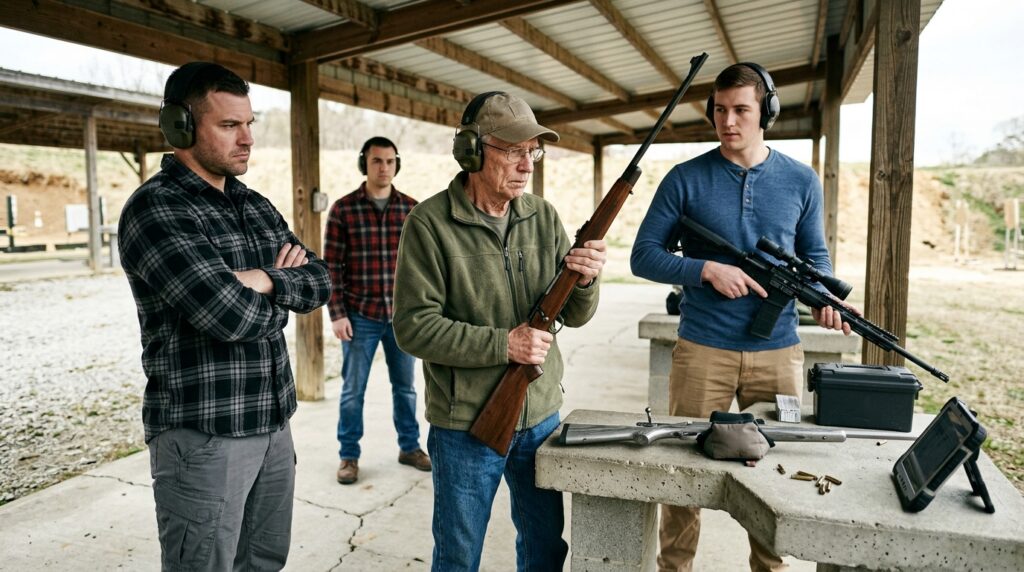
“The old Winchester’s on the table,” Silas said, his boots finding the level sod of the pasture lane. He didn’t look back at the pit where the blue stone sat. “The bolt sleeve needs a new punch to clear the brass. If you’re going to be the line-boss for the grain company, you’ll need something that doesn’t shave the primer when the wind starts to drag through the gap.”
Matthew didn’t answer with words. The track assembly gave a sharp, metallic clank as he climbed back into the high cab, his hand pulling the throttle lever down until the exhaust blew a thick, black plume of carbon over the willow brush. The grader didn’t move forward into the stone; the long steel moldboard swung slowly to the left, its sharpened edge clearing the lead-riveted pin by less than an inch as the machine backed out of the cut into the parched weeds of the ditch.
Garrick stayed at the bottom of the trench for a minute, his flannel shirt a dark knot in the yellow clay. Then he lifted the heavy hexagonal bar onto his shoulder and walked up the bank toward the pasture gate where the truck driver was already unhooking the tailgate chains.
Silas didn’t wait to see the limestone dump. He walked the half-mile back to the house by the feel of the zinc wire under his left hand, his boots tracking the high, dry ridges of the sod where his father’s plow had left the earth hard sixty years ago. When his hand found the rough, unpainted cedar of the porch post, the screen door was swinging loose in the wind, its broken spring making a thin, rhythmic whistle against the parched timber of the frame.
He reached into his fleece pocket, his fingers passing the cracked plastic shards of the medicine bottle until they found the cold, heavy cylinder of the split brass casing. He laid it on the porch railing, right where the sun could hit the black hairline crack in the metal, then turned his back to the road and went inside the dark kitchen where the table cloth was still white under the lime-dust.








