
CHAPTER 2: THE FRICTION OF IRON
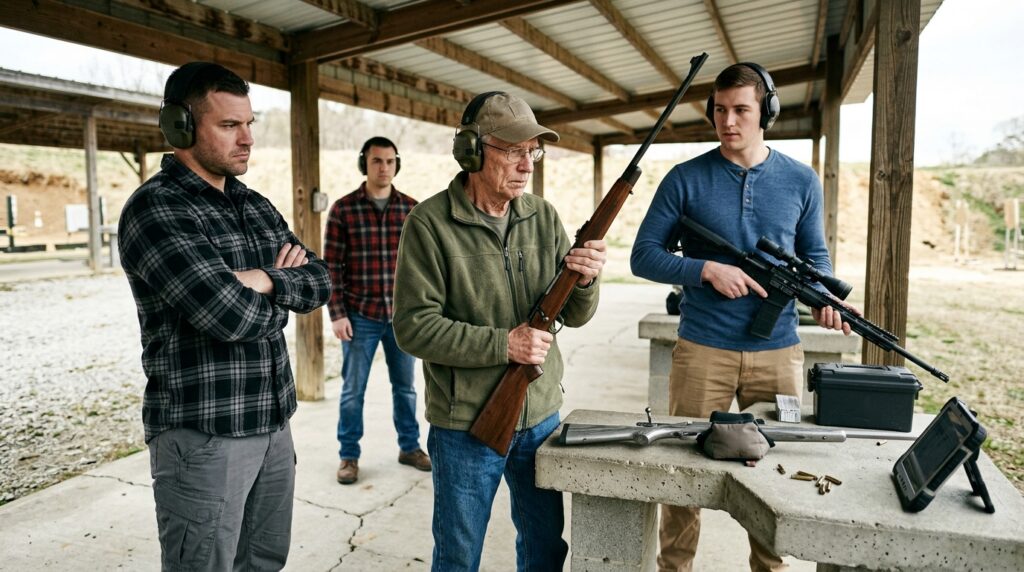
The steel of the cartridge case scraped against the feed ramp with the dry, rasping hiss of a file on a burred edge. Silas pushed the bolt forward with his palm, feeling the mechanical hesitation where the lugs met the receiver. It was a roughness he had grown to rely on—a three-thousandths-of-an-inch tolerance that told him the metal was seating against fifty years of carbon and oil.
His eyes hummed. The gray cloud in the center of his vision, the one the clinic doctor in town had called an inevitability, pulsed to the rhythm of his collarbone pressing into the heavy wool of his shirt. He couldn’t see the initials beneath Garrick’s bipod clearly anymore; the double-barreled ‘M’ had blurred into a dark, multi-legged insect crawling along the anodized aluminum. But his thumb knew the metal. His mind knew the exact depth of the stamp his father had used on the cedar fence lines before the banks took the eastern creek bed.
“You’re holding up the line, Silas,” Garrick said. The younger man’s boots shifted on the gravel, a dry, grinding crunch that sounded like teeth on grit. “Light’s moving. If you’re waiting for the wind to drop, it won’t. This valley doesn’t give handouts after twelve.”
Silas didn’t look back at him. To look back would mean losing the white glare of the hundred-yard target in his periphery. He had to look slightly to the left of the paper—two inches above the orange diamond—to let the healthy edges of his retina catch the stark contrast of the black ink against the sun-bleached wood.
“The wind’s from the nine o’clock,” Silas said. He brought the buttstock into the pocket of his shoulder. The walnut was cold, the grain pitted from rain at the county matches back when Garrick’s father was still hauling hay in short pants. “It’s dragging through the ditch at four miles. Maybe five at the berm.”
“The sensor on my rail says seven,” Garrick dryly countered. “With a two-degree vector change from the heat rising off the ditch.”
“Your sensor reads the air at your nose,” Silas murmured.
He took a breath, the smell of burnt gunpowder from the previous lane’s modern magnum filling his throat. It was a sharp, sulfurous stink that tasted like vinegar. He let the air out slowly, his ribs expanding against the concrete edge of the bench. The front iron sight—a heavy, hooded post that looked like a black tooth—rose up into the white field of the target.
His right hand began to betray him. The small, rhythmic tremor started in the meat between his thumb and index finger, a tiny twitch born from the strain of holding seven pounds of steel steady against the gray fog in his head. He didn’t fight the shake; fighting it only made the pattern erratic. Instead, he began to trace the circle of the movement, timing the micro-swing of his hand to match the slow, circular wobble of his pulse.
“He’s going to drop it low,” the younger shooter in the blue henley whispered from the backline. The words were small, but they carried through the dry timber of the roof supports. “Look at the barrel. It’s dipping.”
Silas didn’t hear them. Or rather, his mind dropped them into the same bucket as the crows circling the carcass in the brush behind the targets. He was counting the grains of sand on the concrete bench through his left eye. He was waiting for the gray patch to drift.
The world narrowed to the single-stage trigger. It didn’t have the clean, glass-rod break of Garrick’s electronic assembly. It had creep. It was a two-pound take-up through old grease, followed by a hard wall that felt like a rusty bolt being forced into a threaded nut.
He squeezed. Not with his finger, but with his whole palm, drawing the stock back into his flesh until the wood grain bit through his fleece.
The rifle didn’t report with the sharp crack of the modern high-velocity rounds. It was a flat, heavy boom that shook the loose dust from the corrugated tin above them, a cloud of gray lime settling on the silver barrel of Garrick’s chassis. The recoil was a slow, blunt shove that pushed Silas back two inches on the concrete, the iron buttplate leaving a sharp imprint through his shirt.
Through the white smoke clearing from the muzzle, Silas kept his cheek welded to the comb. He didn’t look up to check the hit. He watched the target through his peripheral vision as the paper twitched.
A tiny, dark dot had appeared three inches to the left of the orange center. A clean miss from the bullseye, but a deep puncture through the black ring.
Garrick let out a short, nasal bark that might have been a laugh if his mouth hadn’t remained flat. “Two inches off. In a real match, that’s a loss before you even clear the third frame.”
Silas opened the bolt. The long, heavy casing slid out, dropping onto the concrete with a heavy, metallic clink. The brass was smoking, the scent of hot zinc and carbon thick in the shade. He reached down, his fingers brushing the silver chassis of Garrick’s rifle as he picked up his spent shell. His skin made contact with the cold aluminum right over the double-barreled mark.
“The wind didn’t take that,” Silas said, his hand staying on the metal of Garrick’s gun, his thumb feeling the rough edges of the home-cut brand. “The wind was exactly four miles. This rifle didn’t throw the lead. I did.”
He turned his head fully then, forcing his direct, clouded gaze straight into Garrick’s eyes. The younger man didn’t look away, but his jaw gave a small, involuntary twitch when Silas’s thumb remained locked on the stock.
“You bought this rig three weeks ago from the boy down at the mill,” Silas said, his voice dropping below the level of the other shooters’ ears. “The one who told his mother he was using the money for a new truck axle.”
Garrick’s eyes went narrow, the skin around his temples tightening until the small blue vein near his ear began to pulse. “A legal sale. Signed and registered at the courthouse. The land was his to sell, Silas. It wasn’t doing anything but growing thistles and ironweed.”
“He sold you the thirty acres behind the old kiln,” Silas said. He looked down at his own dark casing, then dropped it into the black ammunition box with a soft click. “The thirty acres with my father’s name on the deed.”
“The county changed the line in ninety-two,” Garrick said, his voice dropping into that same tight, transactional hum he used at the grain elevator. “Your boy knew it. He took the money because he didn’t want to spend the next twenty years scraping rust off an old tractor just to lose thirty dollars an acre on rye. He wanted something that works.”
Silas picked up his cleaning rod from the bench. The wood was dark, the brass tip green with ancient oxidation. “He didn’t sell you the land, Garrick. He sold you the right to put your boots on my porch.”
From the end of the line, the silent witness in the red shirt stepped forward, holding a pair of heavy spotting binoculars. His face was gray under his cap. “Silas,” he called out, his voice cutting through the heat. “You need to look at the backboard. The paper’s splitting.”








