
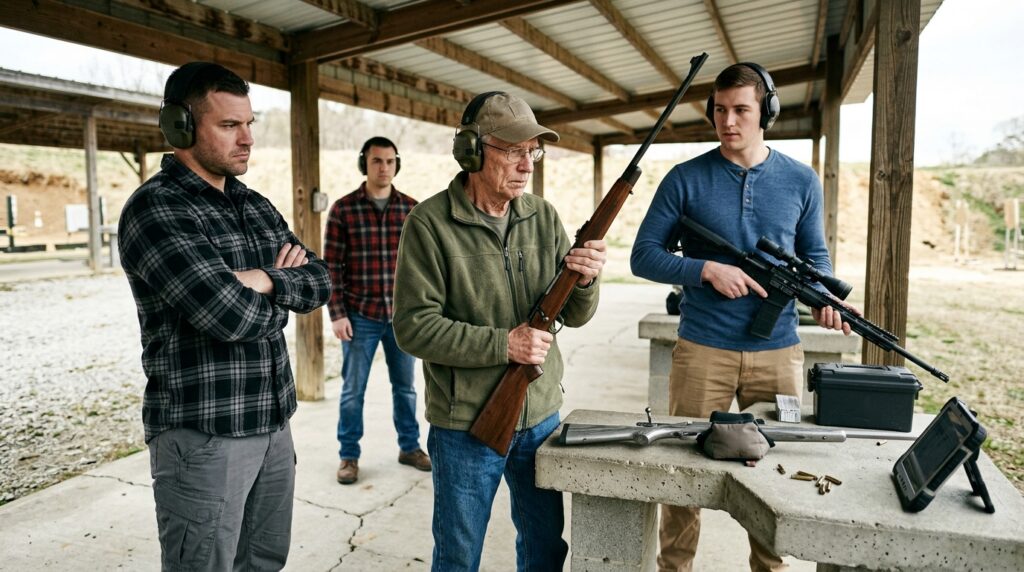
CHAPTER 5: THE FINAL CASING
The smoke from the receiver didn’t rise; it clung to the grease on Silas’s cheekbone, tasting of sour ammonia and hot iron. He didn’t drop the stock. His fingers remained locked around the walnut, the wood fibers pressed into his skin until his knuckles were the color of salt.
Garrick didn’t reach for the blue paper on the bench. He watched Silas’s left hand come out of the fleece pocket, not with the hammer he’d demanded, but with the broken shards of the plastic eye-drop bottle. The clear fluid was mixed with the gray dust of the timber floor, dripping through the old man’s fingers like melted tallow.
“The seal was broken before we left the house this morning,” Garrick said, his boots static on the concrete. The transactional weight in his voice had thinned, leaving only the bare friction of two stones rubbing together in a dry creek. “The doctor told Matthew last month. There isn’t an injection left that can stop the shadow from taking the rest of the field.”
Silas stood up. His knees made a sharp, dry sound—the same sound the wooden targets made when the frame warped under the noon sun. He didn’t look at the lane. He didn’t look at the blue easement paper where his grandson’s pencil mark was already fading under the lime dust. He looked through the peripheral edge of his left eye, where the world was nothing but a narrow fringe of orange clay and parched timothy grass.
“The bolt isn’t frozen,” Silas said.
He didn’t use the iron punch from his kit. He took the flat of his palm, the skin calloused into yellow ridges from forty years of handling rough cedar posts, and struck the welded bolt handle down. It didn’t budge. He struck it again, harder this time, the impact sending a dull, wet vibration through his forearm and directly into the marrow of his shoulder.
On the third blow, the iron gave way. The fused brass casing broke its weld with a sound like a pistol shot, sliding out of the blackened chamber and rolling across the bench until it struck the aluminum chassis of Garrick’s silver rifle. The metal left a dark, smoky smudge right over the double-barreled ‘M’ stamped into the frame.
“He didn’t sell the thirty acres behind the kiln to get the gun, Silas,” Garrick said softly. He reached out and picked up the blue paper, folding it twice until the X was hidden inside the wool pocket of his flannel shirt. “He sold it to pay the junction clinic for the laser work they did on your left eye back in November. He took the silver rig because the company required a certified glass line before they’d let a man over sixty-five sign the county hauling contract. He was trying to buy your sight back before the road went dark.”
Silas stood in the shadow of the corrugated roof. The silent witness in the red shirt had gone back to his truck, the engine idling in the lane with a low, rhythmic vibration that shook the parched weeds by the fence line. The valley was wide, empty of everything but the white glare of the sun on the limestone gravel.
Silas picked up his custom wooden cleaning rod. The dark walnut handle was warm from his skin, the green oxidation on the brass tip dry and rough against his fingers. He slid the rod down the long barrel of the Winchester, feeling the rifling catch the tip—six grooves, right-hand twist, cut by hand in a shop that had been torn down before Garrick’s father was born.
“He should have asked,” Silas said. His voice didn’t have the rasp anymore. It was clear, thin, and level as a plumb line. “The land was meant for the rye.”
“The rye hasn’t paid the seed bill since ninety-six,” Garrick replied. He reached down and lifted his silver rifle by the carrying handle, the bipod legs folding against the carbon-fiber stock with a smooth, hydraulic click. He didn’t look at the paper target down the lane. “The boy’s waiting at the crossroads with the grader. He’s got four miles of ditch to clear before the state man comes back on Monday.”
Silas didn’t follow him to the truck. He stayed under the tin roof until the sound of the tires on the flint gravel died away, replaced by the high, thin whistle of the midday wind dragging through the drainage ditch.
He lifted his right hand into the narrow crescent of light that remained at the bottom of his eye. The thumb was still gray from the iron scales of the target bracket, the skin dry and rough as a cedar shingle. He didn’t clean the carbon from his cheekbone. He took the last spent brass casing—the one with the split mouth and the blackened primer—and dropped it into his fleece pocket next to the broken plastic shards of the medicine bottle.
The lane was empty. The paper target at the hundred-yard line was just a pale white tooth sticking out of the red clay of the hill, its black rings already lost in the gray fog that was closing in from the edges of the valley. Silas adjusted his cap against the glare, turned his back to the open field, and began to feel his way along the cold iron rail toward the road.








