
CHAPTER 3: THE SPLITTING GRAIN
The heat from the gravel road came up through Silas’s thin soles as he walked the hundred yards down the lane. He didn’t look at Garrick, who marched two paces to his right, his heavy tactical boots striking the flint stones with a rhythmic, heavy thud. The silent witness in the red shirt stayed five steps back, carrying the clipboard like a shield between them and the corrugated shade of the firing line.
Down here, away from the roof, the sun had an edge. It baked the weeds in the drainage ditch until they smelled like parched timothy grass and dry loam. The gray smudge in the center of Silas’s vision swelled under the glare, a greasy thumbprint that turned the distant treeline into a trembling watercolor wall. He kept his chin tucked, using the narrow band of clarity at the bottom of his right eye to trace the white line of the lime-wash on the target lane timbers.
When they reached the berm, the target holder was swinging loose. The pine frame had taken forty years of stray lead, its lower cross-brace split into long, dry splinters that resembled a fractured bone.
Silas reached out, his calloused palm catching the rough edge of the wood. The fiber was brittle, leaving three thin slivers of pulp embedded under his thumb. He didn’t pull them out. His eyes were fixed on the heavy iron bracket that held the frame to the concrete base. The iron was encrusted with flaky red rust that fell away in small scales under his touch, but beneath the oxide layer, a stamped serial number was visible. It matched the registration numbers in the leather folder under Silas’s own kitchen sink—the original township land markers from before the county highway department split the valley in two.
Garrick didn’t look at the bracket. He was staring at the paper target itself.
The hole from Silas’s seventy-grain bullet sat exactly two inches low and two inches left of the orange diamond. But it wasn’t a clean punch. The paper had torn downward in a jagged, three-inch flap, exposing a thick layer of old cardboard beneath the current match sheet. Embedded in that ancient backboard was another slug, oxidized white and flattened by time into an ugly lead scab.
“You hit the old hardware,” Garrick said, his voice stripped of its dry provocations, replaced by something flat and hard as limestone. “That’s forty-four forty lead from before the Korean War. You didn’t miss the center because of your eyes, Silas. Your bullet caught the nose of the old man’s anchor pin.”
“My father put that pin in when the county surveyor tried to move the fence six feet north,” Silas said. He reached down, his thumb dragging across the cold, flaky iron of the bracket. The rust came off on his skin like dried blood, dark and metallic. “He fired three rounds through the center of the post to rivet the iron into the limestone bed. He told the state man that if they wanted to pull the marker, they’d have to dig out three feet of lead first.”
Garrick stepped closer, his flannel shirt brushing against the parched weeds of the berm. He reached into his pocket and pulled out a small steel hex wrench—the tool used to adjust the carbon-fiber stock on his silver rifle. He didn’t use it on his own gun; instead, he pointed the black metal tip toward the split in the pine frame.
“The marker isn’t there anymore, Silas,” Garrick said. His face was in the shadow of his cap, but his mouth was set in a narrow line that showed the white edges of his teeth. “The surveyor didn’t move it. Your boy Matthew did. He dug out the limestone three months ago when we signed the option at the bank. He brought me the iron pin in a burlap sack so I’d know the boundary was clear for the new storage bins.”
The clipboard rattled behind them. The man in the red shirt took a slow step back into the dry weeds, his boots crunching on an old beverage can.
Silas didn’t move his hand from the bracket. The cold of the deep iron seemed to go straight up his forearm, settling behind his collarbone like winter water. “Matthew doesn’t have the iron,” he said softly. “The iron stays where the concrete poured.”
“He sold it for forty dollars an hour on the grader,” Garrick said, his voice transactional, devoid of malice but heavy with the weight of an engine closing a gap. “He’s got three kids, Silas, and the mill hasn’t run three days a week since the frost went out. He didn’t buy that modern silver rig to show off at the county fair. He bought it because I told him if he could clear three inches at five hundred yards by the end of the month, I’d put him on the payroll as the valley line-boss for the grain company. He needed the gear to qualify for the corporate insurance.”
Silas looked up, his clouded eyes catching the glare of the white paper against the hill. The gray spot in his vision was larger now, a thick, dark wool ball that hid the entire orange diamond, leaving only the white margin of the paper visible at the edges of his world.
“He didn’t tell you,” Garrick said, his hand dropping back to his side, the hex wrench clicking against his pocket zipper. “He didn’t want you out here today with that Winchester because he knew what you’d see when the gun came out of the case. He’s down at the county seat right now, signing the release for the access road through the creek.”
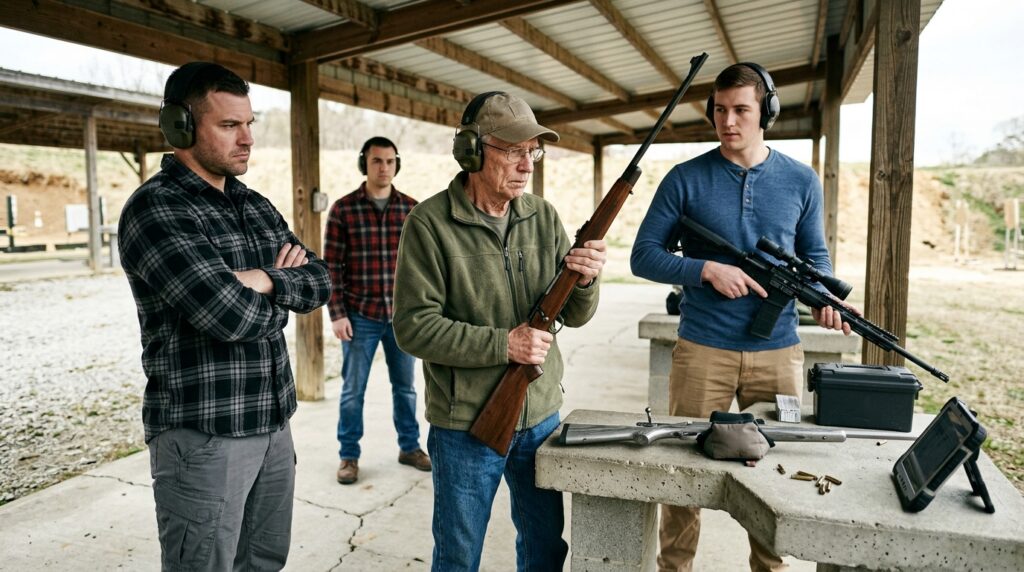
Silas turned his body back toward the firing line. The corrugated tin roof looked small from here—a narrow strip of green paint against the vast, desaturated sky of the valley. On the concrete bench, the silver rifle lay across the timber, its long bipod legs looking like the mandibles of an iron grasshopper waiting for the sun to go down.
“The lane isn’t clear yet,” Silas said. He started back up the gravel track, his steps slower now, his boots dragging slightly through the coarse stone. “We have two frames left on the card.”
Garrick didn’t follow immediately. He stood by the torn paper, his fingers touching the white lead scab in the old pine. “There’s no oil left in that well, Silas,” he called out across the hundred yards. “The boy’s already signed the paper.”
Silas didn’t stop. He reached the shade of the roof before the sweat could dry on his neck, his hand reaching directly into the small black ammunition box for his next cartridge. His fingers found the metal, but as he lifted it into the dim light of the porch, the brass didn’t shine. The base of the casing was split from the rim to the neck, a thin, black hairline crack where the old metal had finally given up under the pressure of the powder.








