
CHAPTER 6: THE HOUSE OF TOUCH
The screen door didn’t slam; the spring had rusted through during the heavy rains of April, leaving the wire mesh to scrape against the cedar frame with a slow, fibrous drag. Silas stood on the threshold, his boots remaining on the hemp mat. The kitchen smelled of cold tallow, dry linseed oil, and the sour alkaline tang of the lime-dust he’d carried home in the wool of his fleece.
He didn’t reach for the light switch beside the casing. The copper wires inside the wall had gone brittle twenty years ago, and the bulb would only offer a yellow, vibrating pulse that his right eye could no longer translate. The gray cloud had taken the kitchen table entirely. To his left, through the narrow crescent of remaining peripheral vision, the window over the sink was a flat, milky square that showed no trees, no road, and no sky.
His knuckles found the edge of the oilcloth table cover. The fabric was cracked into thousands of tiny, hardened squares that felt like lizard skin under his thumb.
“The coffee’s on the back burner,” Matthew said from the corner of the room.
The voice was lower than it had been in the spring, thicker around the edges from twelve-hour shifts on the road-grader. Silas didn’t turn his head. If he turned, the dark spot would center on his grandson’s face, erasing him into a gray silhouette. Instead, he kept his chin angled toward the cast-iron stove, letting the lower margin of his retina catch the blue smudge of Matthew’s work shirt.
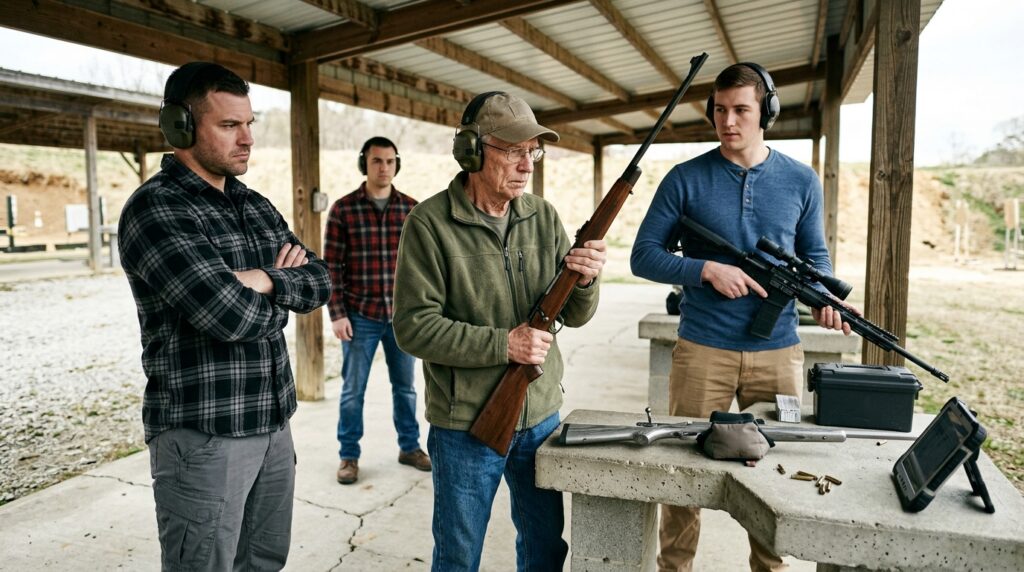
“The burner’s cold,” Silas said. He let his palm slide over the table until it struck the cold, heavy cylinder of the Winchester’s receiver. He hadn’t put the rifle back in its sheepskin scabbard. The bolt handle was still welded flat against the steel lugs, the yellow brass dust from the split shell frozen into the tracking groove like sulfur scale.
Matthew didn’t move from the low bench by the woodbox. The dry crunch of his work trousers told Silas he had his knees tucked tight, his spine bent forward the way his father used to sit when the interest notices came from the bank in the mail.
“Garrick called from the junction,” Matthew said. He didn’t ask about the target sheet. “He said you broke the action on the third frame.”
“The brass gave out,” Silas said. He reached down to his hip, his fingers tracking the iron latch-string of the cellar door until they found the brass padlock on the old grain-ledger box beneath the bench. The metal was pitted, coated in a greasy green oxidation that stuck to his skin like salt. “The metal can only take so many stretches before the mouth splits. You know that if you’ve been looking at the loading dies.”
Matthew let out a short, dry breath through his nose. “I wasn’t looking at the dies. I was looking at the tax receipt for the north pasture. The county clerk said if the easement isn’t recorded by five o’clock on Tuesday, they’re putting the drainage assessment on the winter warrant. That’s nine hundred dollars, grandfather. We don’t have ninety.”
Silas didn’t answer. He took his thumb and traced the small, square keyhole of the ledger box. He didn’t need the key; he knew the specific hitch in the internal tumbler—the way you had to lift the iron shackle two millimeters to the left to let the rusted tooth release without snapping the brass key off in the core.
“The bridge stone is already at the culvert,” Matthew pressed, his boots shifting on the pine floorboards with a dull, hollow scrape. “Garrick’s got three tri-axles lined up to drop the limestone before the rain hits on Thursday. If the trucks don’t move, the contract goes back to the state.”
“The stone’s too heavy for that ditch,” Silas said. His fingers left the lock and found the rough timber of the table leg. “The bank will cave before the frost is out of the ground. Your father knew that. He spent three winters hauling fieldstone to line that run so the water wouldn’t take the bottom out of the rye field.”
“The rye’s gone, grandfather,” Matthew’s voice rose, dropping its weight, turning thin and sharp like a saw-tooth catching a nail in old oak. “The grader’s already down to the subsoil on the kiln road. I spent six hours today ripping out the wild cherry stumps. The surveyor’s pins are already in the clay.”
Silas turned his face slightly, letting the small slit of gray-white light at the bottom of his eye catch the outline of the blue paper document Matthew had laid on the oilcloth. It sat right next to the rusted Lyman punches and the small iron hammer.
“You brought the pen?” Silas asked.
“It’s in the drawer,” Matthew whispered.
Silas didn’t reach for the drawer. He took his hand and laid it flat across the welded bolt of the Winchester, his palm absorbing the cold grease that had leaked from the blown primer. The metal felt dead, a seven-pound bar of scrap iron that had no more use in the valley than the old threshing machine sinking into the weeds behind the barn.
Outside, the first low rumble of the diesel grader came through the floorboards—a deep, rhythmic thrumming that shook the dry horsehair plaster inside the kitchen walls until a tiny trickle of white lime-dust fell from the ceiling, settling like salt across the blue paper of the easement.








