
CHAPTER 4: THE PRICE OF LEVERAGE
“That casing’s split, Silas. Your pressure’s blowing back through the firing pin.”
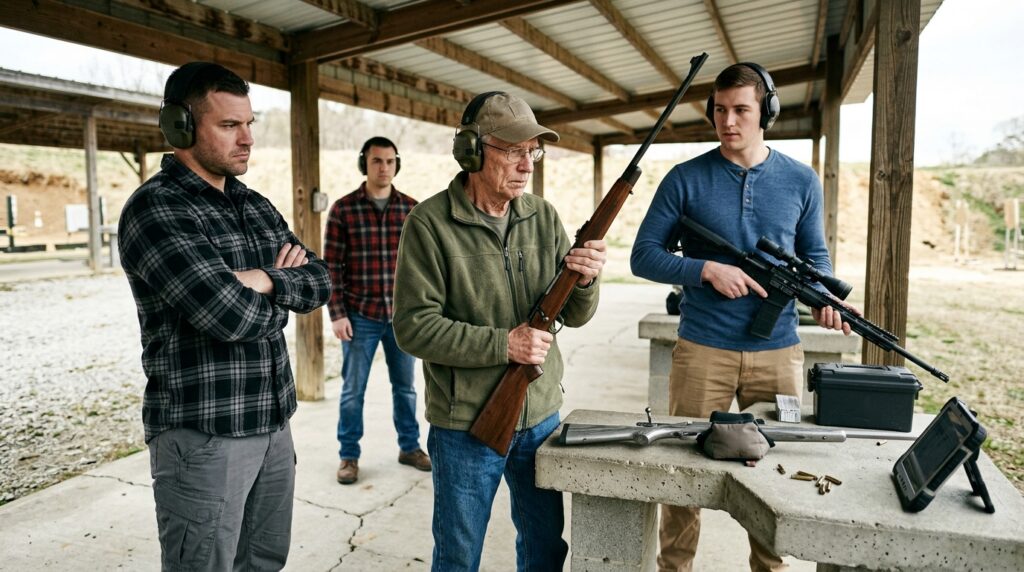
Garrick didn’t step onto the wood planks of the shooting stand. He leaned his hip against the corner post of the tool shed, his hand checking the pocket of his plaid flannel shirt where the land options sat. The desaturated gray dust of the county road was drifting across the benches now, a fine limestone powder that settled in the grease of the bolts and turned the gun oil into a gritty paste.
Silas didn’t drop the damaged cartridge. He held the brass between his thick thumb and forefinger, right where the gray blotch in his right eye made the hairline crack look like a thick black vein. His palm tasted like lead and cheap nitrocellulose.
“The brass has three more reloads in it,” Silas said, though the metal felt thin as a dead leaf between his skin. “The wall just took an extra thousandth of a stretch from the cold chamber.”
“The wall’s done,” Garrick said. He looked down at the concrete where Silas’s small tool kit lay—a rusted set of Lyman punches and a small iron hammer with a handle carved from hickory. “Just like the firing pin sleeve. Look at the brass filings coming out of the shroud. You’re shaving your primer every time the trigger hits the wall.”
Silas didn’t answer. He turned the bolt handle up on the Winchester. The action was heavy, resisting his palm with a dry, metallic drag that wasn’t there when the light was high. When the cylinder slid back, a tiny pinch of bright yellow brass dust fell out of the recess, dropping into the gray lime on the timber. His hand gave that short, circular jump again, the twitch worse now that the sun was hitting the iron barrel directly.
The younger shooter in the blue henley didn’t laugh this time. He stood by the gun rack, his fingers tracking the synthetic sling of his scoped rifle, his eyes shifting from Silas’s shaking knuckles to the open door of Garrick’s pickup truck. Inside the cab, the red light of a commercial radio was pulsing against the vinyl dashboard.
“Matthew called from the terminal,” the shooter in the blue shirt said softly to Garrick. “The state inspector wouldn’t clear the bridge over the creek without the grandfather’s signature on the easement. The boy’s signature on the option isn’t enough to drop the stone for the culvert.”
The silence came back, thicker than the dust.
Silas reached down to his box, his fingers ignoring the split brass. He felt for the third round—the one with the heavy hundred-grain round-nose lead he’d cast in the iron ladle over the kitchen stove. His vision was closing down from the top now; the gray cloud had taken the treeline entirely, leaving only a small, crescent-shaped slit of gray-white light at the absolute baseline of his eye. He had to lift his chin three inches higher just to see the silhouette of the silver rifle on the next bench.
“You knew the boy couldn’t pass the insurance check without the land behind the kiln, Garrick,” Silas said. He pushed the heavy round-nose bullet into the magazine box, his thumb forcing the spring down until the steel lips clicked against the brass rim. “You told him the company required thirty acres of clear access, but you didn’t tell him the county road map still had my father’s name on the stone.”
“The stone’s under four feet of gravel since they graded the county line,” Garrick said, his hand coming out of his pocket, holding a black ink pen with the grain company’s logo printed on the barrel. He stepped onto the timber floorboards, the wood groaning under his weight. He laid the blue paper of the easement next to Silas’s black ammunition box. “The boy needs the job, Silas. The bank’s already got the description for his house on the bulletin board down at the grocery store. Sign the waiver for the creek gate, and I’ll leave the silver rig on your bench when I drive out.”
Silas looked down at the paper. To his right eye, the document was just a blue square with three gray lines across the center where the ink sat. He couldn’t read the small print about the title transfer or the indemnification clause. He could only see the white space at the bottom where the X had been scratched with a pencil by his grandson’s shaky hand.
“The silver gun is junk,” Silas said, his hand closing around the walnut stock of his own rifle. The wood felt warm, holding the heat of his shoulder from the last shot. “It has no balance in the wind. The barrel’s too light behind the gas port.”
“It hits what it’s pointed at,” Garrick said. He didn’t raise his voice. He had the calm, flat certainty of a man who owned the scale at the elevator. “And it doesn’t need an old man’s memory to find the target. Sign the line, Silas. Let the boy go to work on Monday.”
Silas didn’t pick up the pen. He lifted the Winchester instead, his left elbow coming down onto the concrete bench with a dull, heavy thump that sent a small tremor through the iron punches in his kit. He didn’t use the rest; he wedged his forearm against the side of the ammunition box, using the weight of the wood-stock to crush his own hand against the stone until the twitching in his thumb stopped from the pressure.
Through the bottom slit of his vision, the target lane looked five hundred yards wide, a white blur surrounded by the dark gray wall of his own dying optic nerve. He couldn’t see the orange diamond at all now. The paper was just a pale ghost against the red clay of the backstop.
“One frame left,” Silas said, his teeth clicking together as he brought his cheek down against the comb. The wood was slick with his own sweat. “If the lead stays in the black, the gate stays locked.”
“You can’t see the black, old man,” Garrick said, his boots stepping right up to the edge of the bench, his shadow falling across Silas’s iron sights. “The paper’s gone gray.”
Silas didn’t move the barrel out of the shadow. He let his right eye go dark entirely, switching his mind to the feeling of the concrete under his elbow and the specific, oily smell of the grease inside the bolt sleeve. He knew the target wasn’t where his eyes said it was. It was three inches lower, right where the old iron bracket was rusting into the limestone.
He pulled the trigger.
The sound wasn’t a clean report. The split sleeve inside the action let go with a wet, heavy thud, and a jet of gray-black gas blew straight out of the bolt shroud, striking Silas across the cheekbone like a handful of hot sand. The rifle didn’t move forward; it jammed hard against his collarbone as the bolt handle locked itself into the receiver slot, welded shut by the pressure of the failing brass.
Silas didn’t cry out. He stayed down on the wood, his face black with the carbon fouling, his thumb still hooked around the dead trigger.
Through the smoke, the man in the red shirt didn’t move toward the berm. He was looking at Silas’s face, where a thin line of dark grease was running down the old man’s jaw from the blown primer. “Silas,” he said, his voice dropping into the grass. “The bolt’s frozen. You’re done.”
Silas didn’t drop the gun. He reached into his fleece pocket with his left hand, his fingers searching past the lint until they touched the small, square glass bottle of eye drops the doctor had given him at the junction clinic. He didn’t pull it out. He let his fingers crush the plastic cap until it cracked in his pocket.
“Get the hammer,” Silas whispered.








