
CHAPTER 1: THE DUST ON THE BENCH
“That old stick belongs in a museum cellar, Silas. It’s a deficit on the line.”
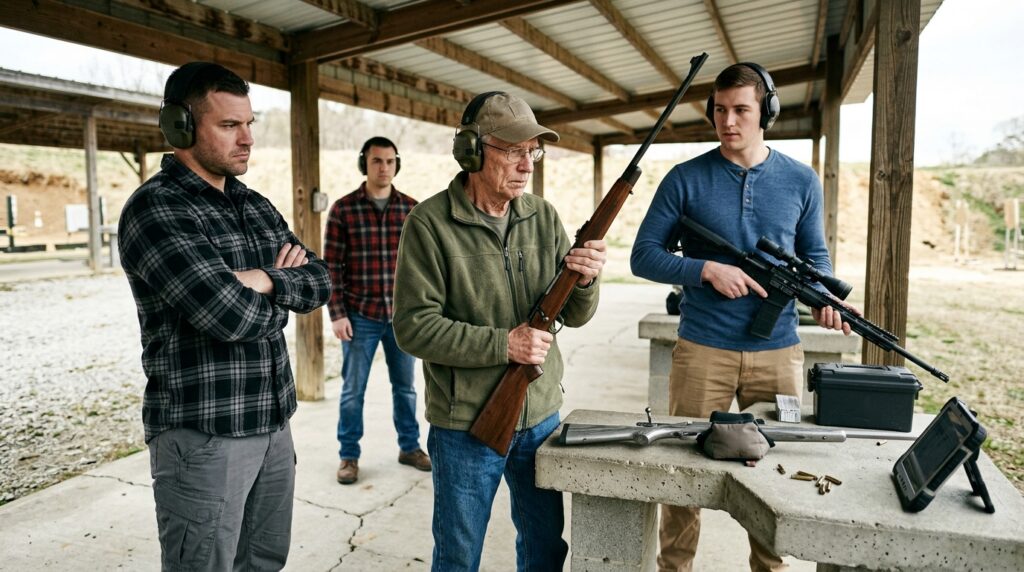
The words didn’t bounce off the corrugated tin roof; they seemed to sink into the heavy, oil-soaked timber of the benches. Garrick stood with his arms locked tight across his plaid flannel shirt, his knuckles gray from mechanical grease that never quite washed out. He didn’t look at Silas’s face. He looked at the walnut stock of the Winchester, where the varnish had gone dull and dark from decades of palm sweat.
Silas didn’t shift his boots. The concrete beneath him was cold, bleeding dampness up through the thin soles of his work shoes, but his spine remained a straight wire. A younger man in a blue henley two lanes down let his bolt click shut—a sharp, synthetic sound of computer-milled aluminum that cut through the midday heat.
“The lane’s clear,” Silas said. His voice had the dry, rhythmic rasp of a hand-saw cutting through cedar. “Unless you’re using it to spend more money.”
“I’m using it to save time,” Garrick countered, stepping closer until the smell of his damp wool shirt mixed with the sour tang of the cleaning solvent on Silas’s rag. “Three thousand dollars of optics means I don’t guess where the wind goes. You’re aiming with seventy-year-old iron and eyes that need two pairs of glasses to read the local ledger. Step off. The boys behind us didn’t drive out here to watch an old man wrestle his shoulder.”
The witness in the red shirt didn’t move. Nobody breathed.
Silas looked down at his own hand. The thumb was flat, scarred across the knuckle from an old press accident in the winter of ’84. It didn’t shake—not yet—but the marrow inside felt heavy, like wet sand. On the concrete bench, three spent brass casings lay near his small black box, their mouths blackened by the low-grade powder he’d brass-loaded himself on the kitchen table. Next to them sat Garrick’s silver rig, a weapon that looked less like a rifle and more like a surgical instrument, all matte finishes and carbon-fiber tracking levels.
“One shot,” Silas said. He reached down, his fingers closing around the cold steel of the bolt handle. The wood was familiar; it had the specific, greasy weight of an object that had outlived three local administrations. “Give me the lane, Garrick, or go back to the office and write another check.”
Garrick’s jaw tightened, the stubble along his throat bunching as he took a half-step back. He didn’t give an inch of respect; he gave space the way a man opens a gate for a stray bull, waiting for it to trip on its own weight. “Take it then. Hundred yards. Let’s see what that hand-turned lead actually buys you when the light starts dropping.”
Silas moved. It was a single, heavy step into the open box of the firing position. The air outside the roof’s shadow was brighter, the sun striking the gravel yards with a flat, desaturated glare that turned the white paper targets downrange into small, blurred squares.
He didn’t lift the rifle immediately. He let the buttstock rest against the concrete ledge, his left hand reaching into his fleece pocket. His fingers searched through the lint until they struck the cold, hard ridge of a single custom-loaded seventy-grain cartridge. It wasn’t factory-bright. The copper was dull, almost purple near the neck where the seating die had pressed it home.
As he brought the round up into the daylight, his eyes adjusted to the glare, and the small details of the bench came into focus. That was when he saw it.
Etched into the underside of the silver rifle’s aluminum chassis—partially hidden by the modern bipod mount—was a small, crude mark. It wasn’t a manufacturer’s serial code. It was a notched initials stamp, the double-barreled ‘M’ that Silas had branded into the oak posts of his own north pasture thirty years ago. A mark that only one other person in the county had the right to carry.








