Chapter 9: What the Records Revealed
The independent accounting review began the following month.
With Karen removed from the board, the remaining directors took steps under the association’s governing documents to appoint interim leadership and authorize a review of the disputed transactions.
Elaine Foster agreed to serve temporarily as president.
Thomas Ridley remained on the board but requested that his previous oversight decisions be examined along with the other records.
It was not an easy admission.
He had spent months approving expenses he did not fully understand.
Now he wanted to correct that mistake.
The independent accountant, a woman named Denise Walker, reviewed bank statements, vendor contracts, invoices, approval records, and payment documentation.
Her work took several weeks.
Margaret was not involved in the accounting process.
She deliberately kept her distance.
She wanted the review to be independent, not another personal battle.
During that time, the neighborhood began changing in small ways.
Residents returned to the clubhouse.
The veterans committee resumed planning its annual dinner.
Neighbors who had avoided meetings started attending again.
The board suspended collection of several disputed penalties while it reviewed whether they had been properly imposed.
Margaret’s $500 fine was among them.
Frank’s $750 penalty was also placed on hold.
But the most important changes were still ahead.
When Denise completed her initial report, she presented the findings to the board.
The review identified multiple weaknesses in the association’s financial controls.
Several transactions involving Caldwell Community Consulting lacked clear documentation of competitive review or appropriate conflict-of-interest approval.
Some invoices described services too vaguely to verify exactly what had been delivered.
Certain expenditures had been charged to budget categories that did not clearly match their purpose.
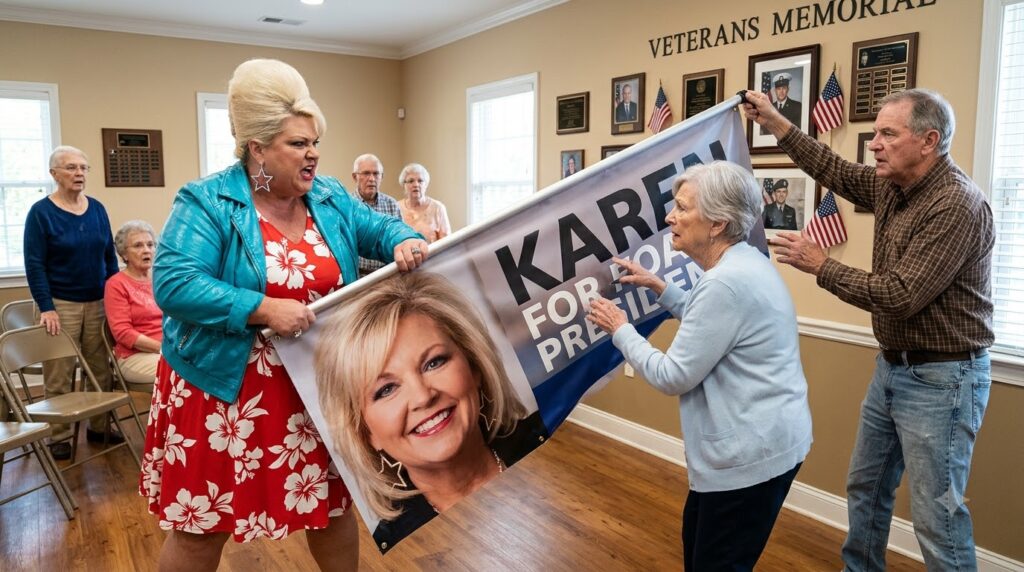
The $4,800 memorial banner expense was among the questioned payments.
The review also found that portions of the promotional work had been approved without adequate documentation of board authorization.
The findings did not establish that every payment was fraudulent.
But they provided substantial grounds for further examination.
The board consulted independent legal counsel.
It then sought repayment of certain unsupported charges and pursued additional documentation from the vendors involved.
Karen disputed the findings.
Through her attorney, she maintained that the services had been legitimate and that the board had benefited from her work.
The disagreement continued for several months.
Eventually, the HOA and Karen reached a written settlement resolving specified disputed payments and related claims without an admission of wrongdoing.
Under the settlement, the association recovered $24,600.
It was not every dollar residents had questioned.
But it was a meaningful recovery.
More importantly, the association adopted new financial safeguards.
Related-party transactions would require clear disclosure and documented review.
Larger contracts would receive additional scrutiny.
Financial summaries would be made available to homeowners through an established records process.
Violation notices would be reviewed for consistency and proper authority.
The board also established a formal procedure for homeowners to appeal fines.
Several previously disputed penalties were canceled after review, including those issued to Margaret and Frank.
Evelyn Price received a refund for the flowerpot fine after the association determined that the cited restriction had not been properly applied.
Susan Bell’s pool-related complaints were revisited.
The board approved repairs to the accessibility lift that had been out of service for months.
These were not dramatic victories.
There were no television cameras.
No courtroom confrontation.
No shouting match in the clubhouse.
Just careful work that made daily life better for people who lived there.
For Margaret, that mattered more than seeing Karen embarrassed.
Linda Parker’s situation also improved.
After her dismissal, she had consulted an employment attorney and reviewed her options.
The new board independently examined the circumstances of her termination.
Linda ultimately accepted an offer to return to her administrative position with clarified reporting procedures and employment protections.
Her first day back was emotional.
Several residents brought flowers.
Margaret brought a homemade lemon cake.
Linda laughed when she saw it.
“I thought I was supposed to be the one welcoming people back.”
“You’ve welcomed us for nine years,” Margaret replied. “It’s our turn.”
The veterans memorial received special attention.
The board approved a preservation policy requiring formal review and homeowner input before significant changes could be made to the display.
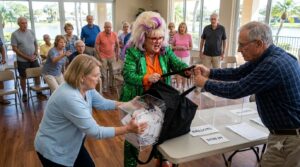
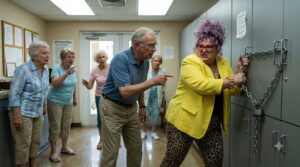
The missing brass plaques were located in a storage cabinet and returned to their places.
The damaged mounting holes left by the banner installation were repaired.
The wall was repainted.
And the large retractable advertisement was finally removed.
Frank supervised the work, standing nearby while a licensed contractor carefully detached the mechanism.
When the metal housing came down, Margaret felt an unexpected wave of emotion.
She had imagined that moment many times.
She had expected triumph.
Instead, she felt sadness.
So much trouble had begun because one person believed her own importance outweighed the memories of an entire community.
Frank carried the dismantled banner housing toward the storage room.
“What should we do with the portrait?” he asked.
Margaret considered the question.
“Let the board decide how to dispose of association property properly.”
Frank chuckled.
“You really have become the rules person around here.”
Margaret smiled.
“Somebody has to be.”
Later that afternoon, she stood alone before the restored memorial.
Robert’s photograph hung exactly where it belonged.
She touched the edge of the frame.
For years, she had come here to remember what she had lost.
Now the wall reminded her of something else.
The strength she had found.