Chapter 3: The Company Behind the Curtain
Three days later, Frank arrived at Margaret’s house carrying a laptop and a look of grim satisfaction.
“I found the company.”
Margaret poured him coffee.
“Caldwell Community Consulting?”
“Registered right here in South Carolina.”
He turned the computer toward her.
The public business filing listed Patricia Caldwell as the company’s registered agent.
The address matched Karen’s home.
Margaret stared at the screen.
“What does the company do?”
“According to its registration, community management consulting and promotional services.”
Frank clicked through several pages.
The company had been formed shortly after Karen became HOA president.
There was nothing inherently wrong with that.
People were entitled to operate businesses.
But the timing raised questions.
Especially because Karen had never mentioned the company during the association’s annual financial presentations.
Frank had also discovered something else.
The business website, which appeared outdated, displayed photographs of neighborhood events, decorative banners, clubhouse signage, and community newsletters.
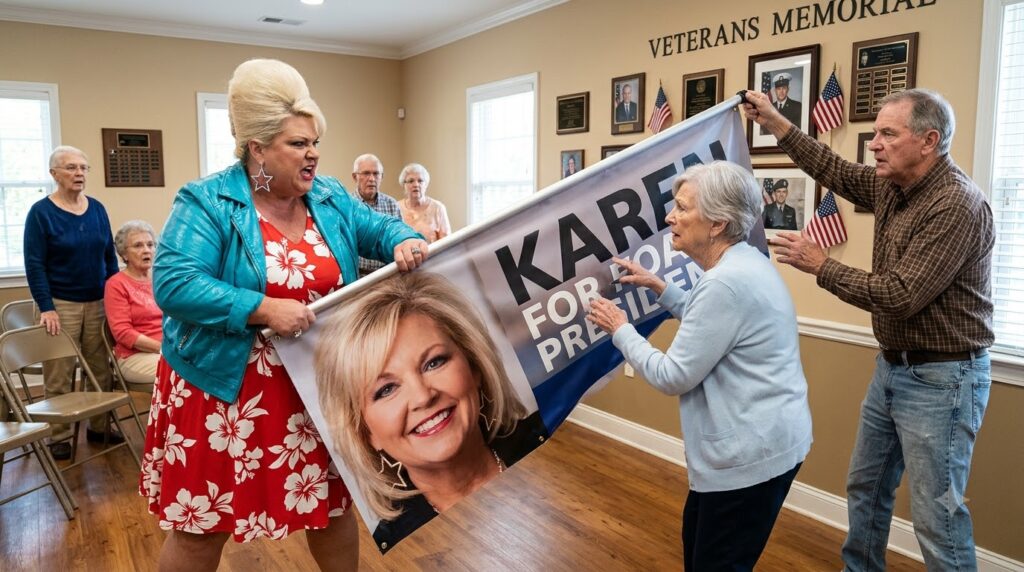
One photograph showed a large promotional banner bearing Karen’s face.
It was the same design that had covered the veterans memorial.
Margaret leaned closer.
“How much did it cost?”
“We don’t know yet.”
“Can we find out?”
“That’s the plan.”
Their first opportunity came sooner than expected.
On Monday morning, Linda Parker called Margaret from a private telephone number.
Her voice was barely above a whisper.
“I can’t talk long.”
Margaret sat down.
“Are you all right?”
“No. But I think you need to know something.”
Linda explained that Karen had ordered the banner through Caldwell Community Consulting.
The invoice had been submitted to the HOA under a category labeled Community Engagement and Historical Display Improvements.
Margaret closed her eyes.
“How much?”
“Four thousand eight hundred dollars.”
For a moment, Margaret thought she had misunderstood.
“Four thousand eight hundred dollars for a banner?”
“That included design, installation, and promotional consulting.”
Margaret looked at Robert’s photograph on her living room mantel.
Four thousand eight hundred dollars.
The veterans committee had spent nearly two years raising $2,000 to replace damaged memorial plaques.
Karen had refused to approve additional association funding for that project.
She had said the HOA couldn’t afford it.
“Linda, do you have a copy of the invoice?”
A long silence followed.
“I have access to the association records, but I can’t just take documents.”
“I wouldn’t ask you to.”
Linda exhaled.
“Then request the vendor payment register. And the board approval records.”
“Will they give them to me?”
“They’re supposed to process proper requests. But Mrs. Caldwell has been blocking everything.”
Margaret thanked her.
Before ending the call, Linda added something that made Margaret’s stomach tighten.
“The banner isn’t the only payment.”
That afternoon, Margaret and Frank met with Harold Jenkins.
Harold had spent thirty-eight years working as a bank auditor before retiring to Magnolia Pines.
He was a quiet man who disliked gossip and preferred evidence.
When Frank showed him the public company registration, Harold adjusted his glasses.
“This proves she owns the company,” he said. “It doesn’t prove she did anything improper.”
Margaret nodded.
“Then we need the records.”
Harold agreed to help review whatever they could lawfully obtain.
He also suggested they stop discussing their suspicions in public.
“If money is involved, we need to be precise. No accusations we can’t support.”
Over the next week, the three residents submitted formal requests for association financial records.
They sent copies by certified mail and retained proof of delivery.
They also reviewed the HOA’s governing documents.
Those documents contained an important provision.
Directors were required to disclose financial interests in transactions involving the association.
Any transaction involving a director’s business required review under the association’s conflict-of-interest policy.
Margaret read that section several times.
It did not automatically mean Karen had violated the rules.
But it meant the payments deserved scrutiny.
Meanwhile, Karen began fighting back.
A notice appeared on the clubhouse bulletin board.
WARNING: FALSE INFORMATION ABOUT HOA LEADERSHIP WILL NOT BE TOLERATED.
Another notice announced new restrictions on resident gatherings inside the clubhouse.
Groups of more than four people would need advance written permission.
Frank called Margaret after seeing it.
“She’s trying to stop us from meeting.”
Margaret looked around her living room.
There were six chairs at her dining table and another four in the den.
“Then we’ll meet at my house.”
That Thursday evening, fourteen neighbors arrived carrying casseroles, cookies, and folders of HOA correspondence.
Some had never spoken publicly against Karen.
Others had been waiting years for someone to challenge her.
Dorothy Miller brought a photograph of her brother’s memorial plaque.
Evelyn Price brought receipts for fines she believed were retaliatory.
A retired nurse named Susan Bell brought copies of notices Karen had sent after Susan questioned the pool maintenance contract.
Margaret listened to each person.
She did not promise revenge.
She promised only that they would examine the records and follow the rules.
Near the end of the gathering, Harold opened the HOA bylaws.
He pointed to a section concerning special membership meetings.
Under the association’s rules, a petition signed by twenty percent of eligible homeowners could require the board to call a special meeting.
Twenty percent of 146 homes meant they would need at least thirty valid signatures.
Frank looked around the room.
“We already have fourteen households represented here.”
Margaret glanced at the photograph of Robert above the fireplace.
For the first time since the banner incident, she felt something stronger than grief.
She felt purpose.
But the next morning, a letter arrived from an attorney representing the HOA.
It accused Margaret, Frank, and Harold of organizing a campaign of harassment against the association president.
It demanded that they stop making what it described as damaging allegations.
And it warned that further action could result in legal proceedings.
Karen had turned a dispute over a memorial into a threat against three retirees.
What she didn’t realize was that the letter would bring someone new into the fight.
Someone who knew exactly how to read the rules Karen had been using against her neighbors.