Chapter 10: The Wall That Belonged to Everyone
The following spring, Magnolia Pines held its annual Veterans Appreciation Dinner.
The clubhouse looked different.
Not because it had been transformed into something luxurious.
But because it once again felt welcoming.
Fresh flowers decorated the tables.
Small American flags stood beside framed photographs of service members.
The kitchen smelled of roasted chicken, warm rolls, and homemade apple pie.
Volunteers moved between the tables carrying pitchers of iced tea.
Children and grandchildren had come to help serve dinner.
At the far end of the room, the veterans memorial stood fully restored.
The photographs were polished.
The brass plaques gleamed.
A new wooden sign had been mounted above the display.
It read:
IN HONOR OF THOSE WHO SERVED — THEIR SACRIFICE, OUR GRATITUDE.
There were no campaign slogans.
No portraits of HOA officers.
No oversized advertisements.
Only the names and faces of people whose service the community had chosen to remember.
Margaret arrived wearing a pale-blue cardigan.
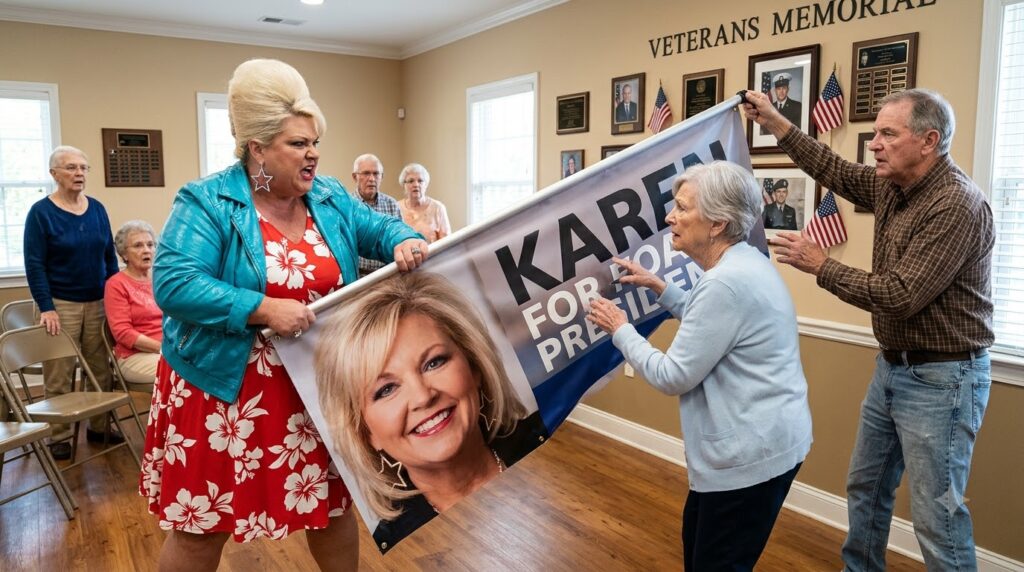
It was the same cardigan she had worn the afternoon Karen pulled the banner over Robert’s photograph.
She had considered choosing something different.
But in the end, she decided there was no reason to let that memory determine what she wore.
Rebecca accompanied her, along with Margaret’s two grandchildren.
Her grandson, sixteen-year-old Ethan, carried a small bouquet of white roses.
Her granddaughter, twelve-year-old Lily, held a framed photograph of Robert standing beside his Army unit.
They placed both items near the memorial.
Lily studied her grandfather’s portrait.
“Grandma, was Grandpa really the one who helped build this wall?”
Margaret smiled.
“He was.”
“Did he know all these people?”
“Some of them. Others he knew through their families.”
Lily looked at the photographs.
“Why did he want to make it?”
Margaret thought for a moment.
“Because he believed people deserved to be remembered for what they gave, not for how important they thought they were.”
Lily nodded seriously.
Then she reached for Margaret’s hand.
Across the room, Frank was helping Harold arrange chairs.
Dorothy stood beside her brother’s restored plaque.
Linda welcomed guests at the entrance.
Elaine Foster moved from table to table, speaking with residents and answering questions about the upcoming board election.
The atmosphere was peaceful.
Not perfect.
Magnolia Pines still had disagreements.
Some residents thought the landscaping budget was too high.
Others wanted longer pool hours.
A few complained about parking.
But those arguments now happened openly.
People could disagree without fearing retaliation.
The HOA had published a clearer annual budget and established regular opportunities for homeowner questions.
New board candidates had come forward.
Several were people who had never considered serving before.
Margaret had been encouraged to run.
She declined.
She had no desire to become president.
Her goal had never been to replace Karen with herself.
She wanted an association that did not depend on any single person’s personality or power.
That evening, Elaine invited Margaret to say a few words before dinner.
Margaret walked to the front of the room.
She looked toward the memorial.
Then toward the people gathered around the tables.
“I’ve lived here a long time,” she began. “Long enough to know that a neighborhood isn’t made by its rules or its buildings.”
She paused.
“It’s made by the people who look after one another.”
Several residents nodded.
Margaret continued.
“We’ve had a difficult year. Some of us were hurt. Some were frightened. And some of us made mistakes.”
Her gaze moved gently toward Thomas, who sat beside Carol.
He lowered his eyes, then looked up again.
“But we also learned something important. Respect isn’t something a board can demand. It’s something we owe each other.”
The room remained quiet.
Margaret glanced at Robert’s photograph.
“My husband believed service meant doing what was right even when nobody was watching. I hope we can carry a little of that spirit into the way we treat our neighbors.”
She stepped away from the microphone.
The applause began softly.
Then grew.
Frank stood first.
Dorothy followed.
Soon the room was on its feet.
Margaret’s cheeks flushed.
She had never enjoyed being the center of attention.
Rebecca embraced her when she returned to her seat.
“Dad would have been proud.”
Margaret looked toward the memorial.
“I hope so.”
Outside, the South Carolina evening settled gently over the neighborhood.
Porch lights glowed along the quiet streets.
A warm breeze moved through the magnolia trees.
Somewhere nearby, children laughed.
Life continued.
Karen Caldwell no longer served on the HOA board.
She still owned her home in Magnolia Pines, and she retained the same rights and responsibilities as every other homeowner.
Most residents left her alone.
Margaret did too.
She had no interest in extending the conflict.
The settlement had addressed the financial dispute.
The new board had corrected the rules.
The memorial had been restored.
And the community had regained something more valuable than any campaign victory.
Its confidence.
After dinner, Margaret remained behind for a few minutes.
The clubhouse had grown quiet.
The last volunteers were washing dishes in the kitchen.
She walked to the memorial and stood before Robert’s photograph.
In the picture, he wore his dress uniform and the small, familiar smile that had always appeared when he was trying not to laugh.
Margaret remembered the afternoon the banner fell.
The shock.
The humiliation.
The terrible feeling that her husband’s memory had been treated as something disposable.
She remembered Karen’s furious voice.
The five-hundred-dollar fine.
The threatening letters.
The meetings.
The neighbors who had been afraid to speak.
And the moment they finally discovered they could stand together.
She reached into her handbag and removed a small folded note.
It was something Robert had written years earlier, tucked inside a birthday card.
The handwriting was slightly crooked.
The words were simple.
The best thing we leave behind is how we treated people.
Margaret had read that sentence hundreds of times.
That evening, it felt especially true.
She returned the note to her handbag and straightened the little American flag beside his photograph.
Then she switched off the memorial lights and walked toward the clubhouse door.
Frank was waiting outside.
“Ready to go home?”
Margaret looked back one final time.
The wall stood quiet and dignified.
Every photograph was visible.
Every plaque was in its proper place.
Nothing covered the names.
Nothing demanded attention.
Nothing tried to make one person more important than everyone else.
“Yes,” she said.
“I’m ready.”
Together, they stepped into the warm evening.
Behind them, the clubhouse door closed softly.
And the veterans memorial remained exactly where it belonged.
Not as a monument to power.
Not as a decoration for someone’s ambition.
But as a promise that the people who had served, sacrificed, and loved their community would never again be pushed aside simply because someone louder wanted the spotlight.
THE END