Chapter 5: The Meeting Karen Couldn’t Control
Friday evening brought a thunderstorm to Magnolia Pines.
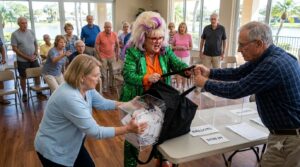
Rain struck the clubhouse windows while residents gathered beneath the covered entrance.
Inside, folding chairs had been arranged in three neat rows.
Karen sat at the front behind a long table.
She wore a bright emerald-green jacket, a leopard-print blouse, and enough gold jewelry to catch every overhead light.
Beside her sat two board members: vice president Thomas Ridley and secretary Elaine Foster.
Thomas was a retired insurance salesman who generally supported Karen without asking questions.
Elaine, a former school administrator, had grown increasingly uncomfortable with the president’s decisions.
Karen opened the meeting by announcing that several residents had engaged in conduct harmful to the association.
She did not mention the veterans memorial.
Instead, she described unauthorized gatherings, interference with association property, and efforts to undermine community leadership.
Margaret sat in the second row beside Frank.
Rebecca was nearby, attending as Margaret’s guest.
Harold held a notebook on his lap.
Karen’s voice grew louder as she spoke.
She accused unnamed residents of spreading misinformation and creating unnecessary conflict.
Then she announced that the board would consider additional penalties for repeated violations.
Frank raised his hand.
Karen ignored him.
Elaine leaned toward the microphone.
“Patricia, shouldn’t we allow the affected residents to respond?”
Karen turned sharply.
“This is a board meeting, Elaine.”
“Yes,” Elaine replied. “And we should follow our procedures.”
A murmur moved through the room.
Karen glared at her.
For several seconds, neither woman spoke.
Then Thomas suggested moving directly to a vote.
But Elaine asked to see the written violation reports and the authority supporting the proposed penalties.
Karen shuffled papers.
She could not immediately produce the documents.
Margaret watched the exchange carefully.
This was the first time she had seen another board member openly question Karen.
When the floor was finally opened for limited resident comments, Margaret stood.
She held a single sheet of paper.
Her hands were steady.
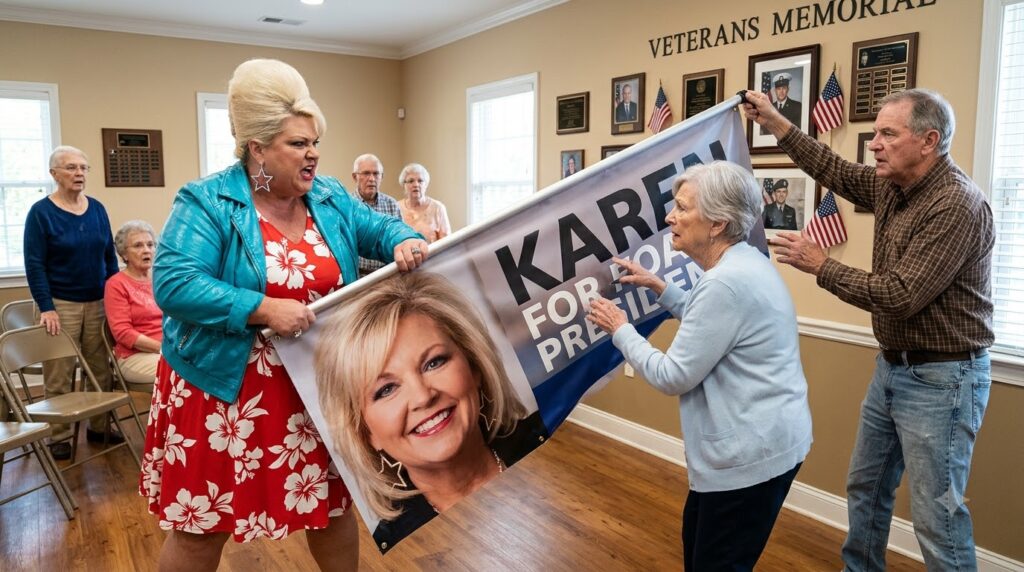
“I’d like to ask why the veterans memorial was covered by a campaign advertisement.”
Karen leaned toward the microphone.
“That matter has already been addressed.”
Margaret continued.
“Who authorized the expense?”
Karen’s expression tightened.
“The association approved community improvements.”
“Was there a board vote?”
Karen looked toward Thomas.
Thomas stared at his notes.
Elaine spoke.
“I don’t recall voting on that particular banner.”
The room became very quiet.
Karen quickly insisted that the expenditure had fallen within her administrative authority.
Harold raised his hand.
When recognized, he asked whether the association had disclosed that the vendor was a business registered to the HOA president.
Thomas looked up.
“What business?”
Harold stated the company name.
Caldwell Community Consulting.
Elaine turned toward Karen.
“Patricia, is that your company?”
Karen’s face flushed.
“It provides legitimate services.”
“That wasn’t the question,” Elaine said.
Karen slapped her palm against the table.
“I will not be interrogated by a mob!”
Several residents recoiled.
Margaret remained standing.
“Nobody is asking you to surrender your dignity, Mrs. Caldwell. We’re asking you to respect ours.”
The sentence landed more forcefully than any shouted accusation.
Karen attempted to end public comment.
But Elaine requested that the board postpone disciplinary action until the supporting documents could be reviewed.
Thomas hesitated.
He had spent years avoiding confrontation.
Now he was watching the president’s authority unravel in front of dozens of neighbors.
Finally, he agreed.
By a two-to-one vote, the board postponed the proposed penalties.
Karen voted against the postponement.
It was a small procedural decision.
But to the residents of Magnolia Pines, it felt enormous.
For the first time in years, Karen had not gotten everything she wanted.
After the meeting, Margaret stood beneath the clubhouse awning while rain poured into the parking lot.
A woman approached her.
She introduced herself as Carol Ridley.
Thomas’s wife.
Carol was seventy, soft-spoken, and visibly nervous.
“My husband doesn’t know I’m talking to you,” she said.
Margaret waited.
Carol glanced back toward the clubhouse.
“Thomas has been worried about the spending for months.”
“Then why hasn’t he said anything?”
Carol looked embarrassed.
“Because Patricia told him the association could be sued if the board questioned contracts that had already been signed.”
Margaret felt a familiar anger rising.
Karen had apparently frightened her own board members as effectively as she had frightened the homeowners.
Carol lowered her voice.
“There’s something else.”
She explained that Thomas had recently received a packet of financial documents for the annual budget review.
Several invoices appeared to involve companies connected to Karen.
Thomas had asked for clarification.
Karen told him the contracts were confidential and warned him not to discuss them.
Carol looked directly at Margaret.
“He doesn’t want trouble. But he doesn’t want to be responsible for something wrong, either.”
Margaret thanked her.
Before leaving, Carol reached into her purse.
She removed a folded piece of paper.
It was a list of vendor names copied from a board packet.
Margaret did not take it immediately.
“Does Thomas know you’re sharing this?”
Carol shook her head.
Margaret gently pushed the paper back.
“Please ask him to bring his concerns to the board himself. We need to do this properly.”
Carol looked surprised.
Then relieved.
The following morning, Thomas called Harold.
He wanted to meet.
And this time, he was willing to bring the records.