Chapter 8: The Vote Beneath the Smiling Portrait
The special membership meeting began at six o’clock on a Tuesday evening.
By five-thirty, the Magnolia Pines clubhouse parking lot was nearly full.
Residents arrived carrying folding umbrellas, reading glasses, and carefully organized folders.
Some used walkers.
Others leaned on canes.
Several came with adult children who helped them navigate the crowded entrance.
The atmosphere was tense but orderly.
Elaine Foster had arranged for the meeting to be conducted according to the association’s governing documents.
An independent meeting facilitator had been retained to oversee the voting process and help ensure that the required procedures were followed.
The eligible voting list had been reviewed.
Proxies and ballots would be handled under the association’s rules.
Margaret was grateful.
Whatever happened, she wanted the result to be legitimate.
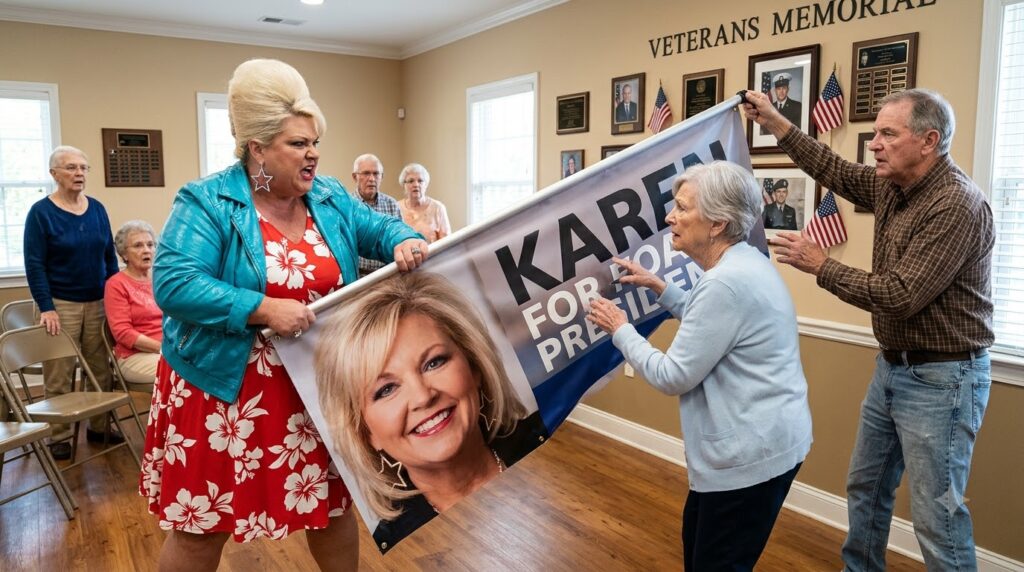
Inside the clubhouse, the veterans memorial stood uncovered.
The giant retractable banner remained jammed near the ceiling.
Karen’s smiling portrait looked down upon the gathering.
Nobody had removed it because the board had agreed to preserve the disputed installation until the matter could be properly resolved.
The irony was impossible to miss.
Karen arrived shortly before six.
She wore a brilliant fuchsia suit, oversized pearl earrings, and her towering platinum-blonde hair arranged with extraordinary precision.
She walked to the front of the room without acknowledging Margaret.
Thomas and Elaine sat at the board table.
Harold occupied a chair near the front.
Frank stood beside the memorial, wearing a dark jacket with a small veterans pin.
Margaret sat quietly in the second row.
She had brought a photograph of Robert in her handbag.
Not because she expected to need it.
But because holding it reminded her why she had begun.
The meeting opened with a review of the agenda and voting procedures.
Residents would consider the removal of Karen from the board under the applicable provisions of the HOA’s governing documents.
They would also discuss proposals for financial oversight and memorial protection.
Karen was given an opportunity to address the membership.
She spoke for several minutes.
She described improvements completed during her presidency.
She cited landscaping projects, clubhouse upgrades, and efforts to maintain property values.
Some residents nodded.
Those projects had mattered to them.
But Karen’s tone changed when she addressed the controversy.
She accused critics of creating division.
She insisted the memorial banner had been misunderstood.
She portrayed the financial questions as attacks on her personal integrity.
Then she pointed toward Margaret.
“This entire mess began because one woman refused to respect HOA authority!”
A murmur moved through the room.
The facilitator reminded everyone to keep comments directed toward the issues.
Karen sat down, visibly irritated.
Margaret had prepared a short statement.
When her turn came, she walked to the front without notes.
She looked around the room.
She saw neighbors who had attended Robert’s funeral.
People who had delivered meals when she was ill.
People who had quietly endured fines and threats because they were afraid of losing the peaceful retirement they had worked so hard to achieve.
Margaret spoke slowly.
“I didn’t come here to embarrass anyone. I came because my husband’s photograph was covered, and I was told I had no right to question it.”
She paused.
“Then I learned other people had been afraid to ask questions too.”
She looked toward Karen.
“An HOA should help neighbors take care of the place they call home. It shouldn’t make them afraid to live there.”
The room remained silent.
Margaret continued.
“We deserve clear records, fair rules, and respect. Whoever serves on this board should remember that.”
She returned to her seat.
Frank squeezed her shoulder.
The facilitator then summarized the voting process.
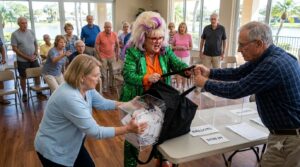
Ballots were distributed and collected.
The count took longer than expected because the officials carefully checked eligibility and reconciled the voting records.
During the wait, Margaret sat beside Dorothy.
Neither spoke much.
Across the room, Karen paced near the windows.
She occasionally whispered to Thomas, who responded politely but did not appear interested in a prolonged conversation.
Finally, the facilitator returned to the microphone.
The room fell quiet.
The votes had been counted and verified.
The motion to remove Patricia Caldwell from the board had passed by the required margin.
For several seconds, nobody moved.
Then a wave of applause spread through the clubhouse.
Some residents stood.
Others remained seated, wiping tears from their eyes.
Margaret closed her eyes.
She felt no desire to humiliate Karen.
Only relief.
Karen rose abruptly.
She demanded a recount.
The facilitator explained the available procedures for challenging the result and confirmed that the count had been conducted under the meeting rules.
Karen argued that residents had been misled.
She accused the newspaper of bias.
She insisted that her leadership had been essential to Magnolia Pines.
But the vote stood.
Karen gathered her handbag and moved toward the exit.
Before leaving, she looked back at Margaret.
“You think you’ve won?”
Margaret met her eyes.
“I think our neighbors have finally been heard.”
Karen left without another word.
The applause had already faded.
People were beginning to discuss what came next.
There were vacancies to address, records to review, and relationships to repair.
Margaret understood that the vote was not the end of the work.
It was the beginning of accountability.
Above the memorial, Karen’s smiling portrait still hung crookedly from the ceiling.
Frank looked at it.
“Well,” he said quietly, “I suppose we can finally take that thing down.”
Margaret smiled.
But Harold approached them with a serious expression.
“The financial review still needs to happen.”
Margaret nodded.
She knew he was right.
Removing Karen from office did not answer what had happened to the association’s money.
And until those questions were resolved, the community could not truly move forward.