Chapter 4: The Daughter Who Knew the Law
Margaret’s daughter, Rebecca Whitmore Lawson, arrived from Charleston on Saturday morning.
At fifty-one, Rebecca was a civil litigation attorney who had spent much of her career representing small businesses and homeowners in contract disputes.
She had inherited her father’s steady temperament and her mother’s stubborn sense of fairness.
She read the HOA attorney’s letter at Margaret’s kitchen table.
Then she read it again.
“Mom, what exactly have you told people?”
Margaret explained the banner, the fines, the company registration, and the financial records requests.
Rebecca listened without interrupting.
When Margaret finished, her daughter folded the letter.
“First, you need to stop treating every threatening letter like a court judgment.”
Margaret managed a small smile.
“That’s easier when you’re a lawyer.”
“Second, don’t ignore it. We need to respond carefully.”
Rebecca explained that a demand letter did not establish that anyone had committed wrongdoing.
She also cautioned that the association’s governing documents and applicable law would determine what records residents could inspect and what procedures the board had to follow.
The safest approach was to focus on verifiable facts.
No public accusations of theft.
No speculation about criminal conduct.
No personal attacks.
Just documented questions about association spending, disclosure, and board authority.
Margaret appreciated the advice.
But what mattered most was that Rebecca believed her mother had a legitimate reason to ask questions.
That afternoon, Rebecca accompanied Margaret to the clubhouse.
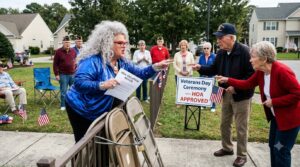
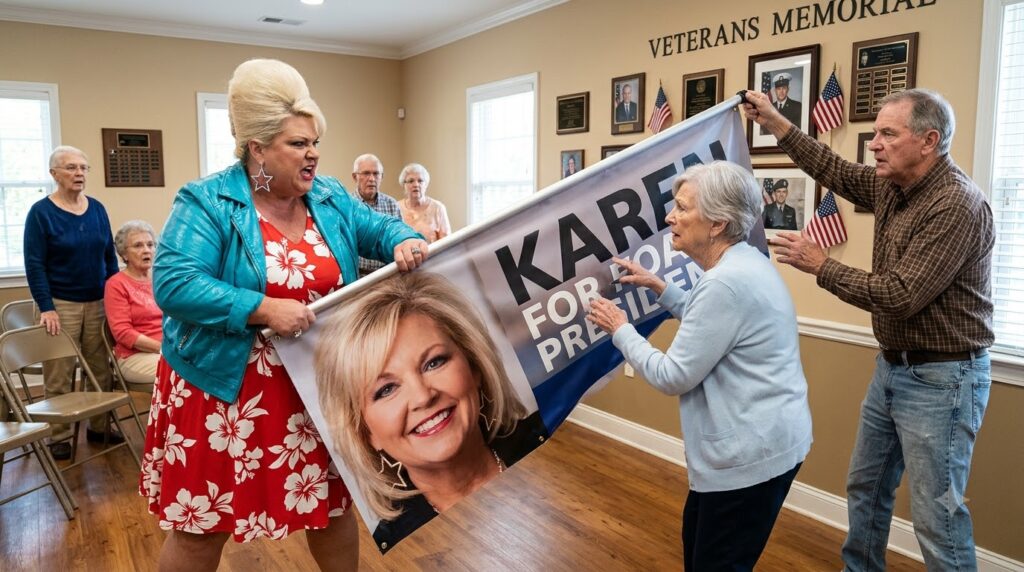
The veterans memorial was visible again.
However, the retractable banner remained mounted above it.
Someone had tied the release cord high against the wall.
A new sign hung beside the display.
MEMORIAL AREA UNDER ADMINISTRATIVE REVIEW. DO NOT ALTER.
Margaret stood before Robert’s photograph.
His eyes seemed to follow her from the frame.
Rebecca stepped beside her.
“I remember when Dad helped put this wall together.”
Margaret nodded.
“He measured every frame himself.”
Rebecca smiled faintly.
“And complained that nobody knew how to use a level.”
For a moment, they both laughed.
Then Rebecca noticed several empty spaces near the bottom of the memorial.
“Were there plaques here?”
Margaret looked closer.
Three small brass nameplates had been removed.
She recognized one immediately.
It belonged to Dorothy Miller’s brother.
The other two honored veterans whose families still lived in Magnolia Pines.
Margaret felt her chest tighten.
“Those were here last week.”
Rebecca photographed the empty spaces.
They went directly to the office.
Linda was working alone.
When Margaret asked about the plaques, Linda looked distressed.
“Mrs. Caldwell ordered them removed.”
“Why?”
“She said the memorial was being redesigned.”
Rebecca asked whether there had been a board vote approving the change.
Linda shook her head.
“Not that I’ve seen.”
She then handed Margaret an acknowledgment of her earlier records request.
The association had agreed to provide certain financial documents within a specified review period.
Rebecca examined the letter.
It was progress.
Not victory, but progress.
Before they left, Linda quietly mentioned that she had been instructed to prepare a list of residents who had signed complaints against Karen.
Rebecca’s expression sharpened.
“Who requested that list?”
“Mrs. Caldwell.”
“Did she say why?”
Linda hesitated.
“She said the board needed to identify troublemakers.”
Rebecca did not react dramatically.
She simply wrote down the date and Linda’s exact words.
Outside, Margaret looked worried.
“Could Linda lose her job for talking to us?”
“She could face pressure,” Rebecca replied. “We shouldn’t put her in a difficult position.”
They agreed not to disclose Linda’s involvement without her permission.
That evening, Rebecca reviewed the HOA bylaws with Frank and Harold.
The documents gave the board authority over common areas, but they also required proper procedures for certain expenditures and membership actions.
More importantly, the bylaws described how homeowners could call a special meeting and vote on removing directors.
The process would require careful notice, verification of voting eligibility, and compliance with the association’s rules.
It would not be quick.
And Karen would almost certainly fight it.
But the procedure existed.
Frank leaned forward.
“Can we remove her?”
Rebecca chose her words carefully.
“The members may have that authority if they follow the governing documents. But don’t assume removing one person fixes everything.”
Harold agreed.
“We need to know where the money went.”
Margaret looked at the stack of violation notices on the table.
“And we need to stop her from punishing people who speak up.”
Rebecca nodded.
“Then you need more than a petition. You need a community willing to participate.”
Over the next several days, Margaret began visiting neighbors.
She did not knock on doors demanding signatures.
She asked people how they felt about the HOA.
Many invited her inside.
She heard stories of loneliness, frustration, and fear.
One man admitted he had stopped inviting his grandchildren to use the community pool because Karen had repeatedly questioned whether they were authorized guests.
Another resident said she had paid a landscaping fine rather than risk losing access to the clubhouse.
A retired postal worker described receiving warning letters after questioning an unexplained increase in maintenance fees.
Margaret realized the problem extended far beyond the veterans memorial.
Karen had created an atmosphere in which ordinary residents felt they needed permission to enjoy their own neighborhood.
By Wednesday evening, Margaret had collected twenty-seven signatures.
Three more would meet the petition threshold.
Then Karen announced an emergency HOA board meeting.
The agenda contained only one item.
Consideration of Disciplinary Action Against Residents Engaged in Organized Disruption.
The meeting was scheduled for Friday.
Margaret understood the message.
Karen intended to make an example of her before the petition could succeed.
But by then, Margaret had learned something important.
Fear worked best when people believed they were standing alone.
And she was no longer alone.