Chapter 2: The Five-Hundred-Dollar Notice
The violation notice arrived the following morning.
Margaret found it taped to her front door beneath a small American flag she had displayed beside her porch.
The envelope bore the official Magnolia Pines HOA seal.
Inside was a single sheet of paper.
VIOLATION: Unauthorized Interference With Association Property.
FINE: $500.
ADDITIONAL WARNING: Continued disruptive conduct may result in suspension of clubhouse privileges.
At the bottom was Karen Caldwell’s signature.
Margaret read the letter twice.
Then she sat at her kitchen table and began to cry.
Not because of the money.
Five hundred dollars was a considerable amount on her fixed retirement income, but she could manage it if necessary.
What hurt was the accusation.
For fourteen years, Margaret had volunteered at the clubhouse.
She organized holiday dinners, delivered meals to recovering neighbors, and maintained the veterans memorial without receiving a penny.
Every Memorial Day, she polished the frames and replaced the faded flags.
Now the association was threatening to ban her from the very building where she had spent so much of her retirement helping others.
Her telephone rang.
It was Frank.
“Did you get one too?”
Margaret wiped her cheeks.
“A fine?”
“Seven hundred and fifty dollars. They say I damaged association equipment.”
Margaret looked toward the kitchen window.
Across the street, a landscaper was trimming hedges outside Karen’s house.
“That banner wasn’t supposed to be there,” she said.
“Maybe not,” Frank replied. “But I think we need to find out who paid for it.”
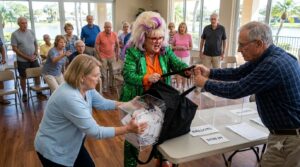
By ten o’clock, Frank was sitting across from Margaret at her kitchen table.
He brought a folder containing photographs he had taken the previous afternoon.
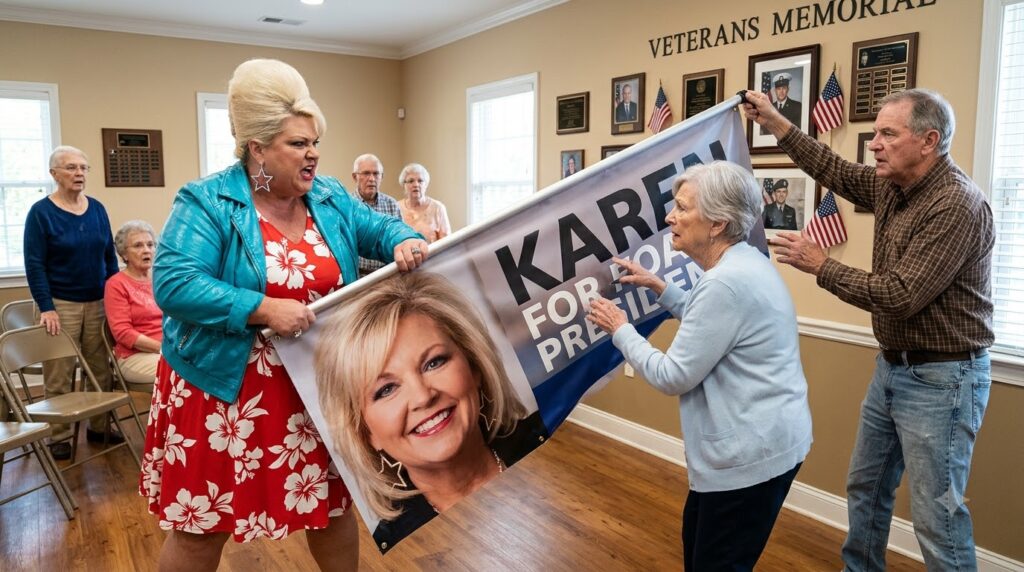
One showed the memorial before Karen pulled the banner down.
Another showed the advertising display covering the portraits.
A third captured Karen standing beneath her enormous smiling face.
Frank had also photographed the banner’s mounting brackets and a small manufacturer’s label on the metal housing.
“Professional installation,” he said. “Not something she picked up at a craft store.”
Margaret examined the photographs.
“Why would she spend so much money on a campaign banner?”
Frank hesitated.
“That’s what bothers me. The next HOA election isn’t until spring.”
Magnolia Pines had 146 homes, most occupied by retirees.
The HOA collected monthly dues to maintain the clubhouse, landscaping, private roads, and community pool.
The annual budget was substantial enough to require careful oversight.
Unfortunately, very few residents attended financial meetings.
Most trusted the board to handle routine business.
Karen had exploited that trust.
During her presidency, she had replaced two board members with close supporters, moved financial discussions into closed sessions, and repeatedly delayed requests for detailed spending reports.
Residents who questioned her decisions often found themselves receiving violation notices.
A widow who complained about landscaping costs had been fined for an allegedly unapproved bird feeder.
A retired schoolteacher who requested meeting minutes received three warnings about the condition of her mailbox.
Frank himself had been threatened with legal action after asking why the HOA’s insurance expenses had increased.
Margaret had heard these stories.
She had never connected them.
Until now.
“Maybe we’re not the only ones,” she said.
Frank nodded.
They spent the afternoon making telephone calls.
By evening, they had spoken with eleven neighbors.
Eight had received unexpected fines after criticizing Karen.
Three had stopped attending meetings because they felt intimidated.
One resident, seventy-six-year-old Evelyn Price, admitted she had paid a $300 penalty rather than challenge Karen over a flowerpot.
“I just wanted peace,” Evelyn said.
That sentence stayed with Margaret.
She understood it.
At seventy-four, peace was precious.
After Robert died, she had worked hard to rebuild a quiet life.
She enjoyed tending her roses, reading mysteries, and watching her grandchildren play in the backyard.
She did not want a war with the HOA.
But she also remembered something Robert used to say.
Peace isn’t worth much if you have to surrender your dignity to keep it.
The next afternoon, Margaret visited the clubhouse office.
The association’s administrative assistant, Linda Parker, sat behind a desk stacked with folders.
Linda was sixty-three, with tired eyes and a habit of glancing toward Karen’s closed office door before answering questions.
Margaret politely requested copies of the approved budget, recent board meeting minutes, and invoices related to the memorial banner.
Linda’s expression changed.
“I can give you the records request form.”
“That’s fine.”
Linda slid a paper across the desk.
Margaret completed it carefully.
When she handed it back, Linda lowered her voice.
“Mrs. Whitmore, please be careful.”
Margaret looked at her.
“Why?”
Linda glanced toward the hallway.
“Because Mrs. Caldwell doesn’t like people looking at invoices.”
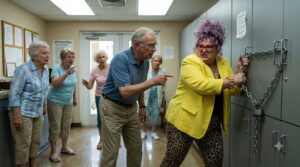
Before Margaret could ask another question, Karen’s office door opened.
The HOA president stepped into the hallway wearing a bright purple pantsuit and enormous gold sunglasses perched on her head.
Her gaze moved from Linda to Margaret.
Then to the completed request form.
“What are you doing here?”
Margaret straightened.
“Requesting association records.”
Karen snatched the paper from Linda’s desk.
She read it.
Her face hardened.
“Those documents are confidential.”
Margaret remained calm.
“I’d like the board to respond to my request in writing.”
Karen crumpled the form in her fist.
“You’re not turning this community into a courtroom.”
Margaret looked at the crushed paper.
Then she reached into her handbag and removed a second copy.
“I brought an extra.”
For the first time, Karen seemed genuinely surprised.
Margaret placed the duplicate on Linda’s desk.
And as she walked out, she noticed something through the partially open office door.
A cardboard box stood beside Karen’s filing cabinet.
Printed on its side were the words:
CALDWELL COMMUNITY CONSULTING — PROMOTIONAL MATERIALS.
Margaret had never heard of that company.
But she had a growing suspicion that she was about to.