
CHAPTER 8: THE COLD JUNCTION
The iron handle of the staging gate didn’t have any grease left inside the sleeve. When Miller wrapped his fingers around the bar, the cold came straight through the industrial tape, biting into the bone of his palm like a blunt chisel.
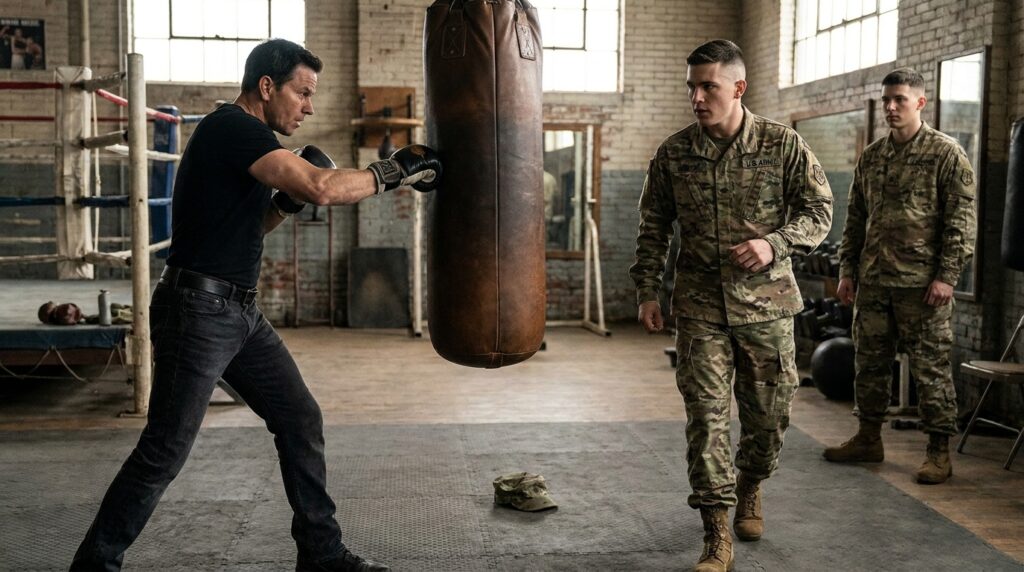
Beside him, Vance didn’t look at the perimeter towers. His boots were frozen solid at the ankles, tracking a thin line of white frost into the dark corridor between the transport containers. His right shoulder was set low, pinned tightly against his ribs by three extra wraps of the gray utility binding, but his lead hand remained tucked under the lapel of his field jacket—holding the crumpled yellow carbon duplicate against his heart.
“The convoy’s idling,” Vance whispered. His breath was small, turning to ice before it reached the wire mesh. “Third truck from the intersection. That’s the Section Four transport. The captain’s car is already parked behind the fuel point.”
Miller didn’t take his eyes off the centerline. Fifty yards ahead, through the desaturated haze of the exhaust fumes, a single black sedan sat under the high beam of a terminal floodlight. Captain Vance stood beside the open hood, his starched fatigues crisp despite the sub-zero wind coming off the salt flats. He held a clipboard under his left arm, his right hand moving a mechanical pen across a thick stack of master master sheets.
Behind him, two garrison guards stood with their boots planted in the freezing slush, their rifles slung low across their chests, their faces hidden by the shadow of their cold-weather hoods.
“The clearance code won’t open the cab,” Miller said, his voice flat, territorial. He stepped over a rusted tie-rod on the gravel track, his weight balanced between his heels. “Once the signature hits that sheet, the boy belongs to the sector roster. The county line won’t matter.”
“He’s signing the asset transfers now,” Vance muttered. He took a short step forward, his boot heel making a sharp, brittle tick against a frozen pool of hydraulic oil. “If we don’t hit the junction before he turns the page, the file seals.”
Captain Vance didn’t look up when the gravel shifted. His pen didn’t stop its rhythmic, mechanical clicking against the aluminum board. “You’re five minutes outside the assembly window, Corporal,” he said. His voice carried the exact, flat drone of the safety audit. “The unit’s already logged into the manifest. Your gear was crossed off at four.”
“The gear’s in the truck,” Vance said, his stance settling into the low, heavy frame Miller had beaten into his ribs inside the Quonset hut. “But the signature line on page four isn’t clean, Captain. The Section Four rider doesn’t have the county clearance stamp.”
The captain stopped his pen. He turned his head slow, his gray eyes catching the blue glare of the terminal tower as he looked past the boy’s shoulder toward Miller. The two guards didn’t raise their weapons, but their hands moved simultaneously toward the heavy nylon webbing of their chest plates—the calculated counter-move of an institution that didn’t tolerate variables at the gate.
“The civilian line is closed, Corporal,” the captain said, his voice dropping below the vibration of the idling diesels. “The court magistrate verified the lease termination at midnight. There is no grid block twelve left on the map.”
“The grid block’s gone,” Miller said, stepping out from the shadow of the container until his gray-taped knuckles were visible under the floodlight. He reached into his coat—not for a weapon, but for the yellowed, watermarked parchment he’d taken out of the concrete safe five hours ago. He laid it flat on the hood of the sedan, directly over the polished chrome of the logistics emblem. “But the signature on the assignment isn’t my partner’s, Captain. It’s my brother’s name. The deployment trust has been paying out to an inactive ledger for twenty-eight years. That’s not a municipal lease termination. That’s a federal audit trigger.”
The silence came back hard, freezing the exhaust plumes into stationary clouds between the trucks.
The captain’s fingers didn’t move on the clipboard. His face remained a mask of desaturated gray, but the ridge of his nose went white as the skin tightened over the bone. He didn’t monologue. He didn’t call the guards. He just looked at the watermarked watermark on the state surveyor’s paper, his mind calculating the cause-and-effect loop of a three-generation fraud being exposed to a garrison court-martial.
“The trust is a closed asset,” Captain Vance said, his voice dropping another register until it was just a dry rasp against the wind. “The service waiver protects the account records during an active deployment cycle.”
“Not when the replacement is standing in the square,” Vance said. He stepped up to the sedan, his uninjured hand coming down on top of the master muster sheet, his thumb covering the purple ink line where his name had been stenciled. “The medical evaluation form isn’t in the folder, sir. If I don’t sign the physical readiness waiver, the transport can’t cross the reservation line without an internal inspection. And the inspector is already sitting at the county seat.”
The equal intellect of the antagonist met its limit not in force, but in the friction of his own ledger lines. The captain looked from the boy’s sutured eye to the old parchment on the hood, realizing that the old man and the recruit hadn’t come to the gate to fight his guards. They had come to lock the gears of his machine from the inside.
“The convoy leaves in three minutes,” the captain said, his eyes drilling into Vance’s face. “If your name comes off that sheet, Corporal, you’re assigned to the salvage yard for the duration of your contract. No commission. No family allotment. You’ll be shifting scrap with the civilians until the iron rots.”
“The scrap stays where it is,” Vance said. He didn’t drop his hand. He looked past the captain’s shoulder toward the highway ridge, where the yellow graders stood dark and silent against the rising gray sky. “We’ve already cleared the space.”
Captain Vance didn’t scream. He didn’t smash the pen. With a slow, mechanical precision that took ten seconds, he pulled the master sheet from the clipboard, folded it twice along the starched seam, and slid it into the side pocket of his field jacket. He turned his back to them, his hand jerking once toward the lead transport truck.
“Clear the corridor,” the captain muttered to the guards. “The Section Four detail is deleted from the manifest.”
The trucks began to move, their heavy tires grinding the frozen slush into gray pulp as they rolled toward the north gate. Miller stayed by the sedan until the tail-lights faded into the salt flats haze, his hands still raised in the loose, low guard of a man who knew the fence wasn’t gone—it had just stopped moving for the winter.
Vance didn’t look at the empty staging track. He walked back toward the gate, his boots heavy but steady on the gravel, his gray-wrapped hand tucked into his pocket beside the crumpled duplicate. They walked side by side out of the reservation line, their shadows long and rusted against the cold concrete of the highway approach, two men who had traded their walls for a boundary line they could finally hold together.








