
CHAPTER 4: THE AUDIT
The headlights didn’t fade when the ignition clicked off; they stayed pinned to the front double doors, casting the shadow of the structural beams backward into the ring like a row of black pikes.
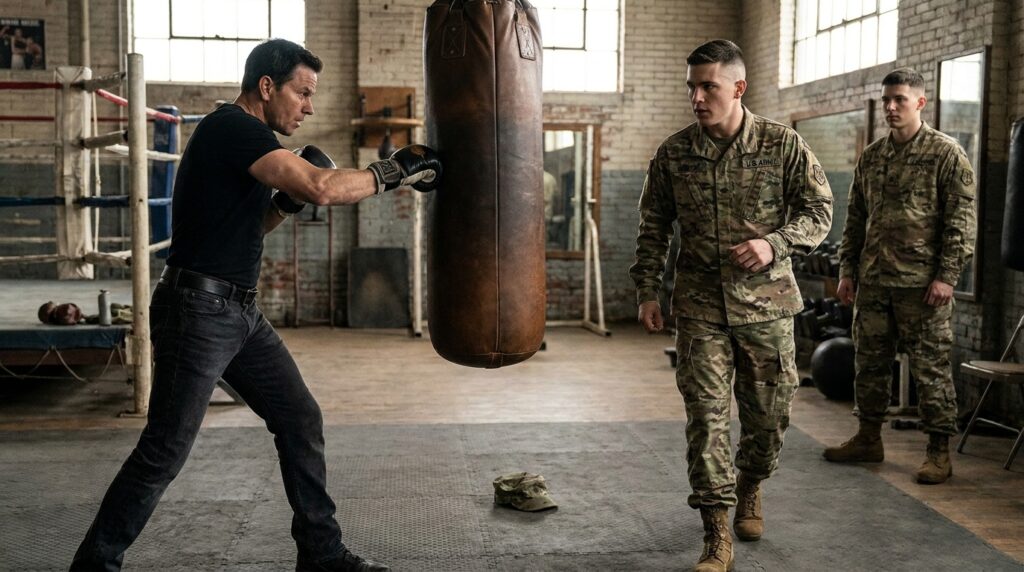
Miller didn’t drop the hand wrap he was re-spooling. He stood behind the main counter, his fingers working the stiff, salt-crust canvas strip back into a tight cylinder. Through the unwashed glass, three figures cut through the high beam glare, their boots loud against the frost-bitten gravel. They weren’t wearing gym clothes. They wore the crisp, low-visibility fatigues of the base garrison command, their heavy webbed utility belts clicking against their sidearms with every second stride.
The man in the lead didn’t knock. He hit the unlatched door with his forearm, letting the cold high-desert draft push the raw smell of diesel and sulfur into the room ahead of him. Captain Vance—the resemblance to the boy on the mat was written in the thin, unyielding ridge of his nose and the grey, transactional quality of his eyes—stopped five feet from the counter. His boots left wet, gray slush marks across the floorboards.
Behind him stood two garrison MPs, their arms crossed over their chest plates, their faces identical under the brims of their stiff utility caps.
“You’re operating outside the city municipal code, Miller,” Captain Vance said. He didn’t raise his voice; it had the flat, dry drone of a man reading a parts manifest. He laid a heavy manila folder on the counter, the cardboard corner catching on a split in the pine. “The safety audit for the North Border corridor was finalized at midnight. This structure failed the reinforcement evaluation. You’ve got six hours to clear out the gear before the physical barricades go up at the centerline.”
Miller didn’t look at the folder. He kept his eyes on the captain’s cuffs, where the starched fabric was stained with a light smear of dark hydraulic grease from the motor pool. “The municipal line ends at the culvert, Captain. Your grandfather knew that when he signed the right-of-way easement back in sixty-two. The gym sits twenty feet inside county jurisdiction.”
“The county sold the grid lines to the infrastructure authority three months ago,” Vance replied. He reached into his pocket and produced a small, notched key—not brass like the one Corporal Vance had carried, but cold, unplated steel with a logistical serial number stamped into the throat. He dropped it on top of the folder. It slid three inches before stopping against Miller’s roll of tape. “Your partner didn’t leave you a deed, Miller. He left you a liability. The M.D. Logistics lease was terminated for non-payment when the highway expansion was funded. This isn’t an eviction. It’s an asset recovery.”
One of the MPs shifted his stance, his heavy boot heel grinding a piece of loose gravel into the floor with a dry, splintering crunch.
Miller looked down at the steel key. It was shaped specifically to fit the old mechanical double-bolt safe built into the concrete wall behind the ring—the safe he hadn’t opened since his partner’s funeral because the combination mechanism had rusted shut during the floods of ninety-eight. The base didn’t just have the ledger information; they had the physical keys to the internal lockboxes. They had been inside the foundation before the first punch was ever thrown.
“The boy was a setup,” Miller muttered, his fingers tightening around the wrapped canvas until his knuckles turned the color of lard. “You sent your own blood in here to take a beating just to get the report on the wire.”
Captain Vance didn’t flinch. His face remained flat, a mask of desaturated gray under the fluorescent tube that buzzed against the beam. “Corporal Vance is an infantry replacement. He has a duty to test his readiness against local variables. His medical report says he has a cracked clavicle and a localized concussion from an unprovoked civilian strike. That report is already on the federal magistrate’s desk. If you’re still inside this frame when the graders start at dawn, the MPs won’t be carrying folders.”
“You’re tearing down the only room in this valley that doesn’t smell like cordite,” Miller said. He stepped out from behind the counter, his knees making a dull, scraping sound against his trousers. He didn’t raise his hands, but his stance was low, his weight balanced between his heels, his left side tucked forward to shield his liver. “You want the ground because the highway needs the grade, or because you can’t stand looking at something you don’t own from the tower?”
“The tower doesn’t care about your ring, Miller,” Vance said, turning back toward the door. He didn’t look to see if his men were following; he knew their boots were already moving in lockstep behind him. “The machine goes where the line is drawn. You’ve been fighting the fence for thirty years, but the fence always wins because it doesn’t get tired. Read the folder. Or don’t. The dozers start at five.”
The double doors swung open, letting in the loud, mechanical roar of a low-flying transport plane that blocked out the stars as it climbed toward the salt flats. The glare from the patrol vehicle’s high beams swept across the gym floor one last time, illuminating the old leather bag, the scuff marks on the mat, and the iron scale that still vibrated from the passing engine.
Miller didn’t pick up the manila folder. He walked to the back wall, his hand tracing the cold, pitted concrete where the old safe sat behind the spare canvas. The steel key Vance had left on the counter seemed to radiate an old, metallic chill that filled the entire room, a physical reminder that the trap hadn’t been set yesterday. The foundation was built on top of it. He looked down at his own hands—the wrapped fingers, the yellowed calluses—and realized he wasn’t the protector of this space. He was just the last tenant who hadn’t been told the lease was dead.








